The Spin | Robots bowling the perfect doosra are some way off but AI is already reshaping cricket

Daniel Kokotajlo, a former researcher at OpenAI, warned last week that it was possible we would end up “creating a new species that ends up ruling the world”. Once the initial shock wore off, and I’d considered what this could mean for my young children and the future of the planet, another thought popped into my head: will this new species be able to swing an old cricket ball or navigate a seaming green top?
It sounds frivolous. It is frivolous. But the question is not quite as ridiculous as it first appears.
Freddie Wilde, an analyst with teams in the Indian Premier League and the Hundred and head of cricket intelligence at CricViz, says “almost all elements” of his day-to-day work have now been touched by AI. There is a grey area between traditional analysis and analysis shaped by artificial intelligence. The models are improving, the tools are faster and more information is being processed.
For Wilde, AI has made him more autonomous. Tasks that once required a data engineer or data scientist can now be attempted by the analyst themselves. That is AI’s first meaningful change to cricket. It is not replacing the player, coach or analyst, it is allowing them to do more.
For a batter, that may mean knowing where a bowler is most likely to pitch and which risks are worth taking. For a bowler, it may mean identifying a weakness against a particular angle, length or field. The final act remains human.
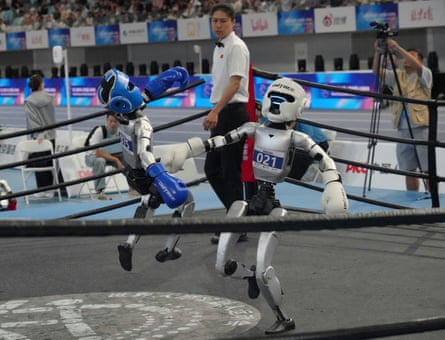
China staged its second World Humanoid Robot Games last month. More than 500 robots competed in football, athletics, boxing and more. Many stumbled or required human assistance, but one ran 100m in 8.64sec. The footage was amusing, but the progress was sobering.
Ray Kurzweil’s Law of Accelerating Returns argues that technological advancement is exponential. The line appears flat, then reaches “the knee of the curve” and shoots upwards. Leading AI experts suggest we are already there. How long, then, before one is capable of bowling an unplayable doosra?
The more pressing question is whether we would accept it. We are comfortable with technology assisting umpires, but DRS is tolerable because a human remains at the centre of the decision. Yet if an AI system could make every call perfectly, how long would we preserve the umpire’s authority? At what point does assistance become substitution? That future remains speculative. The quieter transformation is already under way, in the systems being built to measure and develop players.
EquiPlay is a talent-pathway platform that standardises coach assessments, tracks players’ development over time and uses AI to turn scores into narrative feedback. It has already captured more than 2,000 assessments on 300 young cricketers, completed by 28 coaches in a first-class county pathway.
Prof Adeela ahmed Shafi, of the University of Gloucestershire and a board member at Gloucester CC, says the aim is not to replace coaches’ judgment, but to make it visible. The data can reveal whether groups are progressing differently, allowing clubs to investigate bias linked to ethnicity, socioeconomic background, school or geography. If state-school players dip at 15, say, an intervention can be designed. “Before, we wouldn’t have noticed that,” she says. “We knew who was coming into the pathway, but we never really knew how they were progressing.”
It also tests whether coaches assess consistently and whether particular groups are scored higher or lower. It may make pathways fairer, but Wilde’s point about squad building remains: culture, character and dressing room balance are human judgments. For now.
The media faces a similar choice. Would you mind if your report arrived in seconds if it was delivered by a robot? Editors might love that: no waiting for a journalist to find an unused metaphor for another Harry Brook brain fade.
after newsletter promotion
I see this in my other job, teaching journalism at the University of East London and St Mary’s University, Twickenham. More student assignments now carry the unmistakable stamp of AI. This is not inherently bad. Many people use AI in some capacity, whether drafting an email or finding the right words for a complex idea.
The problem is what happens next. I am increasingly training editors as much as journalists, because students must learn to interrogate and reshape what AI feeds them. Journalism is changing from writing alone to judging what is worth keeping.
If prose, jokes and observations come from the same pool of language, the discourse will flatten. We may see fewer sentences with the fingerprints of writers such as Gideon Haigh or Mike Atherton and more efficient versions of what cricket writing is expected to sound like. The writing may then start to resemble the sport itself, fast becoming a parade of indistinguishable franchises featuring the same players hitting sponsored “maximums” worldwide.
Wilde says live sport is “authentic and real”, unpredictable and impossible to stage. Perhaps that is cricket’s defence. Information and plans matter, but execution matters most. So do memory, uncertainty and meaning.
For the final paragraph of this piece, I asked an AI tool to write something profound about cricket’s human future. It produced this: “As technology advances, the spirit of cricket will endure, reminding us that the game is not merely about statistics, but about passion, unpredictability and the timeless connection between players and fans.”
A bit wafty, but perfectly acceptable. Which is precisely why I dislike it.
-
This is an extract from the Guardian’s weekly cricket email, The Spin. To subscribe, just visit this page and follow the instructions.
KioskNews shows a cleaned-up reading view extracted from the publisher’s page — the original always lives on their site, not ours.