Tamil Nadu tightened grip on women-led electronics manufacturing in FY25
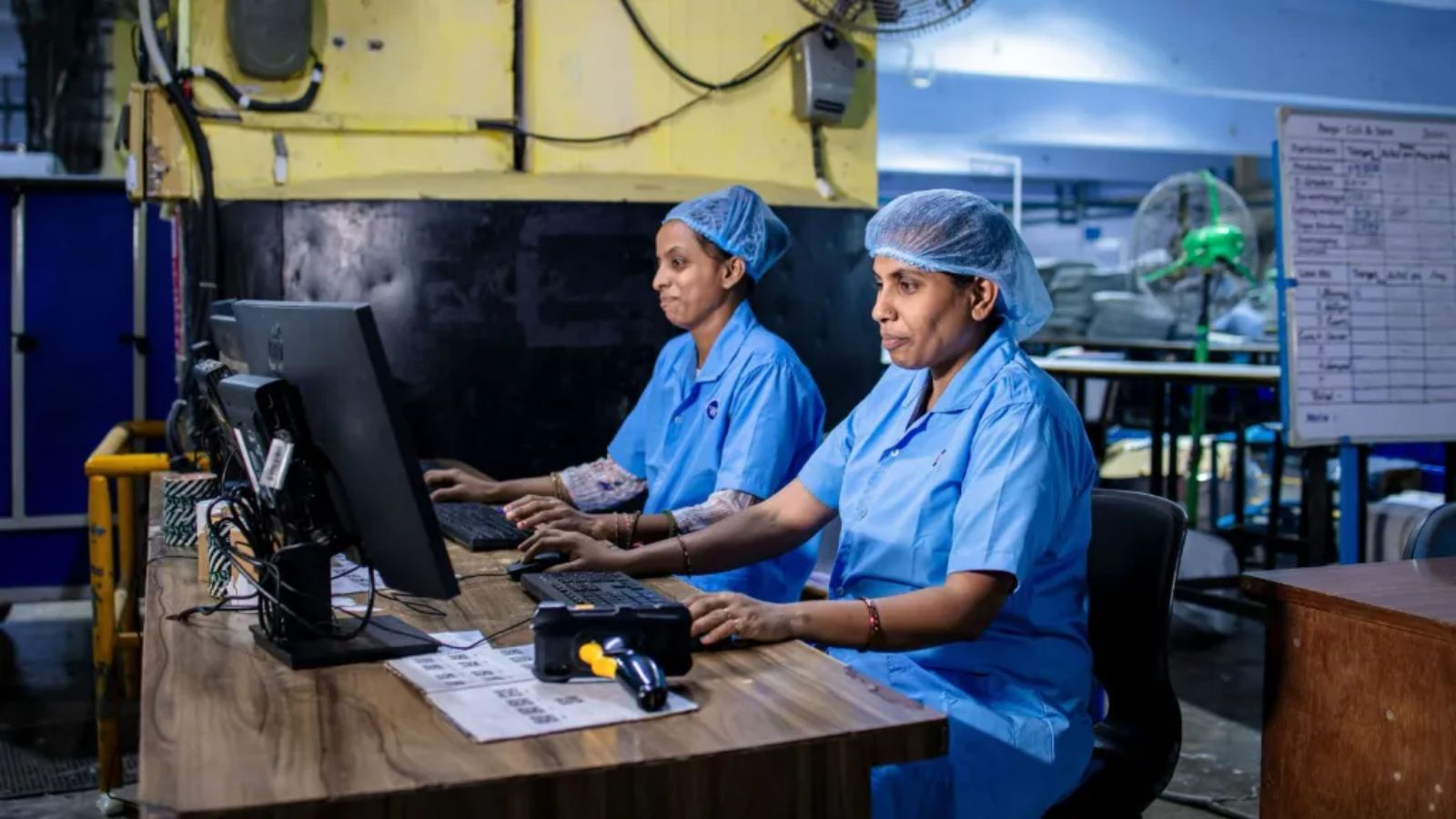
Tamil Nadu further tightened its grip on women-led electronics manufacturing in 2024-25, with the results of the latest Annual Survey of Industries (ASI) for the year showing that 44.4% of all directly employed-women in India who manufacture computer, electronic and optical products now work in the southern state, up from 42.9% in 2023-24.
Meanwhile, the state’s share in directly-employed women in manufacturing electrical equipment rose from 25.5% to 26.2% in 2024-25.
On the other hand, Gujarat’s share declined significantly by around 250 basis points each across both computer, electronic and optical products (from 10% to 7.4%) and electrical equipment (6.5% to 4%). Interestingly, this was not due to other states employing more women to manufacture these goods. In 2024-25, the number of directly-employed women in Gujarat manufacturing computer, electronic and optical products reduced by 335, while those making electrical equipment declined by 942.
However, the role played by contract workers makes it difficult to ascertain the actual number of women working in these factories as the survey does not provide gender-wise break up of contract workers.
For instance, the total number of directly-employed female factory workers in India — across all manufacturing segments — rose by 96,907 in 2024-25 to 17.38 lakh. Meanwhile, the number of directly-employed male factory workers increased by 4.54 lakh to 78.78 lakh.
In comparison, the number of contract workers increased by 5.77 lakh to 70.31 lakh. Interestingly, Tamil Nadu saw a fall in contract workers used in the manufacture of computer, electronic and optical products by 6,624 to 60,378 in 2024-25. At the same time, Karnataka saw an increase of 19,236 contract workers for the same segment.
On the whole, Tamil Nadu continues to employ 40.3% of all directly-employed female factory workers in the country, having replicated the Chinese model of providing dormitories to house women workers to power manufacturing. This is particularly important as the two key obstacles for women are distance from place of work and living arrangements. With migrant workers crucial for southern states whose population has begun ageing, dormitories close to factories or on campuses are important policy interventions.
Story continues below this ad
A report by the Tamil Nadu State Planning Commission on migrant workers in the Chennai region, submitted in March 2025, found that 86% of the surveyed 811 migrant workers came from five states: Bihar, Odisha, Assam, Uttar Pradesh, and Jharkhand. No gender-wise break-up was given. More than half (55%) were employed in the manufacturing sector.
The full ASI report for 2024-25 comes around a month after the Ministry of Statistics and Programme Implementation (MoSPI) released a ‘factsheet’ on the same. The Indian Express had reported from the factsheet that Jharkhand was the only state in 2024-25 whose factory workers were paid less, on average, compared to 2023-24. While wage per worker in the eastern state fell 5.2% in 2024-25, factory wages rose 5.3% nationally to Rs 2.28 lakh. To be sure, factory workers in Jharkhand are paid far more than the national average, with The Indian Express’ calculations showing that the average wage in the state was Rs 3.04 lakh in 2024–25, behind only Rs 4.06 lakh in Sikkim and Rs 3.14 lakh in Goa.
Tamil Nadu also retained its status as the state with the highest number of factories and workers, while Uttar Pradesh was a key driver of industrial expansion. On the whole, the number of factory workers rose 7.3% nationally to 1.67 crore and the number of factories by 2.6% to 2.7 lakh, making it the first time in over a decade that India has seen the number of factories rise by more than 2% in consecutive years.
In 2023-24, the number of factories had risen by 2.7%.
The ASI is one of the most important surveys conducted in the country and covers the formal manufacturing sector. It provides insights into how the country’s — and each state’s — manufacturing industries are changing and are key in calculating the GDP and formulating government policy.
KioskNews shows a cleaned-up reading view extracted from the publisher’s page — the original always lives on their site, not ours.