What the BRICS New Delhi Declaration says on West Asia war, trade: Full text
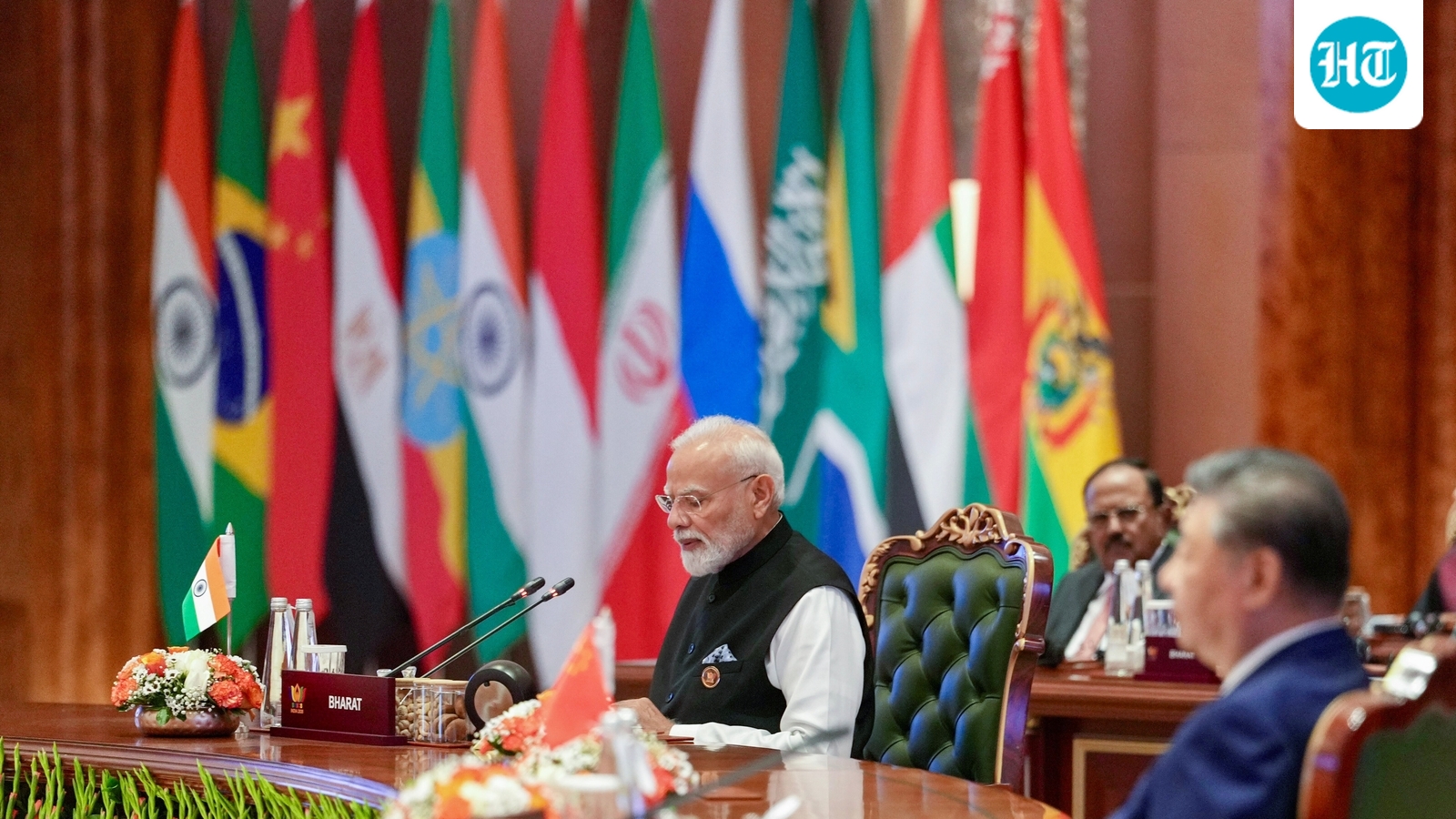
The BRICS grouping adopted a joint declaration with consensus on Saturday.

 Prefer HTon Google

Prime Minister Narendra Modi on Saturday announced the adoption of the New Delhi Declaration 2026 at the 18th BRICS Summit.
"No member has raised any objection. The New Delhi Declaration 2026 is adopted unanimously," PM Modi said.
The adoption came as India hosted the 18th BRICS Summit in New Delhi on September 12 and 13.
The summit was held under the theme: "Building for Resilience, Innovation, Cooperation and Sustainability".
Check full text of the New Delhi Declaration below:
BRICS is a consensus-based grouping, which means that any single member can block a final joint declaration.
Also Read | BRICS flags nuclear risks, steps up terror fight: Inside key New Delhi declaration
BRICS countries reached a consensus on a Joint Statement after intensive negotiations that continued until 4 am on Saturday. The negotiations reportedly saw differences on several contentious issues.
‘Global South should have equal participation…’: PM Modi
PM Modi delivered the closing remarks at the summit session on "Inclusive Global Governance and Strengthening Multilateralism."
He said, "We also emphasised that the Global South should have equal participation in shaping the technologies of the future and the rules governing them. The gap that currently exists between decisions and their outcomes must be addressed through partnership and collective action."
"The New Delhi Declaration adopted today provides clear direction to our shared resolve. It is now our responsibility to turn these commitments into concrete outcomes. As the BRICS Chair, I sincerely thank you all for your valuable contribution, constructive spirit, and commitment. With this, I declare the session closed," the Prime Minister added.
Also Read | PM Modi, Putin and Xi hold hands at BRICS summit in a powerful show of unity
The grouping comprises 11 countries: India, China, Russia, Iran, Brazil, Egypt, Ethiopia, Indonesia, Saudi Arabia, South Africa and the UAE.

Follow the latest breaking news, major developments and agenda-setting stories from India and around the world with the newsdesk at Hindustan Times. Operating round the clock, the desk brings together experienced editors, reporters and correspondents to deliver fast, accurate and contextual reporting across subjects that influence public policy, governance, business, society and international affairs. The HT News Desk covers politics, elections, government policies, the economy, business and markets, science and technology, the environment, law and order, infrastructure, education, climate issues and geopolitics, while closely tracking developments across states, institutions and global capitals. The team also leads coverage of major breaking news events, policy announcements, court proceedings, natural disasters, public emergencies and significant international developments. Reports published by the newsdesk are based on information gathered from reporters on the ground, official statements, government agencies, court records, regulatory filings, recognised institutions and other authoritative sources. Stories undergo editorial scrutiny and verification processes to ensure accuracy, fairness and relevance, and are updated as events evolve and additional information becomes available. Whether covering a key political decision in New Delhi, an economic policy shift affecting millions, a landmark court ruling or a major global event, the HT News Desk aims to provide readers with reliable, fact-based journalism that delivers not only the latest developments but also the context and analysis needed to understand their wider implications.Read More

KioskNews shows a cleaned-up reading view extracted from the publisher’s page — the original always lives on their site, not ours.