New archaeological discovery in Saqqara unveils 4,000-year-old secrets
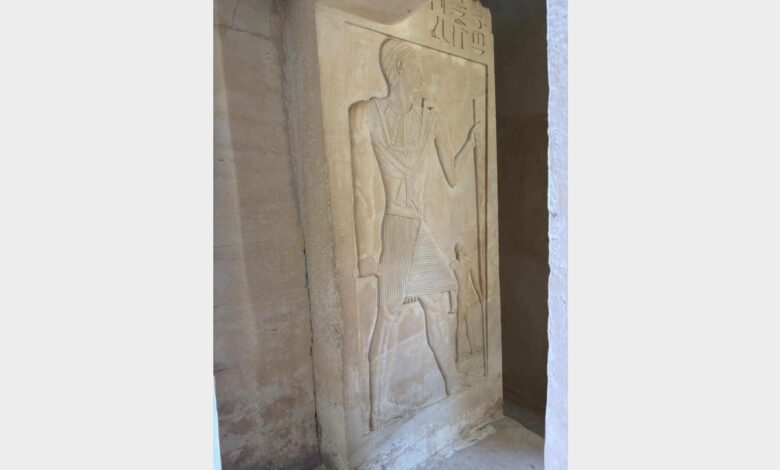
Egypt’s Minister of Tourism and Antiquities Sherif Fathy on Monday inspected the work of the archaeological mission from the Czech Institute of Egyptology at the Saqqara archaeological site.
He reviewed their latest discoveries within the tombs of high-ranking priests of the god Ptah and senior officials from the Old Kingdom—part of an ongoing effort to monitor research, excavation, documentation, and restoration activities at Egyptian archaeological sites.
The tour included an inspection of the tombs of “Sabu” and his son, ” Ptah-shepses,” both of whom held high-ranking positions during the Old Kingdom.
The minister examined architectural elements and inscriptions uncovered by the mission, including an offering chapel belonging to “Ikht-Nefert”—Sabu’s wife— revealed for the first time.
Also featured was the burial chamber of Ptahshepses, where a limestone sarcophagus containing his remains was discovered.
Fathy emphasized the importance of strengthening scientific cooperation with foreign missions and specialized research institutions operating in Egypt.
Such collaboration, he noted, contributes to uncovering further secrets of ancient Egypt while simultaneously building the capacity of Egyptian archaeological professionals.
Significant finding
The Secretary-General of the Supreme Council of Antiquities, Hesham al-Leithy, explained that the significance of the mission’s work lies in the re-excavation of tombs that had remained only partially uncovered since the 19th century.
He noted that the initial discovery of these tombs dates back to the period between 1858-1860.
The head of the Czech archaeological mission, Miroslav Bárta, said that one of the most notable findings is the discovery—for the first time—of an offering chamber belonging to Ikht-Nefert, the wife of Sabu.
Also uncovered was a false door featuring depictions of her alongside her husband and their two sons, Ptah-shepses and Ra-nefer; this provides new insights into the family and the relationships between its members.
He added that Sabu’s tomb is located to the north of his son’s tomb, and its exterior facades are distinguished by architectural decorations that mimic the facades of royal palaces.
The offering chamber also contains well-preserved relief carvings depicting Sabu and his son, Ptah-shepses, overseeing processions of offering bearers.
The head of the mission Miroslav Bárta noted the team’s success in relocating the tomb of Ptahshepses, using satellite imagery and field surveys. He explained that the tomb includes an offering chamber and an entrance adorned with reliefs depicting processions of offering-bearers and scenes of sacrificial slaughter.
The Head of the Egyptian Antiquities Sector at the Supreme Council of Antiquities, Mohamed Abdel-Badei, explained that one of the most significant findings from the excavations at the tomb of Ptah-shepses is the discovery of a burial chamber, which contained a limestone sarcophagus holding the remains of the tomb’s owner.
He added that Ptah-shepses held high-ranking positions during the reigns of four kings of the Fifth Dynasty.
He passed away at the age of over 60—a remarkably advanced age by the standards of that period in ancient Egyptian history.
Abdel-Badei noted that, according to archaeological studies, Ptah-shepses was the first official from outside the royal family to marry an Egyptian princess—Princess Khamerernebty (Kha-maat), the daughter of King Userkaf, the founder of the Fifth Dynasty.
The deputy head of the Czech mission, Mohamed Megahed, stated that the tomb of Ptahshepses was looted in ancient times, resulting in the loss of the jewelry and precious artifacts it once contained.
The remains of his mummy were preserved, however, which allowed a team of Egyptian anthropologists to examine and study them.
KioskNews shows a cleaned-up reading view extracted from the publisher’s page — the original always lives on their site, not ours.