People of 27 nationalities may be among those killed or injured in Spain train crash, Sánchez says – Europe live
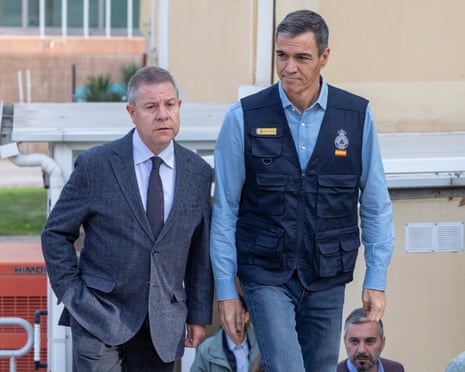
Spanish prime minister Pedro Sánchez and Castilla–La Mancha president Emiliano García-Page have just briefed the media on the latest on the train crash on Wednesday.
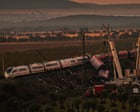
69 people have been confirmed dead, but the toll may rise further, with at least 70 people reported missing. Some may be among those yet to be identified, with emergency services having so far confirmed the identities of only 13 people. A further 31 body bags containing partial remains also await identification, making the process “very complex.”
Sánchez added that there may be up to 27 nationalities among the affected, with authorities working in close coordination with relevant embassies and consulates.
Out of 110 people hospitalised after the incident, 71 have been discharged, and 39 remain in hospitals.
The prime minister also acknowledged that the confidence in the country’s high-speed train, once a source of national pride, is “broken” as he pledged to work on restoring it in the future.
“The government’s job is not just to make the diagnosis, but to offer solutions so that a tragedy of this magnitude never happens again. And that’s what we’re doing,” he said.
Key events
'If they don’t resign, we will force them to resign at the ballot box,' opposition leader says
Spain's transport minister says he has confidence in rail system, would travel by train
Spain's transport minister suggests operations control errors, rejects calls for resignation
Operator who cleared high-speed train to resume travel declines to be interviewed
What we know about the Spanish train incident so far? - explainer
At least 51 foreign nationals affected by Spanish train crash
Work continues on identifying victims, Spanish leader say, with fears that death toll could grow
Evacuations from Russian-occupied Ukrainian city of Oleshky begin
Morning opening: Spain mourns and investigates causes of train crash in Toledo
Despite all these detailed answers, it does not look like the opposition is convinced by Puente’s explanations at all.
El Mundo reported that the opposition People’s Party’s leader, Alberto Núñez Feijóo, took aim at Puente this morning, demanding political responsibility for the crash.
“If they don’t resign, we will force them to resign at the ballot box,” he said, responding to Puente’s comments that he will not resign from the post.
Puente also points out that in all modes of transport, the ultimate responsibility – despite supporting systems – falls on humans running them.
“In the maritime sector, if a ship loses its onboard equipment or the plotter used to chart its course, who takes control? Do we just leave the vessel adrift? No: a person takes control.
If three aircraft are waiting to land and their control and approach systems fail, who takes charge? A person does. In fact, in aviation, there have been instance, even with redundant, ‘double-check’ systems, where human controllers have made errors; this is because the final recourse … is always a human being.
In its standard, day-to-day operation, the system does not rely on human intervention; it relies on automated systems. However, these are always subject to human supervision, and in exceptional cases – when the automated systems fail – humans step in to take control.”
Puente gets asked about the impact of the crash on the electoral campaign and the Socialists’ chances next month.
He says he has given the campaign “zero thought,” as he had “neither the time nor the inclination” to think about it.
He says his focus in on “what has happened, how to understand it … and how to come up with solutions to improve things.”
“I don’t believe anyone would expect me to be thinking about the election campaign at a moment like this,” he says.
Our Madrid correspondent Sam Jones has more on the politics of this crash here:
Asked specifically about this point, Puente says the probe will no doubt look at why the high-speed Ave train was not stopped after resumption even after the preceding Iryo train got back in touch with the control centre confirming it was still stranded.
He adds that he believes there was enough time to stop if an order had been issued.
Puente offers a bit more detail about the main traffic operator in charge of the sector where the crash took place.
He says the operator is a 48-year-old man, with all relevant up-to-date training and two years of experience in control centres, managing this specific sector since February this year. “So, it was a sector he knew well,” he says.
But he doesn’t want to offer any further detail at this stage, but later adds that the man has been suspended.
Asked about the technical differences between the order that was given and the one should have been given, he repeats that “the protocol … is clear,” but “it was not the decision that was taken.”
He then once again gets asked if he would resign if that offered any comfort to the families of the victims.
He says it is a “very delicate” question, but he isn’t clear on how his resignation would offer comfort to victims.
Transport minister Puente also gets asked about Sánchez’s comments on broken trust in the high-speed rail (11:04).
He says it’s undeniable that the public’s trust has been shaken given the two accidents, and he says this “requires changes to our systems.”
But he insists he still has confidence in the system, and would still travel by train.
“I believe our system is safe and that these events … are truly exceptional,” he says.
“I will dedicate my utmost effort and capacity to providing the Spanish people with solutions that will lead to the restoration of trust,” he says.
Puente also defends his earlier commentary, talking on Wednesday about “inexplicable” circumstances that led to the crash. He says this is why this will need to be properly investigated.
He also gets questions on his political responsibility, echoing his earlier sentiment that his resignation would not in itself resolve anything. But he says that if he believed him remaining in the job was a problem, he would resign.
He says he is painfully aware that he will be targeted with criticism, “insults … and the presumption of guilt” during the electoral campaign, and it would be easier for him to step aside.
But he’s not planning to do that.
Peunte says the government is “evaluating” whether its needed to review other lines.
He says the Spanish system, unlike the German one, focuses on keeping lines running during maintenance works to avoid disruption.
He says the government will have to consider whether that should change, but he is clear that there would be push back from service users.
Puente gets challenged on what a reporter suggests is his attempt to put blame on “a human factor.”
He says he didn’t actually use the phrase, even if that’s how his words may have been interpreted. Instead, he says he wants to present the facts, and let people draw their own conclusions.
There is also an interesting question on whether seatbelts should be introduced on high-speed trains – but he says it’s not up to him, but for experts to evaluate.
Puente also says that high-speed rail network can only operate with a mix of technology and human oversight.
He says when the signalling system fails, the high-speed network defaults to the same rules that apply to the rest of Spain’s rail network, 12,000km of it.
He says that human oversight is always “the final line of defence,” but it doesn’t mean that operators sit with “a pen and paper,” but have extensive screens and systems available to them.
He says that there are some key rules that should have been applied to this situation: that the train behind must remain stationary until the train ahead moves; that the train behind should be told to travel “at sight” with severely restricted speed.
He stresses the trains were correctly halted by the automatic systems, and only resumed moving on manual orders from the operations centre.
“It will be up to the investigation and the judiciary to clarify the reasons and the consequences,” he says.
He says the government’s priority is to “examine what support mechanisms were in place and determine whether they can be improved.”
And we’re moving on to the Q&A.
Puente says that the control centre had 16 controllers at the time of the crash, which falls within “completely normal conditions”.
He says the control centres have seen an increase of operators from 1,008 in 2016 to nearly 1,700 today, with additional technological improvements.
“It is simply incorrect to suggest the service is understaffed,” he says.
But he says all of this “does not mean there is nothing that needs to be improved,” as he repeats his earlier line that Spain should not have to deal with two major train crashes in nine months.
“We know this will not be easy … but I assure you we will spare no effort to overcome this crisis,” he says.
Puente says it remains unclear what caused the communications failure that originally caused the six affected trains to stop. He says the system operator is waiting for judicial approval to access its logs.
But he says that signalling failures are “not uncommon,” and in either case systems are designed in such a way to handle them without issues.
He says there were some 170 similar signalling incidents in 2026, which “may appear high to the general public, but falls within the normal range by European standards,” and below recovered averages.
He says that safety system rely on physical infrastructure, which can fail or be affected by acts of vandalism or theft, “which, unfortunately, occurs quite frequently.”
He says the LZB system is “a robust, highly-reliable” system which remains in use in several other countries, including Austria, Germany, and the UK, even as it’s being phased out in favour of a newer single European ERTMS system.
He says Spain is “the frontrunner” in implementing the ERTMS system, ahead of EU-specified deadlines, but explains why the rollout has been hit by some delays. The system is expected to be fully operational on Madrid-Sevilla route in early 2027, he says.
He then goes into explaining how the backup automatic braking system ASFA is meant to be work, and how it was applied to this case.
KioskNews shows a cleaned-up reading view extracted from the publisher’s page — the original always lives on their site, not ours.