Third time’s the charm? What US-mediated Russia-Ukraine talks could yield, the role India can play
US President Donald Trump announced earlier last week that he had met with Russian President Vladimir Putin’s envoy at the White House and that a “big, beautiful agreement” over the war in Ukraine was on the horizon.
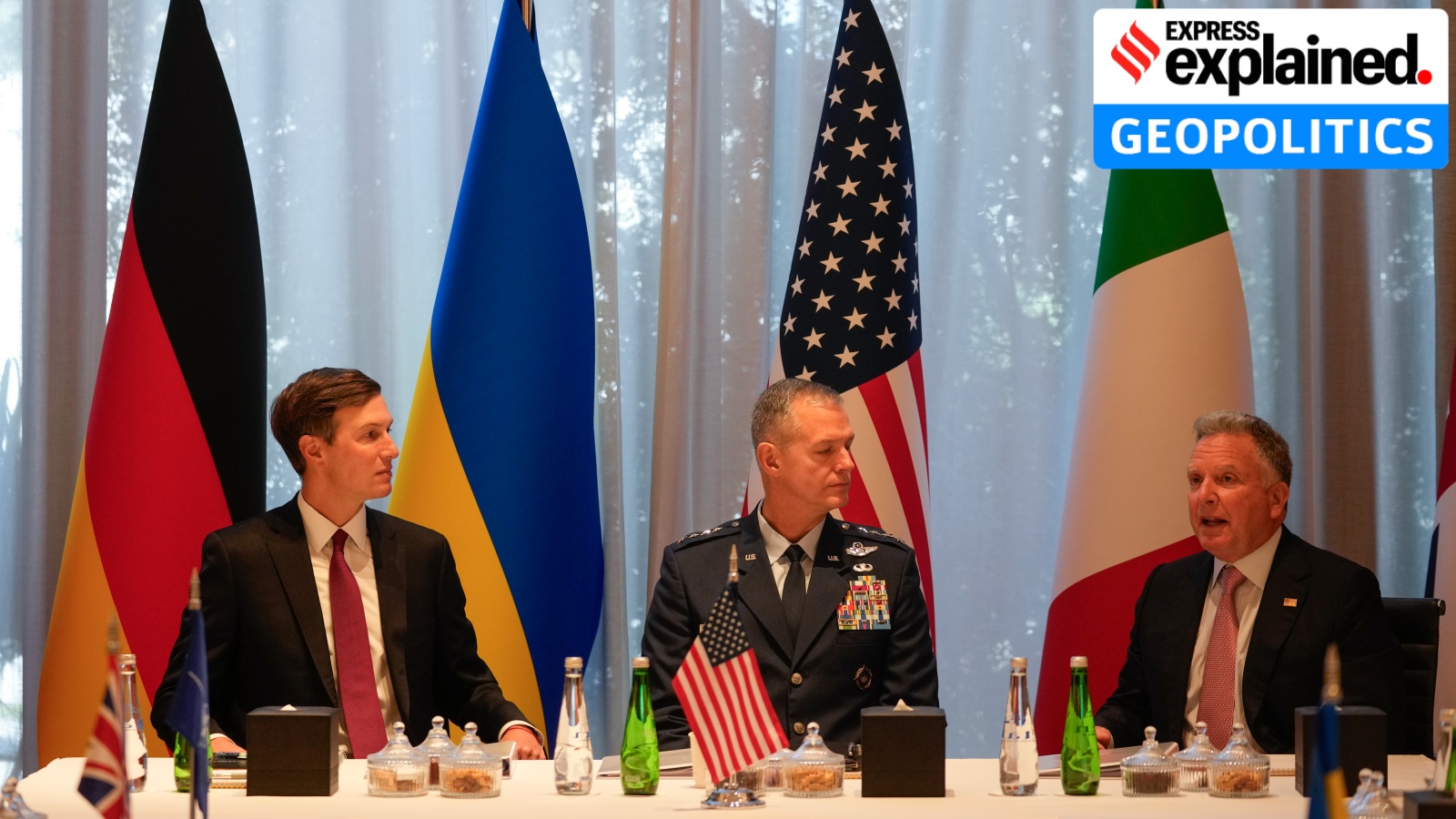
Trump’s words, however repetitive they might have been in spirit, were supplemented by US envoy Jared Kushner, who stated on Thursday (November 5) that US officials in Brussels held “productive and substantive discussions” with Ukraine and NATO.
Scheduled to meet in Abu Dhabi on November 10, delegations from all three nations will sit down over the next two days for the third iteration of the US-mediated peace talks. They face the task of wrapping up the nearly five-year-long war — now the deadliest conflict that Europe has seen since the Second World War.
What is likely to be on the bargaining table, and what is not? Do the US midterm results affect the talks? And how will the question of a broader European security architecture be broached?
First, what happened during the earlier round of talks?
In May-June 2025, Ukrainian and Russian officials met for their first direct talks after the 2022 war began in Istanbul, Turkey.
This Turkey-mediated meeting was marked by a 28-point US-Russia peace plan that included Ukraine permanently denouncing NATO membership and a total prohibition on Ukraine’s long-range arsenal — a demand that was denied by Zelensky. It was also met with a swift counter-proposal by the European bloc, which demanded a “robust, Article 5-style security guarantee” mirroring that of the NATO agreement. Article 5 encapsulates the principle of collective defence, where an attack on any member is considered an attack on all.
Russia’s proposal also outlined sweeping domestic reform, such as an armed personnel cap, and ultimately, no common ground was reached.
Story continues below this ad
Subsequently, the next meeting came about in February 2026 in Geneva. Here, Moscow firmly insisted that Ukraine formally cede the entire Donbas region before it would even entertain a cessation of hostilities. Kyiv explicitly rejected these terms, Ukrainian President Volodymyr Zelensky’s delegation demanded an unconditional ceasefire, and the talks stalled again.
Any further action was marred by the fact that only days later, the US — alongside Israel — was embroiled in a conflict against Iran, severely depleting its diplomatic capacity and shifting its focus elsewhere.
How is the bargaining table positioned now?
The two days of negotiations in Abu Dhabi are expected to focus on the three broad questions of territory, post-war security guarantees and the future security architecture of Europe.
Notably, Russia — and Putin — have remained steadfast in insisting that no European delegation be present, despite the Trump administration having suggested that a new European security “framework” may be tabled.
Story continues below this ad
The most immediate sticking point remains the question of territory. Russia currently controls Crimea, which it annexed from Ukraine in 2014, and substantial parts of eastern and southern Ukraine. Moscow has also claimed the Donetsk, Luhansk, Zaporizhzhia and Kherson regions as Russian territory. Their principal demand remains that Ukraine withdraw from Donbas, allowing the surrender of territory that may have otherwise not been captured.
Ukraine has repeatedly rejected such demands. According to Reuters, US negotiators believe a compromise on territory may be possible, with both sides making limited concessions.
Another concern for Ukraine is whether Russia could launch another military offensive in the future, which is why Kyiv has demanded security guarantees as non-negotiables to peace.
Ukraine previously sought NATO membership, arguing that the alliance’s collective defence clause would provide protection. From Russia’s perspective, though, NATO’s eastward expansion presents a threat to its security, and has been read as a reason for its 2022 invasion.
Story continues below this ad
What about the broader question of European security?
One of the more significant aspects of the current negotiations — besides the exclusion of Europe — is Russia’s insistence that the discussions extend beyond the immediate conflict.
Russian Foreign Minister Sergei Lavrov said on November 10 that defining the parameters of a future European security architecture before addressing the specifics of the Russia-Ukraine conflict was reasonable.
European leaders, however, have argued for the opposite sequence. Ursula von der Leyen, President of the European Commission, has maintained that wider security discussions should follow a ceasefire in Ukraine.
The disagreement matters because a potential settlement that limits NATO’s presence in eastern Europe or restricts Ukraine’s future security choices could have unseen consequences.
Story continues below this ad
European governments are also concerned about being excluded from negotiations that could directly affect their security. Representatives from France, Germany, the United Kingdom, Italy, the European Union, and NATO have been involved in separate discussions with US and Ukrainian officials in Abu Dhabi.
Could the US midterm results affect the negotiations?
The US midterm elections have introduced another variable into the negotiations. Trump’s Republican Party was on the receiving end of a ‘blue wave’ that saw the Democrats win control of the US Congress. Come January, when new members are sworn in, Democratic lawmakers have indicated that they could push for greater military assistance to Ukraine and tougher sanctions on Moscow.
For Russia, the results have raised questions about whether Trump’s negotiating position could face greater domestic opposition.
A change in US Congress, however, does not automatically translate into a change in US foreign policy. The extent to which a Democratic-controlled Congress can influence Trump’s approach will depend on its ability to secure bipartisan support for legislation, funding and sanctions.
Story continues below this ad
The immediate negotiations, meanwhile, remain in the hands of the Trump administration.
What role is India expected to play?
A day before the Abu Dhabi negotiations began, Zelenskyy spoke to Prime Minister Narendra Modi, briefing him on preparations for the trilateral meeting. Hours later, External Affairs Minister S Jaishankar also spoke to his Russian counterpart.
Zelenskyy specifically urged India to identify the steps it could take, and the dialogue it could pursue with other world leaders, to help bring the war to an end. He also pointed to food security as a possible area of cooperation, with India expressing readiness to mediate in establishing food corridors through the Black Sea.
Earlier in October, Ukraine’s Foreign Minister Andrii Sybiha had described an Indian proposal for a limited ceasefire as the most comprehensive among the proposals received from several countries.
Story continues below this ad
The broad contours of the Indian proposal, reported earlier by The Indian Express, involve three elements: reducing attacks around the Black Sea to allow the movement of Ukrainian agricultural exports, a halt to Russian attacks on Ukrainian energy infrastructure, and Ukraine refraining from attacks on Russian positions along the line of contact.
What happens if the talks fail?
A failure to reach an agreement would not necessarily bring the diplomatic process to an end.
The US could continue engaging the two sides through separate channels, while negotiations on issues like prisoner exchanges and the safety of commercial shipping could continue independently.
However, the lack of progress on territory and security guarantees would leave the central dispute unresolved. For Ukraine, a failed negotiation would mean continuing to seek military and financial support from the US and Europe while attempting to prevent further Russian advances. For Moscow, it would mean continuing its military campaign while retaining its stated negotiating demands.
Story continues below this ad
The consequences would also extend beyond the battlefield. Continued attacks on energy infrastructure, ports, and commercial shipping could deepen disruptions to international trade, affect agricultural exports, and add to Europe’s security concerns.
KioskNews shows a cleaned-up reading view extracted from the publisher’s page — the original always lives on their site, not ours.