Cook This: 3 recipes from Mexican Soul, including cheesy, melty choriqueso

Our cookbook of the week is Mexican Soul by Santiago Lastra, written with support from his brother, Eduardo Lastra.
Sign In or Create an Account
Jump to the recipes:choriqueso, albóndigas (meatballs) and butternut squash aguachile.
Chef Santiago Lastra takes his native cuisine to unexpected places in his cookbook debut, Mexican Soul (Quadrille, 2026). Using pistachios to make guacamole and mashed potatoes to make tortillas, he shows that Mexican cooking isn’t bound to a set of ingredients. It’s a state of mind.
“My dream is to be able to showcase the quality of Mexican cooking, but also just the diversity of it,” says Lastra. “There’s an opportunity for people to make their food a little bit more Mexican, but more than just using very traditional recipes.”
The first part of the book focuses on the foundations of Mexican food, with traditional recipes that illustrate its core elements. In the second part, Lastra features “Mexican Soul Recipes,” all of which use ingredients available in supermarkets year-round.
“I realized that I don’t cook as much Mexican food at home myself, and it’s always been this limitation of being outside Mexico that I believed was the problem,” says Lastra, who was born in Mexico City, raised in Cuernavaca and lives in London, England. “But actually, it’s a combination of that, and just the way that we’re introduced to Mexican cooking that can sometimes be very complicated.”
Lastra saw an opportunity to tell a story about the ease and accessibility of Mexican food — one that he says has already been established with other cuisines, such as Italian. If you have pasta, tomatoes, olive oil and garlic, you can make Italian food. “My question was, ‘Can Mexican food be like that?’ Can Mexican food be done with three or four ingredients — and quick?”
At his two London restaurants — the Michelin-starred KOL and the more casual Fonda — Lastra focuses on British ingredients. In Mexican Soul, he casts his net wider, making his local ingredients whatever home cooks commonly have in their kitchens.
Take the potato, for instance. Lastra considers sourcing fresh masa (made from ground nixtamalized corn) and its preparations, such as sopas, tamales and tortillas, the greatest obstacle to cooking Mexican food outside of Mexico. “And the biggest challenge is being solved by the ingredient that everyone has — that is potatoes,” he says. After years of research, Lastra landed on masa made with mashed potato and potato starch as a readily available alternative.
“The tortillas puff, and they’re delicious, and they taste like mashed potatoes, but they have the texture of the tortillas.”

In the first part of the book, Lastra “untangles” Mexican food by explaining what it is, how it tastes and sharing the “unwritten rules” that are common knowledge among Mexican cooks, along with traditional recipes.
“It couldn’t be a Mexican cookbook without a guacamole made with avocados or a quesadilla made with corn masa or carnitas,” says Lastra. With Mexican Soul, he wanted to give people a foundation to build on, and then an invitation to play. “It’s hard to have innovative or different recipes if you don’t understand the source of what the tradition looks like.”
In restaurants, the more you strive to create something unique, the more complicated things become, says Lastra. Writing the book reconnected him to what it means to cook at home — to nourish and bring people together with limitations that don’t exist in fine dining.
“It feels very nice because you can cook with less. And you can make things that are quick, delicious, beautiful and Mexican, but without having to overcomplicate (things),” says Lastra. “This book is helping me understand food on such a different level, and now I do all these recipes all the time.”
His brother and “right-hand man,” Eduardo, also makes them often, and they’re teaching their mother, Gladys, to make them, too. “She loves it. It’s just great, and they work, and it’s such a joy.”
Lastra has been a chef for 22 years. After leaving Mexico at 18 and working in Michelin-starred restaurants abroad, he has dedicated the last decade to his native food culture. Mexican Soul is his story, says Lastra. Everywhere he’s been in the world, he may not have had Mexican ingredients, but he’s brought his cultural background, experiences and personality.
“I think if you add Mexican soul to your cooking or to your everyday dishes, it just makes it brighter,” says Lastra. “It’s just colourful, and it’s the way that we are as Mexicans. We are colourful. We are spicy. We are fun. We are welcoming. We like a party. We like sharing. We’re generous. I think those are the values you can add to your everyday ingredients to make them be Mexican.”

Serves: 6
20 mL (4 tsp) vegetable oil
300 g (10 1/2 oz) fresh cooking chorizo, roughly chopped and any casing removed
200 g (7 oz) Emmental cheese
150 g (5 1/2 oz) fresh mozzarella
200 g (7 oz) pre-grated mozzarella
6 large flour tortillas
1/2 onion, finely chopped
30 g (1 oz) cilantro leaves, finely chopped
Heat the oil in a frying pan over a medium heat (you want to render the fat slowly) and fry the chorizo for 8-10 minutes until it starts to fall apart. Remove from the heat.
Preheat the broiler to high or preheat the oven to 190C fan/convection (400F).
Combine all the cheeses and the chorizo with your hands and place on an ovenproof plate or in a baking dish. Place under the grill for 7 minutes or bake in the oven for 10-15 minutes until the cheese has melted and is caramelized on the top.
Heat a large dry frying pan over a high heat. Warm the tortillas by frying them for 10-30 seconds on each side until golden but without drying them out. Wrap in a cloth to keep them warm.
Remove the choriqueso from the oven and finish with the onion and cilantro, then serve hot with the warm tortillas.
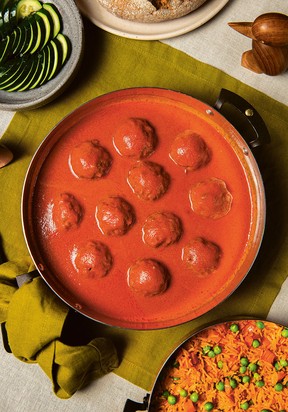
Serves: 4
500 g (1 lb 2 oz) ground beef
8 g (1 1/2 tsp) sea salt flakes
2 g (1 tsp) ground black pepper
15 g (1/2 oz) peppermint, with stalks, finely chopped
6 large eggs, hard-boiled and quartered
All-purpose flour, for dusting
1 quantity tomato caldillo (see recipe)
Vegetable oil, for deep-frying
For the bread cream:
100 g (3 1/2 oz) crustless white bread
100 mL (3 1/2 fl oz/scant 1/2 cup) whipping cream
6 large eggs
1 roasted garlic clove
To serve:
Red Mexican rice
Bread or tortillas
Sliced cucumbers
First, make the bread cream: combine all the ingredients and allow the bread to soak for at least 5 minutes. Then blitz in a food processor or with a hand-held blender until smooth.
Put the beef, salt, pepper and peppermint into a bowl and combine with your hands, then add the bread cream and work with your hands until smooth. Cover and leave in the refrigerator for 20-30 minutes to set.
Remove the meat from the refrigerator and use an ice-cream scoop or spoon to divide it into 50 g (1 3/4 oz) balls. Press 2 boiled egg quarters into the centre of each ball and close the meat around them, then dust the balls with flour.
Half-fill a saucepan with oil and heat to 190C (375F) and fry the meatballs for 3 minutes, turning and basting as needed, until golden but still pink on the inside (they will finish cooking in the caldillo). Remove the meatballs from the oil with a slotted spoon and place on a tray lined with paper towels to drain the excess oil.
Pour the tomato caldillo into a saucepan and bring to a simmer, then add the meatballs, cover and cook for 5 minutes.
Serve the meatballs and sauce hot with rice, bread or tortillas and cucumbers.
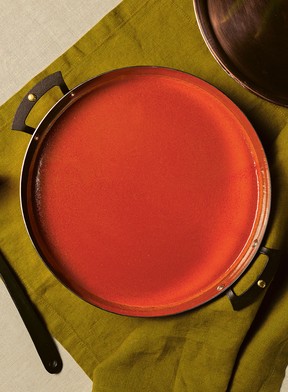
Makes: 2 litres (68 fl oz/8 1/2 cups)
1 kg (2 lb 4 oz) tomatoes
2 onions
3 garlic cloves
2 L (68 fl oz/8 1/2 cups) water
170 g (6 oz) chipotle paste (or equal parts smoked paprika, cayenne pepper, honey, cider vinegar and water)
3 g dried bird’s eye chilies (around 2-3 chilies), or to taste
10 g (2 tsp) sea salt flakes
40 mL (1 1/2 fl oz/3 tbsp) vegetable oil
Put the tomatoes, onions, garlic and water into a larger saucepan over a high heat and bring to a boil, then cook for 45 minutes.
Strain the broth, reserving the solids. Put the solids into a food processor and add the chipotle paste, chilies and salt along with 1 litre (34 fl oz/4 1/4 cups) of the broth and blend until smooth. If you want to control the spice level, add the chilies one by one and taste as you go.
Heat the oil in a clean saucepan over a medium heat and fry the sauce for 10-15 minutes until it turns deep red (this process makes the caldillo sweeter and more umami), stirring constantly to ensure it doesn’t stick.
Store in the refrigerator for up to 4 days. Serve warm.
Note: With chilies, you will need to adjust the spiciness according to taste, just like salt. You can add more chilies if you like, but it is important to add one extra at a time, and to keep tasting as you go. Chilies can vary depending on the region you are in, the season, the brand and the original grower, so please do see our quantity as guidance rather than a rule.
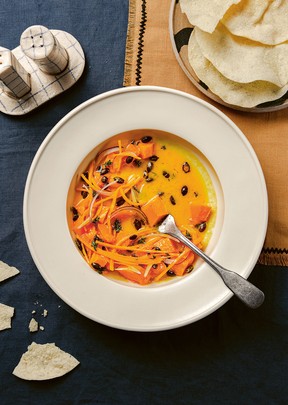
Serves: 4
300 g (10 1/2 oz) butternut squash, sliced into 3 cm (1 1/4 inch) pieces
1 tbsp pumpkin seeds
70 mL (2 1/2 fl oz/5 tbsp) lime juice (from about 2 limes)
100 mL (3 1/2 fl oz/scant 1/2 cup) orange juice (from about 1 orange)
Vegetable oil, for drizzling
Sea salt flakes
For the aguachile dressing:
300 g (10 1/2 oz) butternut squash, peeled and diced into 2 cm (3/4 inch) cubes
80 g (2 3/4 oz/1/3 cup) superfine sugar
80 mL (2 3/4 fl oz/1/3 cup) cider vinegar
2 dried bird’s eye chilies
40 g (1 1/2 oz/2 tbsp) honey
50 mL (1 3/4 fl oz/3 1/2 tbsp) vegetable oil
To serve:
20 g (3/4 oz) red onion, thinly sliced
20 g (3/4 oz) butternut squash, peeled and thinly sliced
1 tsp thyme leaves
2 tsp olive oil
Poppadoms or tostadas
Preheat the oven to 220C fan/convection (475F).
Put the butternut squash onto a baking sheet, drizzle with oil and season with salt, then roast in the oven for 15 minutes.
Meanwhile, to make the aguachile dressing, combine all the ingredients in a saucepan, cover with water and boil for 5 minutes.
Strain the mixture, then transfer the solids and 80 mL (2 3/4 fl oz/5 tbsp) of the cooking liquid to a food processor. Blend until smooth, then pass through a sieve (strainer) and store in the refrigerator.
Remove the squash from the oven, reduce the oven temperature to 180C fan/convection (425F), place the pumpkin seeds on a baking sheet and toast in the oven for 10 minutes until golden.
Place the diced squash on a serving plate or plates, dress with the aguachile dressing, lime juice and orange juice and finish with the sliced onion, squash, pumpkin seeds, thyme and olive oil. Serve at room temperature with poppadoms or tostadas.
Recipes and images excerpted from Mexican Soul by Santiago Lastra (Quadrille, August 2026).
Join the Conversation
This website uses cookies to personalize your content (including ads), and allows us to analyze our traffic. Read more about cookies here. By continuing to use our site, you agree to our Terms of Use and Privacy Policy.
KioskNews shows a cleaned-up reading view extracted from the publisher’s page — the original always lives on their site, not ours.