EYE UP ABOVE: The Cape Town shark spotter who keeps surfers and swimmers safe
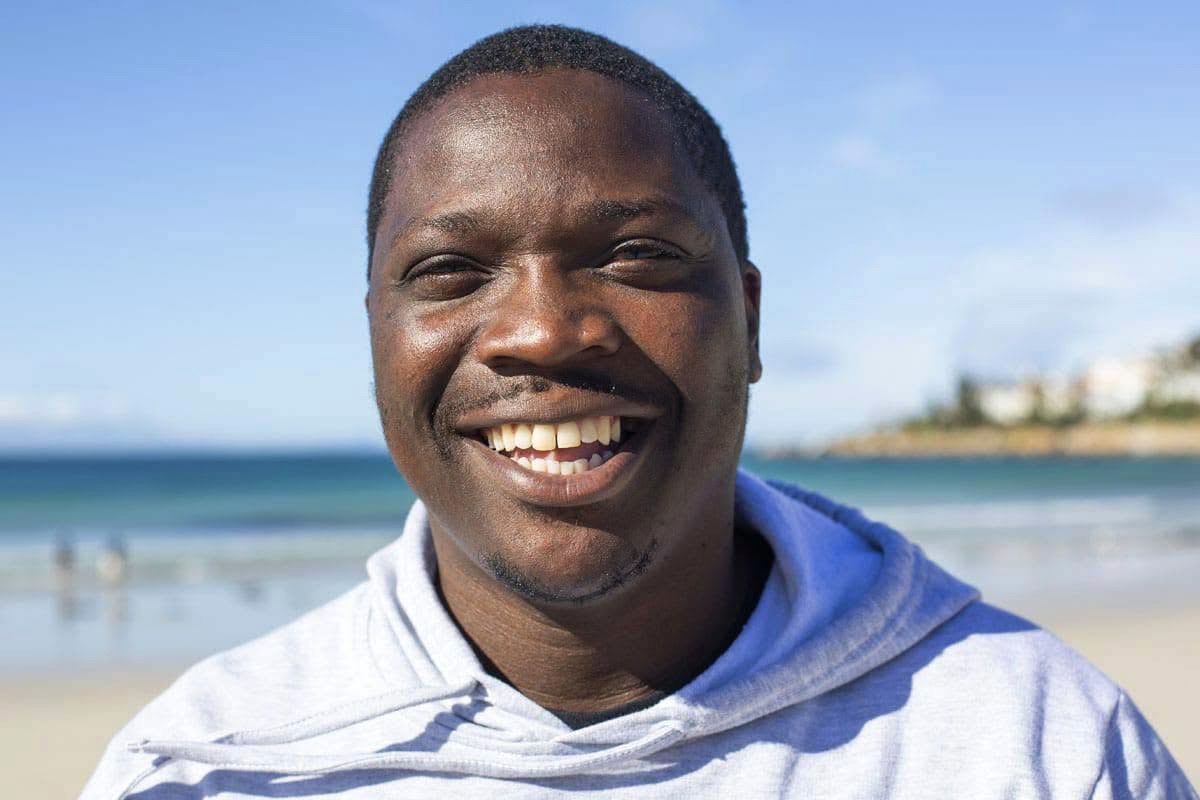
Dennis Chikodze rises before Cape Town wakes up. He has important work to do. Chikodze is a shark spotter.
While many people are still fumbling for the kettle, he is already on his bicycle, pedalling out of Masiphumelele, a settlement tucked between Noordhoek and Kommetjie, where the roads are red dirt and the smell of wood smoke carries even in summer.
In winter it is wet. He makes his way up towards his lookout high above Boyes Drive. It is a long ride. Most of life is a long ride, if you begin from the margins.
From his post, Chikodze has a commanding view over the whole blue sweep of False Bay, the water stretching away towards the edge and indigo mountains. The sea from up there is a polished sheet of blue.
But the ocean has a second nature, and everyone who lives near it long enough comes to know this. Beneath the friendly surface lies an older world, cold and indifferent, that has been going about its business since long before there were people to observe it.
The bay has always contained this duality: beauty on top, appetite below, the gap between them no thicker than skin. One bite from a shark and the water turns red.
Always alert
It is on a cold, windblown morning that I spend some time with Chikodze. He sits in his small lookout hut, a modest timber box against the vastness of the sea, his polarised glasses cutting the glare that bounces off the bay. Another spotter stands a short distance apart, keeping an eye on the water while Chikodze talks to me.
The cold wind comes off the sea and enters your jacket. It finds the back of your neck and stays there.
Chikodze is soft in manner and has a certain faraway look you find in people who have spent years looking at distances. I have seen that in the eyes of soldiers on guard duty, those at funerals. People waiting for trains. Aircraft pilots in full flight. People driving on long, long roads. The receptionist at the mortuary.
He has been doing this work for years. By now, you could tell him very little about fish, sharks, clouds or the many temperaments of the wind.
/file/dailymaverick/wp-content/uploads/2025/04/2-4.jpg "Shark Spotters is a pioneering shark safety and research nonprofit organisation that has proactively reduced interactions and conflict between recreational water users and white sharks. (Photo: Kristin Engel)")
The organisation that employs him, Shark Spotters, does more than protect bathers and surfers. It creates work for people from communities around the bay, offering training and, in a country not always generous with second chances, a path towards something more stable.
Chikodze arrived one day. He stayed because his work became a part of him. Today, he represents all the spotters who are tirelessly working on the mountain. He is their talisman.
Earning a place
The spotters work in two five-hour shifts. The job demands a level of concentration that is almost monastic, and one cannot stare at the sea much longer than that before the mind begins its own wandering.
Before he was trusted with the sea and the mountain, Chikodze had to earn it. Shark Spotters put its people through months of drilling: marine identification, spotting technique, first aid, the slow business of learning how wind and swell and cloud conspire to hide a shark or give it away.
Armed with knowledge and experience, Chikodze watches over Muizenberg Beach. “The first thing,” he tells me, “is that you must learn your terrain.”
He whispers, like a ranger protecting a herd. But he does not mean only the geography. You must come to know the particular rocks below the waterline, the dark patches of kelp, the places where the colour of the water shifts from blue-green to a deeper pewter-grey.
You must learn what belongs and what does not. The binoculars seem almost an extension of his body now. When he passes them to me and I look through the lenses, I notice a rust-coloured stain spreading across a section of water, a red tide, that I would never have seen with the naked eye.
/file/attachments/2997/13HS_000188_723528.jpg "SOUTH AFRICA - JUNE 2013: A 15-foot-long great white shark on the hunt in False Bay. Feature text available. (Photo by Gallo Images / Hotspot Media)")
Far below us, perhaps 300 surfers are scattered in the water, small black marks against the blue, resting on their boards in the morning cold, their confidence placed entirely on the vigilance of men like Chikodze. They do not think about this. Why would they?
Over many years, he has seen hundreds of sharks, many great whites, and schools of yellowtail moving in dense silver formation, as well as stingrays, whales, dolphins, seals.
But he has not seen a great white for some time. The reason, when he tells it, is more unsettling than reassuring.Orcas. They arrive in pairs, he says. They attack the great whites, tearing out only the liver and eating that, leaving the rest of the carcass to sink or drift.
The great whites, which once made this bay famous and frightening in equal measure, have gone somewhere else. Nobody knows quite where. Yet, you never know, one day they appear from a void so dark and frightening and then you have to jump into action.
A spotter’s colours
There are also other dangerous species to watch for. The moment he spots something alarming, he radios the spotter on the beach below. A siren sounds. People must leave the water fast. A white flag goes up.
The grammar of colour, of life or death. White means a shark is in the water nearby and everyone must get out immediately. Red means a shark was seen recently, but is no longer close to swimmers. Black means visibility is too poor for the spotters to tell. Green means spotting conditions are good and no sharks have been seen.
The wind sharpens. It is getting on for midday, but there is no warmth in it.
“Don’t you get lonely up here?” I ask. “At first, yes,” he says. “Then I sang to myself. Later I started talking to myself. Now it is just me and the silence. And the big sea. I am happy.”
In a country so often noisy with crises, with argument and survival and the general grinding weight of things, Chikodze has made a life in watchfulness and solitude. He has been up on that mountain, day after day, through the grey Cape winters and the white summers and all the ordinary seasons in between, and at some point the silence became a place where he lived.
He has become part of the mountain, this fine man: a solitary figure above Muizenberg, keeping watch while the rest of us play in the shallows, trusting, as people do, that the beauty we can see is the whole of it.
Until one day. DM
Since this interview was conducted, Dennis Chikodze has also taken on a role as field manager on Shark Spotters’ Baboon Management Programme, another arm of the organisation’s work protecting both people and wildlife along the Cape Peninsula. If you would like to support Shark Spotters and its work, you can make a donation at https://sharkspotters.org.za/donate
This story first appeared in our weekly DM168 newspaper, available countrywide for R35.
KioskNews shows a cleaned-up reading view extracted from the publisher’s page — the original always lives on their site, not ours.