Zimbabwe pledges mining reforms amid public outcry
Once-green hills outside Zimbabwe’s mining town of Shurugwi have been transformed into barren slopes, pockmarked by open pits dug by Chinese-owned Zimbabwe Chenxi Investments, which lists the son of Zimbabwean President Emmerson Mnangagwa as chairman.
Bulldozers and excavators raised dust that seeps into houses while rains washed cyanide used to extract the precious metal into rivers, locals and environmental activists said.
A major revision under way of a colonial-era mining law promises to boost protection from damage caused by open-cast mining like this, but critics have their doubts.
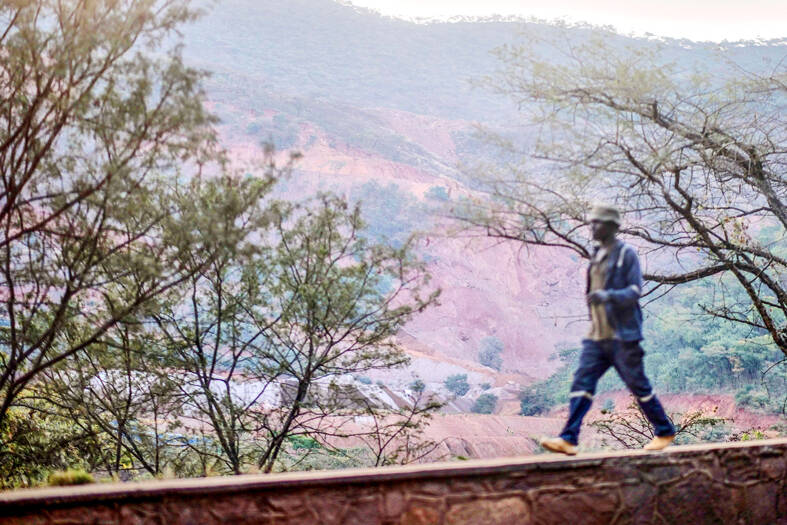
A man walks along a highway overlooking dug-out mountains at a gold leaching plant in Shurugwi, Zimbabwe, on Aug. 29.
Photo: AFP
“There is dust everywhere, even in the food,” resident Bright Mavedzenge said. “We close windows, but it still gets in.”
A nurse said the hospital was seeing more patients with respiratory complaints, with some reports of silicosis.
Houses and water reservoirs had been cracked by blasting, residents’ association vice chairman Pardon Machocho said.
Families were displaced to make way for operations and artisanal miners pushed off their claims, Machocho added.
Zimbabwe’s mineral wealth is the backbone of its economy, and gold is its top export.
The damaging “bed leaching” method that uses cyanide is being employed at “unprecedented” levels across the country, activists said.
A bill before parliament to replace the Mines and Minerals Act includes clauses to boost community and environmental protection. It requires, for example, environmental impact assessments (EIA) before a mining license is issued and introduces an environmental restoration fund.
More broadly, it includes provisions on “strategic” minerals in line with a “resource nationalism” drive under way in several African countries.
However, the predominance of government in the reconstituted mining board was a concern for activist Farai Maguwu, who said the body should be independent.
Corruption was “frequent” in mining, he said.
In Shurugwi, it might be too late for any protection afforded by the new act.
Chenxi said it had valid EIA certificates and underwent regular government inspections.
It had planted 20,000 indigenous trees last year and closely monitored cyanide levels in the groundwater, he said, adding that anyone forced to move received “healthy compensation.”
However, Machocho said community grazing land had been taken over and there was a plan for nearly 150 graves to be exhumed to give way to mining.
“Shurugwi will end up an uninhabitable ghost town if wanton extraction continues,” he said.
KioskNews shows a cleaned-up reading view extracted from the publisher’s page — the original always lives on their site, not ours.