Psychiatrist offers tips to manage trading stress
By Lo Pi / Staff reporter


Psychiatrist Yang Tsung-tsai (楊聰財) yesterday offered tips to manage stress resulting from stock market volatility.
Taiwanese shares saw their fourth-largest single-day point loss on Friday, closing below the 40,000-point mark following an overnight sell-off on Wall Street, although the market recovered from its intraday low on hopes of government measures to support stocks, dealers said.
The TAIEX ended down 1,873.08 points, or 4.51 percent, at 39,701.64 after fluctuating between 37,837.05 and 40,435.83.
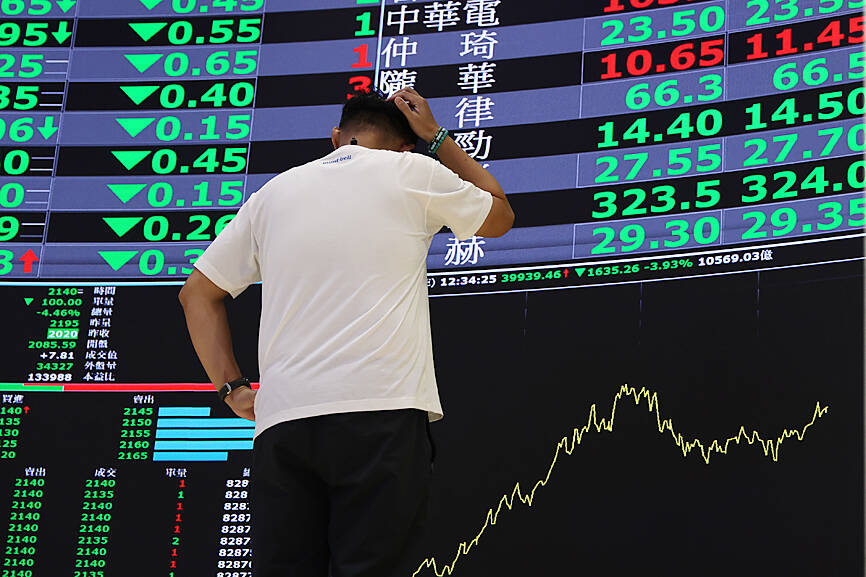
A person observes the Taiwan Stock Market graph inside the Taiwan Stock Exchange office in Taipei on Friday.
Photo: Ritchie B. Tongo, EPA
Turnover totaled NT$1.32 trillion (US$40.28 billion).
Falling stock prices take an emotional toll, partly due to loss aversion, or when the pain of losing money is greater than the pleasure of gaining an equivalent amount, Yang said.
Worrying about being left with devalued stocks or seeing retirement savings dwindle before actually experiencing a loss is a form of anticipatory anxiety, he said.
Rushing to invest after seeing others make money may stem from the fear of missing out, turning investment decisions into emotionally driven reactions, he added.
When the brain perceives a sharp drop in stock prices as a threat, it can trigger the release of stress hormones, causing a person’s heart rate and blood pressure to rise, breathing to quicken and muscles to tense, Yang said.
Those who continue calculating their gains and losses or dwell on missed buying and selling opportunities after the market closes might struggle to unwind, potentially resulting in insomnia, irritability and difficulty concentrating, he said.
Yang offered tips for managing stress related to stock market fluctuations.
First, set fixed times to check stock prices instead of reaching for the phone every few minutes, the psychiatrist said.
“Step away from market updates and unwind,” Yang said.
Second, practice diaphragmatic breathing — inhaling for about four seconds and exhaling for six seconds for three to five minutes — when feeling stressed, he said, adding that there was no need to forcibly hold one’s breath.
Third, exercise regularly and take up activities such as brisk walking, cycling or swimming to help relieve stress and improve sleep quality, Yang said.
It is important to not sacrifice sleep to keep up with market movements, he added.
Fourth, recognize catastrophic thinking by identifying whether concerns stem from actual financial losses or imagined worst-case scenarios, he said.
Cognitive behavioral therapy might help, when necessary, to develop healthier thinking patterns, he added.
Fifth, manage financial risks by avoiding excessive leverage, Yang said.
Sixth, maintain social connections and activities outside of trading, he said.
If insomnia, anxiety, panic attacks or heart palpitations persist and begin affecting work or daily life, consult a doctor for evaluation, tests and treatment, he said.
Symptoms such as chest pain, difficulty breathing, cold sweats or fainting should never be dismissed, Yang said, adding that anyone experiencing such symptoms should seek immediate medical attention.
KioskNews shows a cleaned-up reading view extracted from the publisher’s page — the original always lives on their site, not ours.