How a medical drone pilot program aims to help residents in rural Ontario with medical emergencies
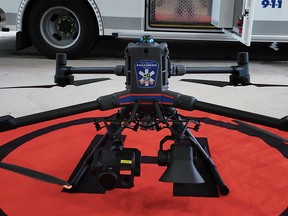
Residents of Bolton, Ont., who call 911 could receive critical life-saving equipment delivered from a drone, with the launch of a Medical Drone Pilot Program this week by Peel Regional Paramedic Services.
Sign In or Create an Account
The program has been designed to support residents of the small town of approximately 27,000 residents northwest of Toronto, when they are facing time-sensitive emergencies, during the crucial moments before paramedics arrive. That includes cardiac arrests, overdoses, severe bleeding and allergic reactions.
Paramedics will be providing real-time guidance for use of the equipment through a video connection, says Brian Gibson, chief and director of Peel Regional Paramedic Services. The drone will not replace paramedics or change the 9-1-1 response.

Get a dash of perspective along with the trending news of the day in a very readable format.
By signing up you consent to receive the above newsletter from Postmedia Network Inc.
A welcome email is on its way. If you don't see it, please check your junk folder.
The next issue of NP Posted will soon be in your inbox.
We encountered an issue signing you up. Please try again
“It is another tool that may help a bystander begin care while paramedics are on the way,” he says.
Ultimately, the pilot project will feed into research done in collaboration with the Sunnybrook Centre for Prehospital Medicine in Toronto about drone-enabled delivery of automated external defibrillators (AEDs), with the aim of expanding access to life-saving defibrillation.
When a 911 call is received, a paramedic crew is dispatched as usual and the drone is launched at the same time. “It follows a planned route while a trained pilot and safety team monitor the flight in real time,” says Gibson. “The route can be changed or the flight can be stopped if weather, people, pets, wildlife or another hazard creates a safety concern.”
If a drone cannot complete a delivery safely, the response is cancelled while the regular 911 response continues.
Gibson says the drone can operate on five different radio frequency bands to ensure optimal connectivity during a flight, enabling remote control and audio-video.
If the drone arrives first before the paramedics, it lowers the medical package into a safe, open area. A 911 dispatcher or paramedic guides the caller or bystander by phone or video on how to retrieve and use the equipment. For an AED, no special training is needed because the device provides clear instructions and will only deliver a shock when appropriate.
“When paramedics arrive, they take over patient care,” says Gibson.
The pilot project involves just one drone. “The drone itself is not unique,” says Gibson. “To date other drone programs have used drones primarily for search and rescue, and have tested the concept of delivery. We are actually doing it.”
The drone weighs approximately 15 kilograms and can carry a 5.5 kilograms payload. It’s 98 centimetres long and 76 centimetres wide.
There is no cost to the taxpayers for the pilot project, says Gibson. Instead, the costs to launch and maintain the program were covered by grants and funding from organizations such as the Cardiovascular Network of Canada and Zoll Medical, a Mississauga, Ont., company that develops medical care devices for cardiopulmonary and respiratory conditions.
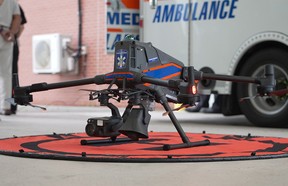
The pilot was not launched in response to a specific community request, says Gibson. Instead, it has been designed to build evidence about whether drones can safely and reliably improve access to life-saving equipment throughout communities where paramedic responses can take longer.
“The lessons and data from this work may help inform future research and decisions about drone-enabled emergency care in rural, remote and Indigenous communities across Ontario. Any future expansion would depend on the results of the pilot, safety analysis, community need and regulatory approval.”
Gibson says Bolton was chosen because it provides the right setting to test the piloting safely and learn how the service could work in different conditions.
“The area includes urban and rural neighbourhoods, longer travel distances, varied road networks, protected and conservation lands, and local airspace considerations. These conditions allow Peel Regional Paramedic Services to test how the drone performs while managing the types of operational and safety challenges that may exist in other communities.”
Gibson notes that there were 417 9-1-1 calls to the Bolton area in 2025, which might have been responded to by a medical drone as well as paramedics.
“It really depends on the emergency,” says Gibson. Paramedics transport “to the hospital that can provide the appropriate care for the condition. In most cases this will be Brampton Civic Hospital and Cortellucci Vaughan Hospital.”
The project started with a simple question about how can Peel Regional Paramedic Services get life-saving equipment to people sooner, says Gibson. “The first focus was delivering automated external defibrillators, or AEDs, during cardiac arrest.” The pilot was expanded to test delivery of other emergency supplies, he explains, including naloxone, bleeding-control supplies and epinephrine auto-injectors.
The Peel project journey began in 2017 by looking at how to optimize drone delivery of AEDs in Ontario. It got further inspiration from Sweden, he says, where in 2022, a cardiac arrest victim received a defibrillator delivered by drone three minutes before emergency responders.
“That was the first time a drone-delivered AED was used in a real emergency response,” says Gibson. “We have been in collaboration with the Swedish team since 2020. Regulatory approvals for us in Canada took longer.”
Our website is the place for the latest breaking news, exclusive scoops, longreads and provocative commentary. Please bookmark nationalpost.com and sign up for our daily newsletter, Posted, here.
Join the Conversation
This website uses cookies to personalize your content (including ads), and allows us to analyze our traffic. Read more about cookies here. By continuing to use our site, you agree to our Terms of Use and Privacy Policy.
KioskNews shows a cleaned-up reading view extracted from the publisher’s page — the original always lives on their site, not ours.