‘Crystal Lake’s Biggest Sci-Fi Twist for Jason Voorhees Doesn’t Make Any Sense

Shawn Van Horn is a Senior Author for Collider. He's watched way too many slasher movies over the decades, which makes him an aficionado on all things Halloween and Friday the 13th. Don't ask him to choose between Michael Myers and Jason Voorhees because he can't do it. He grew up in the 90s, when Seinfeld, Everybody Loves Raymond, and TGIF were his life, and still watches them religiously to this day. Larry David is his spirit animal. His love for entertainment spreads to the written word as well. He has written two novels and is neck deep in the querying trenches. He is also a short story maker upper and poet with a dozen publishing credits to his name. He lives in small town Ohio, where he likes to watch professional wrestling and movies.
Sign in to your Collider account
Editor's note: The below contains spoilers for Crystal Lake.
The slasher craze in the 1980s was ruled by the trifecta of Halloween's Michael Myers, A Nightmare on Elm Street's Freddy Krueger, and Friday the 13th's Jason Voorhees. The first two eventually dug into the origins of their iconic monsters; the absurd Halloween Thorn trilogy wanted fans to believe that Michael's violence was caused by a cult, while Freddy got his powers from dream demons. Both twists were absurd ways to attempt something new in horror franchises that had gone stale.
Over the first eight installments, Friday the 13th never really tried to explain its monster, and the simple setup of a man in a hockey mask stalking camp counselors was effective enough on its own. Eventually, the franchise took a wild swing and a miss with Jason Goes to Hell: The Final Friday. But if you thought that was far out there, A24's Crystal Lake, now streaming on Peacock, gives Jason Voorhees' origin story a nonsensical sci-fi twist.
'Jason Goes to Hell: The Final Friday' Tried To Explain Jason Voorhees' Powers
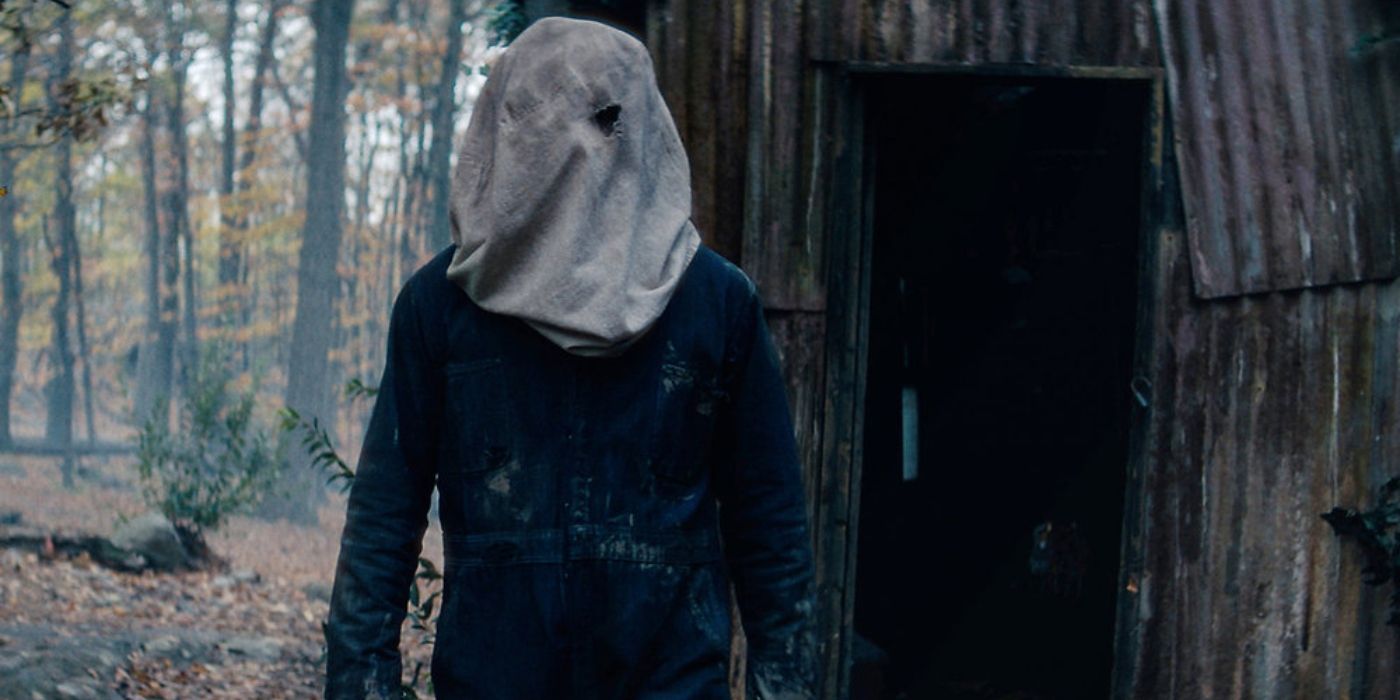
The Friday the 13th franchise began as a mystery, with the first movie's killer unseen until the end, when Pamela Voorhees (Betsy Palmer) emerges as a mother seeking revenge. In the wake of the film's popularity, a franchise was born, with Jason Voorhees resurrected in place of his mother. He was all grown up — a man with a sack, and later a hockey mask, over his face, who spent sequel after sequel in pursuit of his own revenge. In each movie that followed, Jason isn't easily defeated and continually comes back from the dead, sometimes literally, without any explanation.
However, once the Friday the 13th film rights moved from Paramount to New Line, the studio wanted something different. Enter 1993's Jason Goes to Hell: The Final Friday. In the opening scene, Jason (Kane Hodder) is blown to bits by a SWAT team, and at first it seems like there's no coming back from that. Then comes the twist. All this time, Jason has had a demon inside him that can be transferred to other bodies. Before you know it, the demon is killing Jason's victims in other forms and is finally taken down for good when he's stabbed with a magical dagger. This shocking tonal shift was rejected by many fans, who thought the decision to overexplain Jason's powers stripped the character of his impact.
'Crystal Lake's Origin Story for Jason Voorhees Misses the Mark
After Jason Goes to Hell flopped and 2003's Freddy vs. Jason made equally bizarre choices — depicting a killer who so often went into the water as now having a fear of it — Crystal Lake seemed like a return to more realism. Expanding on Pamela Voorhees' (Linda Cardellini) backstory after she witnesses the drowning of her young son, Jason (Callum Vinson), is acceptable because the major details are already established. Unfortunately, instead of relying on the core story fans are familiar with, Crystal Lake takes Jason's story in a bizarre new direction.
Collider Exclusive · 8 Questions · 2 Minutes What Is Your Biggest Horror Nightmare? Elm Street · Chucky · Scream · The Conjuring
Four horror franchises. Four completely different ways of scaring you. One waits until you fall asleep. One makes sure nobody believes you. One is already in your group of friends. And one is in the house with your family. Answer eight quick questions about how you actually watch horror, and find out which nightmare was built for you.
😴Elm Street(Freddy Krueger)
🧸Chucky(Child's Play)
📞Scream(Ghostface)
🕯️The Conjuring(The Warren Files)
01
Which horror scene makes you cover your eyes? Four classic images. One of them is worse than the others for you.
02
You are home alone and you hear a noise. First thought? Everybody has one. It arrives before you have decided anything.
03
Which horror movie rule would you break first? Everybody thinks they would survive. Almost nobody actually does.
04
Something genuinely frightening happens. What do you do? Not in a film. In your actual living room, tonight.
05
How do you actually watch a horror film? Be honest about this one. Nobody is checking.
06
Somebody offers you serious money. Which do you still refuse? The amount does not matter. There is one on this list you are not doing.
07
Which feeling stays with you a week after the film? Good horror does not stop when the credits do.
08
Something wakes you at 3am. What is the worst possibility? Eight questions in, this is the one that decides your nightmare.
The Lights Just Went Out Your Nightmare Is…
Four franchises, four completely different ways of getting underneath your skin. This is the one built out of your particular fear, why it works so well on you, and what it would leave behind.
Elm Street
Your nightmare does not wait outside the door. It waits for you to close your eyes, which you are going to have to do eventually, because nobody has ever won that particular argument.
- Freddy is horror's cruellest idea: a threat that lives in the one place you cannot guard, cannot lock, and cannot avoid forever.
- You are the one who is fine during the film and wide awake at two in the morning. Your own head is where this does its damage.
- These films understood exhaustion as a horror engine. The kids on Elm Street do not lose because they are weak. They lose because they are tired.
- You can lock every door in the house. You still have to sleep.
Chucky
Your nightmare is not really the doll. It is the face of the person you tell, and the way they decide, very kindly, that you have imagined all of it.
- Chucky works precisely because he is absurd. That is the trap: the more accurately you describe him, the less anybody is going to believe you.
- You are the one shouting at the screen because the characters are not listening. You know that feeling from real life too.
- The franchise is at its best when the adults in the room are the real obstacle, and you have met those adults.
- By the time somebody finally believes you, you will have handled most of it on your own.
Scream
Your nightmare has your number, knows your name, and has almost certainly been inside your house before. The worst part is that you already know them.
- Scream is the only one of these where the killer takes the mask off and turns out to be somebody who was at the party.
- You are the person who calls the twist out loud before it lands. You watch people the same way you watch films.
- The franchise made the rules of horror part of the plot, which means the survivors are the ones paying attention. You would be paying attention.
- Everybody is a suspect, including the person who just offered to walk you home.
The Conjuring
Your nightmare is not really about you. It is about the people asleep down the hall, and the feeling that whatever is here is not interested in leaving.
- The Conjuring films are domestic horror. The house, the family, the perfectly ordinary room that quietly stops feeling ordinary.
- Your instinct is to get everybody into one room. Your fear is protective rather than personal, which is rarer than it sounds.
- This is the one franchise where belief is the weapon. The people who come through it are the ones who are not alone and refuse to be.
- Whatever is here did not come for you. It came for the household, and you are the one standing in the hallway.
In Crystal Lake, viewers meet Jason's father for the first time via flashback, and initially, Elias Withering (Hamish Linklater) doesn't come across as someone to fear. He's a quiet, humble man who loves Pamela and works at Bellflower Chemical. But when Pamela has a miscarriage, only to learn that the baby who will become Jason has somehow survived, Elias decides to make his future son stronger by convincing his pregnant wife to participate in the mysterious Project Argonaut. This leads to Jason being born with a deformed head, but as weak as he looks, Jason already has powers because of the experiments performed on him. When he accidentally drowns in the bathtub as a baby, he recovers as if nothing ever happened.
Friday the 13th fans didn't need to know why Jason Voorhees always came back from the dead. It was just accepted — a necessary suspension of disbelief for so many '80s slashers. He certainly didn't need to be the result of a scientific experiment, especially since the series quickly reveals that Jason was one of a long list intended to engineer humans who could survive a nuclear blast. This over-the-top addition takes one of horror's scariest killers and not only makes him more sympathetic, but treats him like a mutant. Fear of the unknown is the genre's easiest and most successful tool, but Crystal Lake strips that away and replaces it with a twist that makes no sense.
KioskNews shows a cleaned-up reading view extracted from the publisher’s page — the original always lives on their site, not ours.