Forget Starbucks – welcome to the birthplace of China’s coffee industry
Yunnan, China: On a remote mountain slope in south-west China, bamboo trays of freshly picked red coffee cherries are drying in courtyards and on the rooftops of farmers’ homes in the tiny village of Zhukula.
Much of the fruit has been harvested from trees planted next to an old church more than a century ago by French missionaries who brought Arabica saplings, along with Catholicism, across the border from Vietnam.
The village’s nascent Christian conversion didn’t survive the religious purges of the Cultural Revolution, but the coffee trees are now recognised as the oldest in the country, making Zhukula the birthplace of China’s coffee cultivation.
In this corner of China, long days ploughing and harvesting the mountainside are book-ended by coffee, not tea.
“Ever since I was little, as far back as I can remember, there have been coffee trees growing all around here,” says Li Jinrong, 57, a third-generation coffee farmer.
“We make coffee as soon as we get up in the morning, drink it, go out to work and then have another cup before dinner.”
The village of Zhukula has just one road in and out for its 83 households, reachable only by driving for hours along slender hairpin bends that snake around a mountain range.
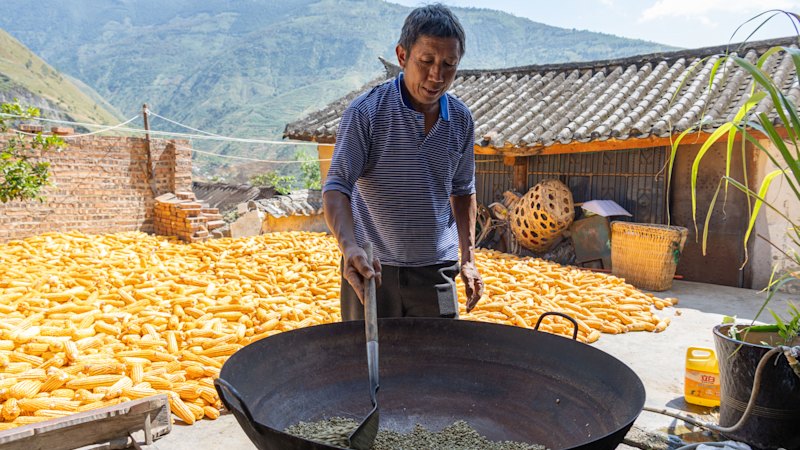
Li invites us into his farmhouse after we poke our heads through an open doorway leading to his courtyard, drawn in by a striking mound of yellow corn cobs baking in the sun and a noisy cat.
His home is a modest three-storey brick structure, centred around an open-air communal room with a concrete-slab floor. One corner functions as a kitchen, with a rice cooker and a camping stove rigged up to a single power board looped around a nail in the wall, while a collection of mismatched plastic stools surrounds a basic dining table.
In the courtyard, he empties a rice sack filled with green coffee beans – shelled from their cherry skins – into a wood-fired roasting pit, fashioned out of an oil drum and large cast-iron work.
With a cooking shovel, he continuously turns the beans, a process that takes more than an hour to achieve a deep roast. It might seem nostalgically authentic, but it’s a laborious task that modern coffee manufacturers long ago outsourced to roasting machines.
While China’s surging taste for coffee helped drive global prices to record highs in 2025, few, if any, farmers in Zhukula have grown rich from coffee.
“We grow coffee beans to make a living, but coffee alone isn’t enough. The problem is that we don’t have much farmland here,” Li says.
“Coffee consumption [in China] has increased, but our area is small, so sales are unstable.”
Until about a decade ago, Yunnan was more famous for its tea production. Today, the sprawling mountainous region produces almost all of China’s coffee beans, an industry that has boomed as cafe culture has exploded across the country.
China still trails miles behind Europe and the United States in terms of global coffee consumption, accounting for just 3 per cent, but it’s the fast-growing market, rising 150 per cent over the past decade.
It’s big business, with large commercial farms harvesting thousands of tonnes of coffee beans each year. You can find Yunnan beans in speciality coffee shops around the world, Australia included.
But today, most of the region’s produce is consumed domestically, fuelled by the rapid expansion of coffee chains such as Chinese giant Luckin Coffee, which has opened 30,000 stores across the mainland since its first in Beijing in 2017.
Boutique cafes serving oat milk lattes, iced Americanos and various berry infused, caramel-lashed, pistachio-rimmed concoctions are now abundant across Shanghai, Beijing and other major cities.
This growing demand has helped pull farmers out of poverty in rural Yunnan, which remains one of China’s poorest provinces. The industry’s rise is also a case study in China’s 1980s pivot from a wholly planned economy to state-supported private enterprise and land cultivation, while also highlighting how rural land reform continues to constrain small-scale farmers.
Which boats have been lifted highest by this rising tide has depended heavily on geographical luck and the Communist Party’s “visible hand” in picking industrial and agricultural winners.
Capitalism with Chinese characteristics
About half a day’s drive from Zhukula, towards China’s border with Myanmar, the sweeping valleys of Baoshan are blanketed in coffee trees, popping with red fruit.
Many of them are owned by private commercial farms such as Gaosheng Coffee Manor, a family operated estate that runs a cafe, cupping room and tasting courses, while its German-imported industrial roasters churn through thousands of kilograms of beans each week.
Once an export-oriented business that used to count Nestlé and Starbucks as its largest clients, Gaosheng is now almost entirely focused on China’s domestic market.
“Luckin Coffee, Cotti Coffee and Mixue are our biggest customers. They’re our gods,” Gaosheng Coffee chairman Gao Jianyun says.
The company is one of several large coffee enterprises that have sprung up in Baoshan over the past two decades. Its roots trace back to a 1950s state policy designating the region as one of China’s agricultural engine rooms, where farmers were instructed to grow coffee.
“At that time, planting coffee wasn’t something they wanted to do themselves. It was mandated by the state’s planned economy,” says Gao, whose parents were among the first coffee farmers in the area.
Similar to the Li family in Zhukula, the Gao family also has three generations rooted in coffee farming, but their trajectories couldn’t be starker. As China’s economy opened up, and the government poured resources into making Baoshan a coffee cultivation powerhouse, the Gaos scaled up and invested in modern equipment, whereas the Zhukula farmers today remain limited by isolation, difficult terrain and low-earning capacity.
When Gao joined his parents working on their farm in the early 1980s, all fresh coffee cherries were still purchased centrally by the collective, and his role was to calculate and distribute wages based on farmers’ planting area.
By 2005, the family had set up its own company, which today owns 34 hectares of coffee plants in Boashan and 80 hectares in the nearby Pu’er region and employs 100 people. Under China’s rural land system, farmers cannot buy or sell farmland, but they can lease their land-use rights to others, enabling wealthier operators and co-operatives to turn fragmented plots into larger estates.
Gao says these farmers’ incomes have increased several times over. Meanwhile, Gaosheng Coffee is on track to make 120 million yuan ($26 million) this year through sales of green beans and packaged coffee products.
In the company’s boardroom, an airbrushed portrait of Chinese President Xi Jinping hangs on the wall, mounted alongside various golden plaques and accolades the business has been awarded. It’s a nod to the link between private commercial success and state support – particularly in the agriculture sector – under China’s model of “socialism with Chinese characteristics”.
“We are also actively working with the government to expand our operations and increase production capacity,” Gao says. His daughter, Gao Jie, who studied a master of business administration in New York and now heads the company’s brand strategy, is aiming for a 20 per cent increase in sales this year.
Coffee farming frozen in time
Back in Zhukula, the remote, rugged beauty of the mountain is also the farmers’ curse – a paradox familiar across rural China. Li’s house is the last at the end of the village, where the road abruptly gives way to a sheer drop to the valley and the Yupao River that flows through it.
The path to Li’s house is too narrow for cars and too steep for bicycles. It winds past his neighbours’ homes, where a few pigs, goats, cows and chickens are kept in cramped wooden pens next to their living quarters. It’s a portrait of communist agrarianism frozen in time, with faded Communist Party slogans painted in red on the outside of homes, urging villagers to march together towards prosperity.
“Contentment with poverty is shameful. Overcoming poverty is honourable,” one slogan reads.
There’s a party activities centre in the village, while a few houses fly the hammer and sickle flag out front, identifying local members with leadership roles in the community. It’s indicative of how party governance is woven into the fabric of even China’s smallest villages.
In the 1980s, after China abandoned the Mao-era commune and collective farming system, Li’s family was assigned 36 coffee trees under a policy that allocated land based on family size. Since then, it has expanded its coffee crop while also farming walnuts, Sichuan pepper and corn, but scaling up remains impossible on a plot of less than a hectare.
Higher bean prices have boosted the family’s income, but it’s still in the realm of subsistence rather than wealth generation.
In a good year, Li and his 34-year-old son, Jiangfu – who also lives in the village with his wife and young daughter – harvest just under 1000 kilograms of coffee cherries.
The crop is the main source of each household’s annual income of about 25,000 yuan ($5400) – in line with the national average for rural farmers, but less than half what a migrant worker can earn as a delivery driver in Beijing or Shanghai.
“Sales have gradually improved. In the past, many people didn’t know about our coffee, and it was difficult to sell,” Jiangfu says.
Now there’s a reliable stream of coffee shop owners, tourists and farmers’ friends and relatives who buy their beans, with demand outpacing their supplies, he says.
The village has clearly benefited from government efforts to transform it into a tourist destination, with newly paved roads, community toilet facilities and the church converted into a museum that chronicles Zhukula’s legacy as China’s first coffee village.
A number of Li’s neighbours are building new homes and Li himself has partially renovated his house, with the support of government subsidies.
Still, it is a world away from where some of Zhukula’s beans end up, served in trendy urban cafes as flat whites or experimental signature drinks for $10 a cup, alongside tasting notes exhorting the rich, nutty flavour of Yunnan coffee.
Get a note directly from our foreign correspondents on what’s making headlines around the world. Sign up for our weekly What in the World newsletter.
KioskNews shows a cleaned-up reading view extracted from the publisher’s page — the original always lives on their site, not ours.