Scientists stuck in red tape and admin work: Niti Aayog report


The report called for more trust-based, outcome-oriented governance model
BENGALURU: India may be producing more research papers, patents and startups, but scientists are still spending too much time navigating the system meant to support their work.A new NITI Aayog report on the Ease of Doing Research & Development lists procedural problems researchers face, from repeated grant applications and delayed funds to cumbersome procurement, vacant posts and excessive administrative controls.The report says India’s R&D ecosystem is still marked by a “significant trust deficit between the R&D project granting agency and researchers”, which keeps scientists from utilising their time purely for research.“Researchers are often not able to utilise their time purely for R&D activities without being worried about the administrative issues. There are also issues of capacity as well as rigidities in the science administration systems, which are largely internal to the institutions,” the report reads.
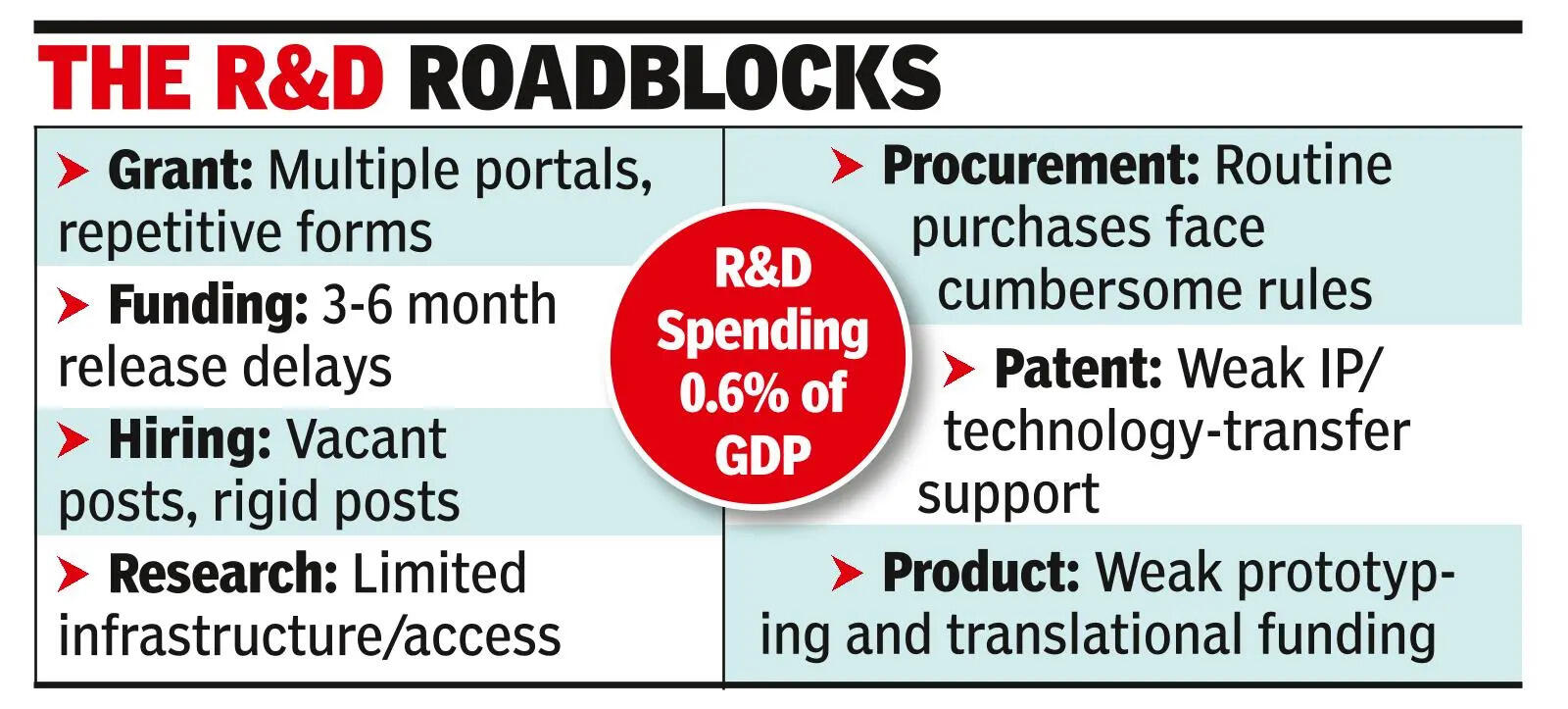
The problem begins with money. India spends 0.6% of its GDP on R&D, a constant for over a decade.
The problem begins with money. India spends 0.6% of its GDP on R&D, a constant for over a decade. Competition for grants has intensified too, with the application-to-grant ratio falling below 10% at several agencies, while 64% of India’s R&D spending comes from the public sector, pointing to weak private participation.
Even approved projects wait. Release of a sanctioned grant can take 3-6 months after the scientific decision, pushing overall turnaround to a year or more. Funds are also withdrawn at year-end and reassigned later, disrupting projects and fellowship payments.Human resources are another weak point. India has just 262 full-time equivalent researchers per million people, against 1,585 in China and 4,821 in both the US and UK.
The postdoctoral ecosystem is thin, with only about 2,500 fellowships supported annually, and a PhD scholar’s first instalment can take 4-5 months. Sanctioned posts often stay vacant, with institutions unable to redeploy them where needed.Inside institutions, scientists often do jobs that should belong to professional research administrators, since many lack dedicated R&D offices and keep approvals centralised.
India does well in publications and patents, but weak technology-transfer infrastructure limits their conversion into products — a burden felt hardest outside premier institutions, which face high journal costs and heavy teaching loads.The report flags a funding concentration problem. “...For instance, the IIT system is known to receive more than 80% of ANRF’s R&D funding. While uniformity in R&D funding is neither expected nor desirable, over-concentration of funding in only a selected set of institutions reduces the funding opportunity for researchers working in other R&D institutions and HEIs.
It may be noted that ANRF has a specific mandate for supporting R&D in state institutions, however, this goal is far from being achieved,” it reads.Prof Jayanth Murthy, former director of the Indian Institute of Astrophysics, said money isn’t the biggest hurdle. PhD stipends, he pointed out, are fully budgeted and yet routinely delayed for no reason: “The money is committed, but you’re not paying them,” he said. Far more time, he argued, is lost after a grant is sanctioned — in paperwork and audits chasing scientists years after a project ends, work he believes should sit with administrative staff, not researchers.The report’s fix is not just more money. It calls for “a more trust-based and outcome-oriented governance model”, backed by professionally staffed R&D offices, greater institutional autonomy, faster grant processing and stronger technology-transfer mechanisms — its message being that India needs to make it easier for scientists to spend their time doing science.
KioskNews shows a cleaned-up reading view extracted from the publisher’s page — the original always lives on their site, not ours.