Why SK Hynix is turning to Japan for its next memory hub
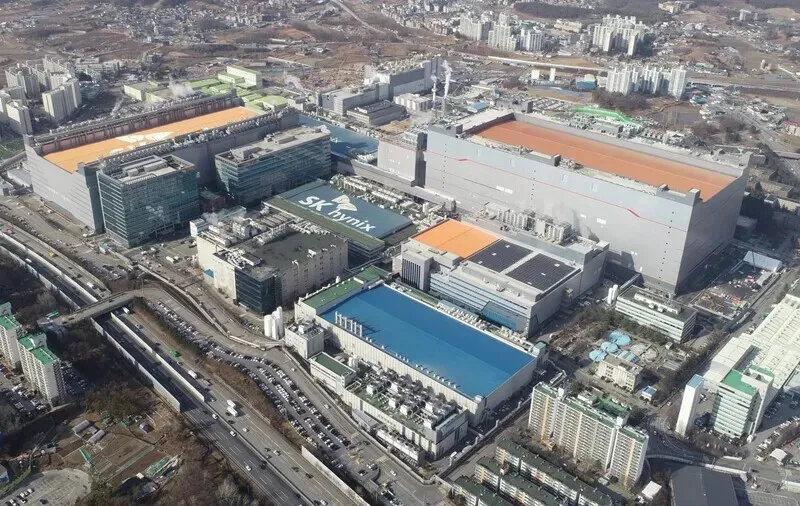
SK Hynix’s plant in Icheon, South Korea. (courtesy of SK Hynix)
SK Hynix appears to be strategically laying the groundwork for deeper cooperation with Japan, a powerhouse in semiconductor materials, component and equipment, by becoming the first Korean company to build a memory chip fab there.
The strategy is to win Japanese government support by establishing a local production base, while strengthening its artificial intelligence chip supply chain through ties with Japan’s materials, components and equipment ecosystem.
Miyagi Prefecture in the northeastern region of the main Japanese island of Honshu, which SK Hynix has selected as a potential investment site, is regarded as a choice location for a new semiconductor production base.
Chipmaker Rapidus, a joint venture between the Japanese government and private sector, runs a plant in Chitose on Hokkaido, Japan’s northernmost island, while Taiwanese semiconductor giant TSMC has a plant in Kumamoto on the southwestern island of Kyushu.
Meanwhile, US memory chipmaker Micron is carrying out a major expansion of the Hiroshima plant it acquired through its takeover of Elpida Memory, which used to be one of Japan’s leading DRAM manufacturers.
In an official statement on Thursday, SK Hynix said, “Any location with the necessary infrastructure could be considered a candidate, but no decision has been made [regarding investment in Miyagi Prefecture].”
However, Hankyoreh reporters have learned that the company is moving forward with plans to build a memory fab in the area.
SK Group Chairman Chey Tae-won spoke favorably of Japan’s competitiveness as a semiconductor production base in a June 10 interview with the Nikkei.
“Japan, as a chipmaking country, has the entire ecosystem that would be needed, including electric power and materials. When considering [investment locations] outside Korea, it’s certainly an excellent candidate,” he said.
Miyagi Prefecture checks many of the boxes for a new semiconductor plant. It’s already a key production base for Tokyo Electron (TEL), Asia’s biggest producer of semiconductor manufacturing equipment, which is investing 104 billion yen to build a new equipment plant there.
The prefecture is also home to major manufacturing facilities, including Sony’s Shiroishi-Zao Technology Center, which produces image sensors, and plants operated by Toyota Motor East Japan, a subsidiary that makes compact cars for Toyota.
Tohoku University in Sendai, a city in Miyagi Prefecture, is also considered a training hub for semiconductor specialists.
The greatest potential benefit of Korean chipmakers’ local investment in Japan is a more robust supply chain for semiconductor materials, components and equipment.
Although Japan is no longer a major producer of finished semiconductors, it remains globally competitive in the materials, components and equipment essential to the manufacture of semiconductors using ultrafine processes.
Furthermore, SK Hynix maintains close partnerships with Japanese companies, including one that provides a critical ingredient in the high-bandwidth memory (HBM, stacks of DRAM chips used in AI) that propelled SK Hynix to its current position. The underfill (a specialized liquid adhesive) used to make those chips is exclusively supplied by Japanese chemical and materials company Namics.
SK Hynix’s main suppliers of silicon wafers, the substrates on which semiconductor circuits are etched, and photoresists, light-sensitive materials used to create microscopic circuits, are also Japanese companies, including Shin-Etsu Chemical and Tokyo Ohka Kogyo.
“Japan designated semiconductors as strategic products when it passed the Economic Security Promotion Act in 2022, paving the way for imposing export controls on the equipment used to manufacture them as well. Running a semiconductor fab inside Japan could allow [Korean companies like SK Hynix] to avoid such restrictions,” said Kim Yang-paeng, a researcher at the Korea Institute for Industrial Economics and Trade.
That implies that a semiconductor alliance between the Korean and Japanese private sectors based on investment in Japan could minimize geopolitical uncertainty over the memory chip supply chain.
That uncertainty was underscored by the Japanese government’s 2019 decision to slap controls on exports of semiconductor materials to Korea following a ruling by the Korean Supreme Court ordering compensation for Korean victims of forced labor during the Japanese colonial period.
In addition to greater supply chain stability, another major potential benefit is the generous financial assistance and subsidies the Japanese government is offering to chipmakers that build factories in the country.
“When SK Hynix eventually seeks to sell its stake in Japanese memory chipmaker Kioxia [formerly Toshiba Memory], Japan’s Ministry of Economy, Trade and Industry may attempt to block the sale on the grounds of economic security or technology transfer,” said a Japanese semiconductor expert who requested anonymity.
The expert said that SK Hynix could use a promise to reinvest the proceeds from the sale in Japan as leverage in its negotiations with the Japanese government.
However, the Trump administration’s efforts to pressure Korean chipmakers to invest in memory fabs in the US could complicate SK Hynix’s prospective investment in Japan.
Korean companies can hardly avoid considering geopolitical factors — including US efforts to expand domestic semiconductor production — in their investment decisions.
KioskNews shows a cleaned-up reading view extracted from the publisher’s page — the original always lives on their site, not ours.