In a world of beige, David’s ‘extreme’ house design is a welcome reprieve
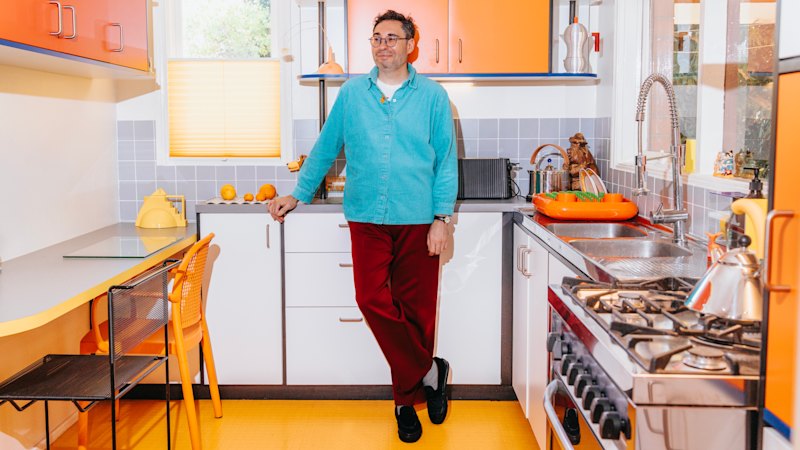
In a world ruled by minimalist design and houses decorated in all the colours of the beige rainbow with names like Warm Neutral, Humble Fawn and White Beach, artist David Capra’s western Sydney home is where personality, whimsy and colour – mixed with family history, anxiety and grief – is living large.
Inspired by the influential Italian movement Memphis design, which was started by Ettore Sottsass in the 1980s – and has nothing but exuberance in common with Elvis Presley’s Memphis, Tennessee – Capra’s home and art will be celebrated in talks and a new exhibition, Memphis Fairfield, opening in November.
Stuck at home in Fairfield during COVID, Capra decided to bring the world of Italian design into his home. “If I couldn’t travel, I would bring Memphis to Fairfield,” Capra said.
And the exhibition will also bring some of Capra’s home to Fairfield City Museum & Gallery, recreating some rooms.
Hidden from the street on a battleaxe block behind a row of nearly identical red brick homes, his home is a mix of exuberant colours and styles, typical of Memphis style.
It includes art he made, furniture he built with family, and rugs he designed and commissioned, including one about his dog, muse and companion of 15 years, Teena, who died last year.
Teena was his co-presenter in a 2018 TedX talk: The Long and Short of it: Life Lessons from Art-dog Teena. She also appeared with Capra on the Today show in 2016 to talk with Karl Stefanovic about a new perfume Capra created, Eau de Wet Dogge.
A portrait of David and Teena, an Archibald Prize entry, by artist Katherine Edney, hangs in his hall.
He said Teena helped connect people “outside the museum world” with art and its healing powers to address loneliness and anxiety. For 10 years, Capra has been the co-ordinator of Campbelltown Art Centre’s Little Orange Studio for artists who have a disability, are deaf or hard of hearing.
As well as the carpet featuring Teena, the hall features Capra’s spin on R. K. Maroon’s movie Who Framed Roger Rabbit with a small rug with a rabbit-shaped hole where a person would usually step.
Capra said the public were being encouraged to disinherit their own style and taste, but his personal taste and style were what linked everything together.
The dining room has a wall of peach and blue. The hall has a full-size illuminated wavy mirror, a knock-off version of a Sottsass design, which has become popular with guests for selfies, and a newly designed kitchen in bright colours pays homage to Mondrian (with a nod to Rose Seidler House’s design by Harry Seidler).
The mantelpiece was an original design by Giuseppe Biachini, an Italian designer he discovered while watching Burke’s Backyard as teenager in the 1990s and who lived in nearby Smithfield.
Sometimes visitors don’t get his home. His own relatives tell him, “‘Oh, I like this house, but it’s a bit too crazy. It’s a bit too extreme.’ There’s lots of questions: ‘Can you have an orange cupboard in your kitchen? No, that’s 1970s,’ they will say.”
He said his work now was dealing with the loss of his mother, who died of a heart attack aged 73 last year.
“Putting [the home] on show is a really big step,” he said, because it was designed for his own pleasure and to explore his art.
Carmel Aiello, the co-ordinator of the Fairfield City Museum & Gallery, said Capra’s work was surprising, fun, colourful and interactive.
“He is interested in what other people think and, importantly, believes art can make the world feel a little less lonely. Pretty much like all his work. Puts a smile on your face,” Aiello said.
She said the gallery was all about championing the work of local artists: “Not by just giving them space to show their work, but giving them the artist space to speak directly to the audience with little or no interference from us.”
KioskNews shows a cleaned-up reading view extracted from the publisher’s page — the original always lives on their site, not ours.