At UN, Russia and Germany’s top diplomats hold first talks since invasion of Ukraine
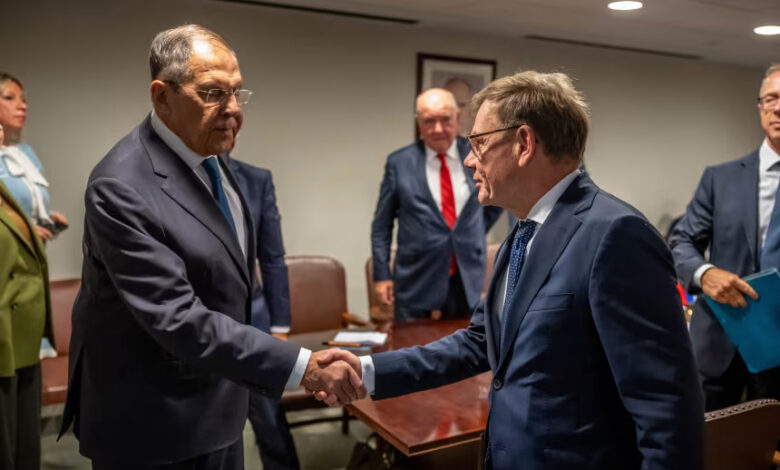
Relations between Moscow and Berlin, a close ally of Ukraine, have been frozen since the Russian invasion, and tensions escalated further after a drone incident at Leipzig/Halle Airport in eastern Germany in August.
In a sign of the continued frostiness, Russian Foreign Minister Sergey Lavrov told a news conference that he had learned nothing new from his German counterpart in the talks that Berlin had not already said publicly in its official statements.
“I told him that frankly … you could just have called me and said: ‘read my statement’,” Lavrov said.
Still, the ministers discussed bilateral ties and the war in Ukraine, officials from both sides said.
German Foreign Minister Johann Wadephul used the talks to urge Lavrov to do “everything possible to reach an agreement on grain exports via the Black Sea,” a German delegation source said. The meeting comes amid diplomatic efforts to revive Russia and Ukraine’s Black Sea grain and energy exports that have been sharply curtailed by attacks on vessels and port infrastructure.
Lavrov told the news conference that Russia had been in talks with India, Egypt and Turkey about proposals to ensure safe navigation in the Black Sea, potentially involving bilateral deals between Russia and those countries.
“There is a need for separate discussions with the Ukrainians, and not in the language of requests, but rather demands,” he said, blaming Ukraine for the attacks on vessels.
Ukraine has said it is open to agreements and blames all the fallout from the war on Russia and its invasion.
Wadephul told Lavrov, “Time is of the essence: given the food shortages in many countries — particularly in the Global South — all parties must be willing to engage constructively,” the German delegation source said.
The German minister also told Lavrov that “a pragmatic solution could pave the way for further concrete steps”, the source said.
In a sign of the sensitivities around meeting the wartime Russian foreign minister, Wadephul notified his European allies of the meeting afterwards in a message seen by Reuters.
“I used this opportunity to reiterate our position on Russia’s war of aggression against Ukraine and to call for an immediate and complete cease-fire, most pressingly with a focus on grain exports, and the energy infrastructure,” he wrote.
The German government said this month it had concluded that Russia was responsible for that attempted drone attack. It closed a consulate and a Russian cultural center in Berlin in retaliation.
The Russian embassy in Berlin has dismissed the allegations as “fabricated provocation” and as “a new wave of anti-Russian hysteria in Germany”.
Wadephul used the talks to call on Russia “to abandon the dangerous path of escalation vis-à-vis Germany, Europe, and NATO”, according to the delegation source.
Wadephul said incidents such as the attempted attack in Leipzig or further hybrid attacks would not shake Germany’s resolve to support Ukraine, according to delegation sources.
KioskNews shows a cleaned-up reading view extracted from the publisher’s page — the original always lives on their site, not ours.