China’s Moonshot AI puts Kimi models into race for science discoveries
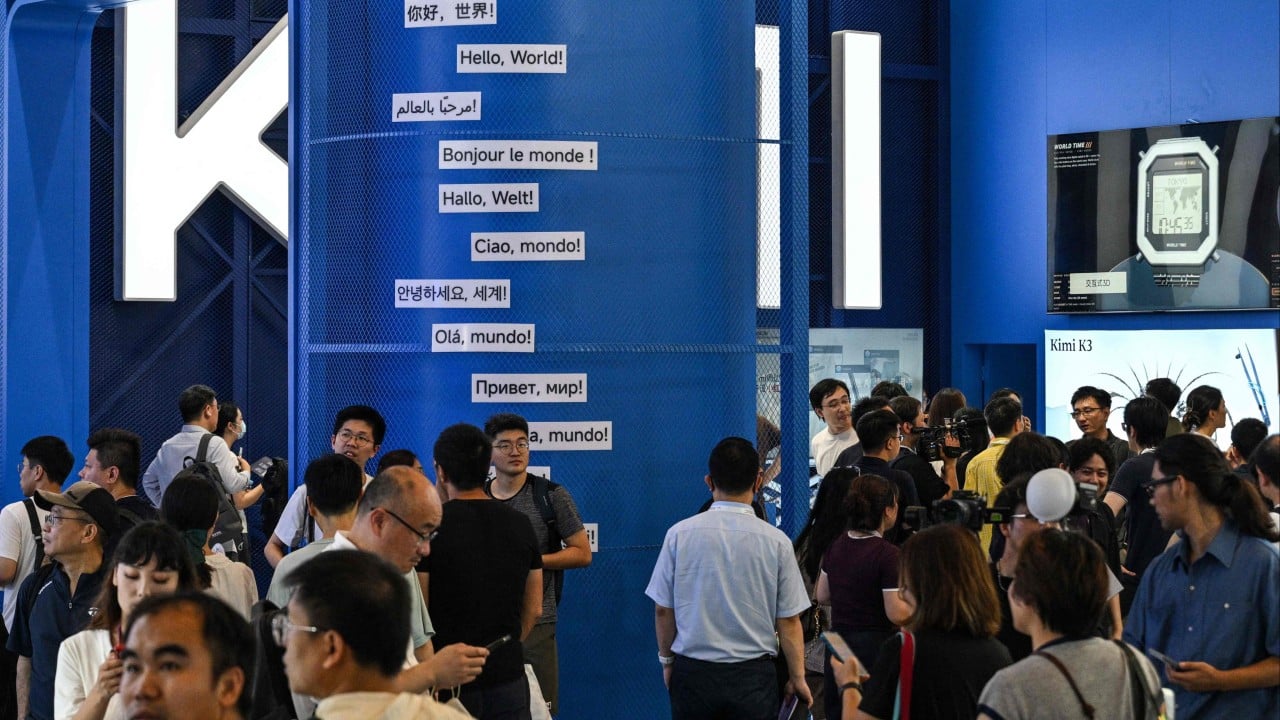
Chinese artificial intelligence start-up Moonshot AI, the developer of the Kimi models, is setting its sights on scientific discovery, joining US rivals in the race to turn AI into a research engine.
The Beijing-based company is increasingly exploring applications that demand more advanced AI reasoning capabilities, pushing into the realms of biology, chemistry and pharmaceutical research.
“The real excitement is … science,” said Giacomo Ficari, Moonshot’s director of international, during a keynote address at the Web Summit technology conference in Lisbon late last week. “While finance and legal are [at] the same level of intelligence [as] coding, science is actually bringing the level of intelligence even higher.”
Ficari said coding, which had driven much of the recent demand for advanced AI models, was approaching saturation in terms of technological progress, prompting Moonshot to explore applications in domains like scientific and pharmaceutical research.
“You see OpenAI focusing a lot on mathematics,” he said. “We are focusing a lot on biology and chemistry. Think about what we can do with pharma and all the technological advancement.”
The company has begun putting its ambitions into practice. On Thursday, DP Technology – a Beijing-based AI-for-science start-up – announced a collaboration with Moonshot to integrate the Kimi K3.1 Pro model into its research agent for biomedical applications.
DP Technology said that in an internal evaluation of AI models for biological research tasks, Kimi K3.1 Pro paired with its coding tool achieved the highest score, relative to other undisclosed model combinations.
In one demonstration, BioMaster, DP Technology’s research agent, and Kimi analysed gene-expression data from 3,696 mouse pancreatic cells, identifying 100 candidate genes for further investigation in about 90 minutes, compared with an estimated four hours of human work.
While the results highlight how advanced models can automate time-consuming data analysis, they stop short of showing an ability to make autonomous scientific breakthroughs.
That distinction was underscored earlier this month in a paper co-authored by Moonshot founder Yang Zhilin and Turing Award-winning computer scientist Andrew Yao, which examined whether leading AI models could contribute to original mathematical research.
The study introduced a benchmark comprising 100 tasks spanning mathematical theorem proving, algorithm development and attempts to solve long-standing unsolved problems in theoretical computer science.
The researchers found that while frontier models could produce verifiable results and assist with complex research tasks, none could independently solve the benchmark’s open mathematical conjectures – highlighting both the promise and current limits of AI in autonomous research.
Moonshot did not immediately respond to a request for comment on Monday.
05:21
The rise and fall of Jensen Huang, who has resigned as Nvidia’s CEO
The company’s push comes amid rival claims of scientific milestones from US peers.
Last month, OpenAI claimed in a blog post that its models had made three new discoveries across mathematics, computer science and physics, generating proofs for long-standing problems. However, its results drew pushback from the scientific community, particularly mathematicians.
In September, Anthropic said its researchers had used its Claude model to discover a new enzyme system.
Still, industry insiders remain cautious about AI’s near-term impact on pharmaceutical research and development.
A survey of 50 US-based pharmaceutical R&D executives by Citi in June found that only 24 per cent expected AI to significantly improve the probability of drug success, even though 72 per cent said their firms were “scaling” or had “fully scaled” the technology across research operations.
KioskNews shows a cleaned-up reading view extracted from the publisher’s page — the original always lives on their site, not ours.