[DECODED] Another school shooting, another wave of disinformation

As long as the online platforms are designed to chase engagement and profits, public safety will always take a back seat
AT A GLANCE
- Following a recent school shooting in Tacloban City, another shooting occurred at Ateneo de Zamboanga University, resulting in two deaths and numerous injuries.
- Online discussions surrounding the shootings have shifted blame from juvenile justice laws to teachers, with unfounded claims of bullying being made against the shooter's educators.
- Experts argue that the real issue lies in the unmoderated social features of online gaming platforms, rather than the violent content of the games themselves, highlighting a need for better protections for young users.
This is AI-generated. Read the article for full context. Report any errors.
Only two months after a school shooting killed at least three students in Tacloban City, another incident took place last week at the Ateneo de Zamboanga University on Tuesday morning, August 18. This time, the shooting left two students dead, including the shooter, and about 20 others injured.
When we at The Nerve analyzed online conversations about the Tacloban shooting in June, we found that bad actors online quickly shifted the blame to the juvenile justice law. They falsely argued that the minors involved would not face punishment, and largely blamed Senator Kiko Pangilinan, singling him out as the author of the 20-year-old law.
READ: [DECODED] Kiko Barzaga strikes again as Tacloban shooting triggers disinfo, muddles chats on juvenile justice law
This time, bad actors on Facebook found a different target.
Using Probe, The Nerve’s content and narrative analysis solution, we found a cluster of public Facebook posts that pinned the blame on teachers instead, with some even making unfounded accusations that the shooter’s teachers had bullied him.
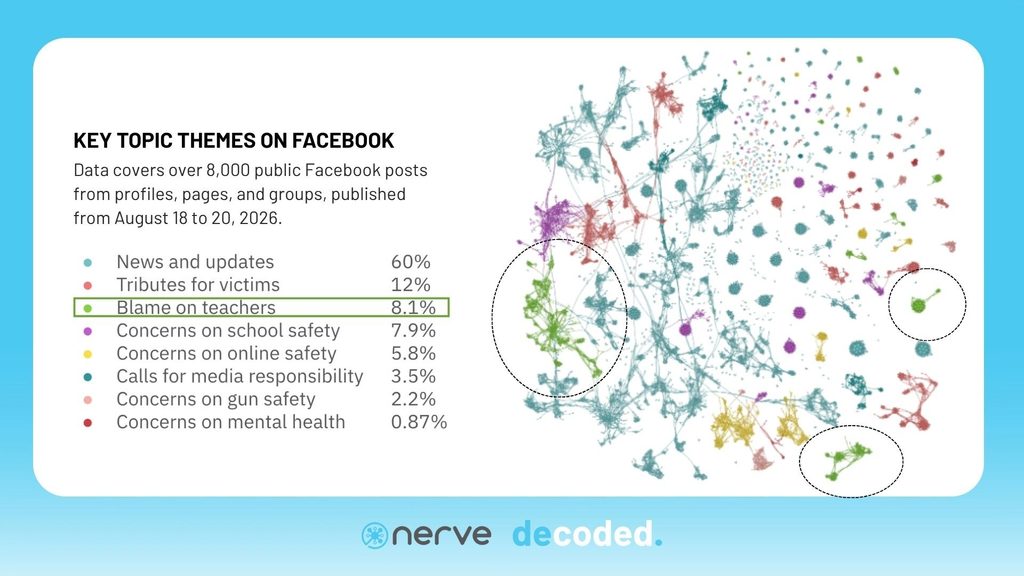
Each node in the topic map represents a post, and posts are connected if they are semantically similar. The posts are clustered together if they have high semantic similarity.
The Nerve found at least 40 posts that spread unverified claims of the shooter being harassed and bullied by his teacher, whom they tagged as a supposed member of the LGBT community. Interior Secretary Jonvic Remulla said reports did not find incidents of bullying that may have triggered the shooter.
Instead, Remulla identified the video gaming platform Roblox as among the games played by the shooter, and called on Congress to “control and curb the use of first-person shooter games.”
The problem with this thinking, however, is that it generalizes the cause of violent crimes perpetrated by minors, even though studies show that shooting incidents triggered by exposure to violent video games are low.
Our chief data officer Don Kevin Hapal wrote in an opinion piece about how the online gaming platforms’ social features pose a more worrying problem than the perceived violence in video games. He also said that relying on parental vigilance alone isn’t enough, because the problem is in the design of the platforms themselves.
READ: [OPINION] ‘Violence’ in video games is not the problem, their social features are
“The real danger isn’t violent gameplay but the monetized, unguarded social environment built into or around these platforms catering to kids,” he wrote, arguing that research indicates no strong correlation between playing violent video games and actual criminal behavior. A better way to address the problem, he said, is to focus on the unmoderated social layers of gaming platforms, such as messaging features and the tendency for conversations to get funneled to other messaging apps, and parental controls.

READ: [DECODED] Child safety isn’t a parenting problem. It’s a platform failure.
After all, it’s not like online and social media platforms have been proactive in protecting their young users.
In related news, Mark Zuckerberg’s Meta is being sued by a group of 29 US states for designing its platforms, Facebook, and Instagram, to allegedly hook young users in the name of profit. The 29 states also accuse Meta of violating federal law for its improper collection and use of the personal data of users under 13 years old.
A former engineering director at Meta Platforms testified against the company and said it was “common knowledge” at Meta that most parents lacked time to fully grasp the company’s products or to monitor how their children were using them. He added that the company had technology to flag potentially millions of users under the age of 13, but chose to adopt a “don’t ask, don’t tell” policy because adding safeguards for minors would not result in profits in the long term.
Putting such importance on profits over safety is the root cause of everything that’s wrong with the online environment we have now. This is why false claims after shooting incidents proliferate on social media despite efforts to fact-check them, why young users remain exposed to online aggression, and why parents find it hard to catch up with the tech products their children use.
As long as the online platforms are designed to chase engagement and profits, public safety will always take a back seat. – Rappler.com
Decoded is a Rappler series that tackles Big Tech not just as a system of abstract infrastructure or policy levers, but as something that directly shapes human experiences. It is produced by The Nerve, a data forensics company that enables changemakers to navigate real-world trends and issues through narrative and network investigations. Taking the best of human and machine, we enable partners to unlock powerful insights that shape informed decisions. Composed of a team of data scientists, strategists, award-winning storytellers, and designers, the company is on a mission to deliver data with real-world impact.
KioskNews shows a cleaned-up reading view extracted from the publisher’s page — the original always lives on their site, not ours.