Spain train crash as it happened: At least 68 killed in high-speed train crash, with death toll set to rise as nation’s PM says ‘all of Spain is in mourning’
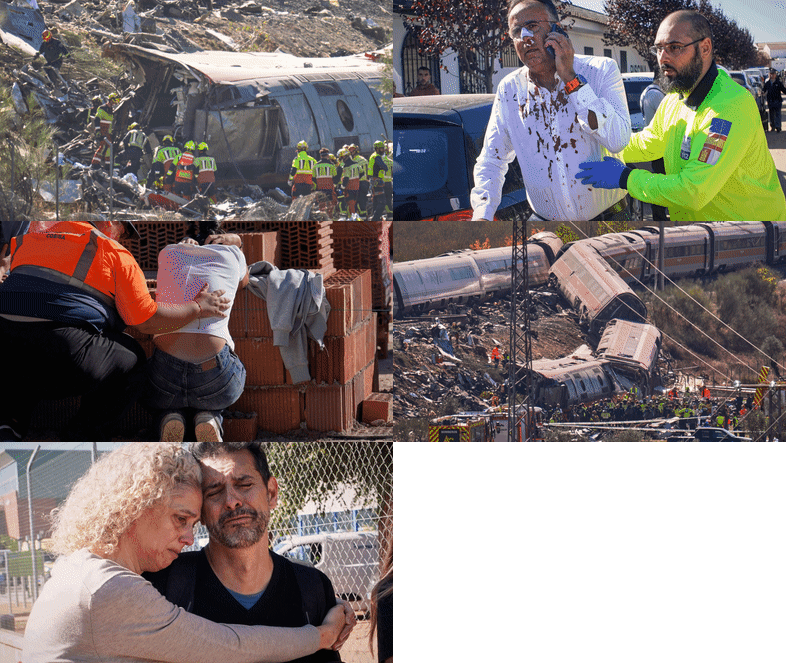
Spain is a country in mourning after a high-speed train crash killed at least 68 people and injured at least 80 others, 15 of them very seriously.
As rescue workers continue to search the wreckage, here is a recap of key events:
- The two high-speed trains crashed south of the Spanish capital, Madrid. The Castilla-La Mancha regional government has warned that the number of fatalities could rise further.
- A train operated by state-owned Renfe struck the rear of another train operated by private company Iryo, which had stopped on the tracks. The Iryo train departed Madrid at 7.54am (local time), bound for Seville, while the Renfe AVE service left minutes later, at 8am, travelling in the same direction.
- The two trains were carrying a combined total of 544 passengers, according to Spanish media.
- A major rescue operation is ongoing at the crash site near Urda, as hundreds of anxious families await news.
- The Department of Foreign Affairs and Trade is not aware of any Australians involved.
- Spain’s Transport Minister Óscar Puente said that the crash was caused by what he called the “inexplicable” order from a central command centre after a security system had failed. He said the train engineers were not to blame.
- Authorities are still determining how fast the train was going, but it could have been travelling at 200km/h on that stretch of the track.
- It’s the second major train crash this year in Spain – and involved the same two rail operators. In January a high-speed train crash killed 46 passengers. It’s also Spain’s deadliest rail disaster since 2013, when 80 people were killed in a derailment in the country’s north-west.
- Spain is set to begin three days of mourning.
Latest Posts
The investigation into this crash is going to turn on whether the right information was sent from the Atocha control centre in Madrid to the two trains sharing the line running south to Seville.
This puts the focus on the control operators but this is already a flashpoint in public debate. When the Spanish transport minister said there was a problem with the instructions sent from Madrid, the main rail union accused him of “scapegoating” the controllers.
There are said to be three audio recordings of exchanges between the train drivers and the Atocha control centre. All concern the key fact that services were stopped at some stage due to concerns about signalling.
Spanish newspaper El Pais reports that two of the exchanges were between the control centre and the Iryo train, said to be stationary at the time of the crash, and one was an exchange between the controller and the Renfe AVE train.
Spanish Prime Minister Pedro Sánchez started Wednesday proclaiming reasons to be “optimistic” as the country’s election neared. Hours later he was standing at the scene of a high-speed rail crash, explaining why at least 68 people were dead.
The accident – Spain’s deadliest rail crash in more than a decade and second major collision this year – is a brutal blow for the prime minister, who’s already facing a difficult election campaign.
Polls show the conservative People’s Party leading, with far-right Vox on the rise, and Wednesday’s events are likely to only increase scrutiny on Sánchez and his Socialist Party.
The Spanish leader tried to get ahead of any attacks, vowing swift accountability from the crash site south of Madrid. And, for the moment, all major political parties except Vox have suspended scheduled campaign events, as Sánchez declares three days of mourning.
Passenger Fernando Seco has recounted to The New York Times what happened when his train crashed into another one, and the aftermath.
He said he was on the Renfe train, heading home to Seville from a business trip in Madrid.
He said his train stopped for a few minutes and a voice on the loudspeaker said there was heavy traffic. Then the train started to move again before there was a “very violent crash”, Seco told the Times.
His train, run by Spain’s national rail provider, had run into the back of the other train, which was stationary.
This latest train crash comes nine months after a collision between high-speed trains belonging to the same operators on the same line that killed 46 people in southern Spain earlier in the year.
That crash in January, which occurred after a train derailed and smashed into an oncoming train near Adamuz, in Spain’s Cordoba province, triggered a debate about the level of investment in railway maintenance in recent years.
The accident is still under investigation. A preliminary report by Spain’s Civil Guard in February pointed to defects in the track, rail or weld between two sections of track as the main hypothesis for the accident, but kept seven other theories open.
The second deadly accident in less than a year will likely raise further questions over the country’s train infrastructure ahead of November’s snap election.
A protest is under way in Madrid as Spanish citizens demand a key minister takes responsibility for the rail tragedy.
Hundreds of people have gathered outside the Ministry of Transport in Madrid, where it is coming up to 9.45pm, and are calling on Transport Minister Óscar Puente to resign.
A video shared by news site El Espanol shows the crowd a short time ago.
The government has promised a full investigation into the crash but many Spaniards appear to be blaming the control office at Atocha, the main railway station in Madrid, for not preventing one train crashing into the rear of another.
The Department of Foreign Affairs and Trade is not aware of any Australians involved in the train crash in Spain that has taken at least 68 lives and injured dozens more, Education Minister Jason Clare has confirmed.
“As you’d expect, we’ve got consular officials in Spain who stand ready to help any Australians or any Australian families if they are affected,” he told ABC TV moments ago.
“I think the whole country is in shock at the moment, seeing these images on our screens, [they’re] just horrific.”
KioskNews shows a cleaned-up reading view extracted from the publisher’s page — the original always lives on their site, not ours.