Carney, Lula urge nations to join middle-power group
Leaders from Canada, Brazil, Kenya and the EU unveiled a joint diplomatic front on the eve of the UN General Assembly, seeking to shield global cooperation from an increasingly transactional geopolitical order.
Called “Partners for Multilateralism,” it aims to “create a flexible, open framework for countries from different regions and political traditions that are willing to work across divides,” Canadian Prime Minister Mark Carney, Brazilian President Luiz Inacio Lula da Silva, European Council President Antonio Costa and Kenyan President William Ruto wrote yesterday in the Financial Times.
The leaders said the mechanism, which they shorthanded P4M, would serve to build coalitions for reform and to translate into practical action shared principles, including those enshrined in the UN Charter.
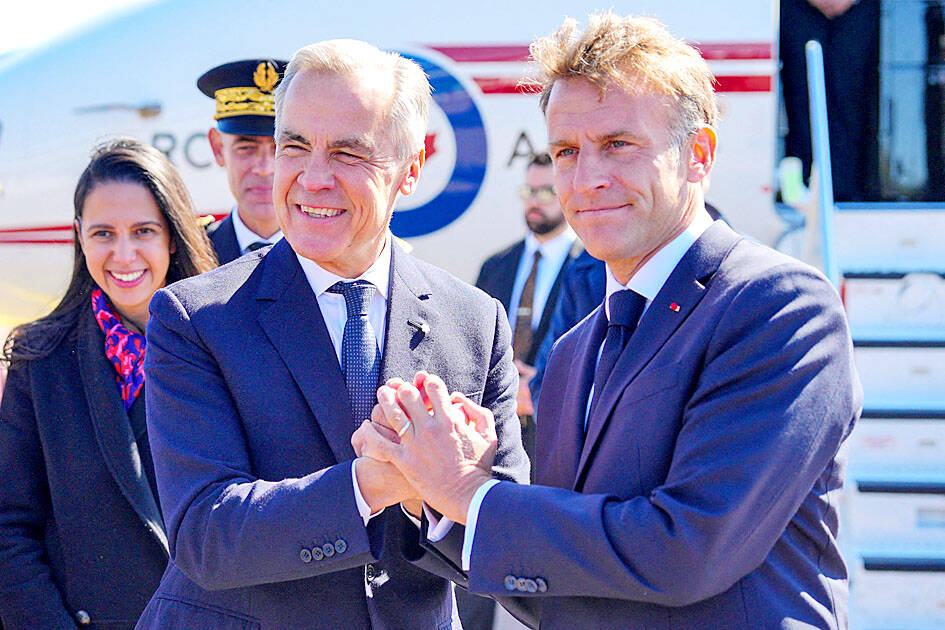
French President Emmanuel Macron, right, and Canadian Prime Minister Mark Carne, left, meet in the small French territory of Saint Pierre and Miquelon, France, on Sunday.
Photo: Reuters
They planned to convene yesterday on the sidelines of the UN Assembly general debate in New York.
Representing key middle powers and developing nations, P4M leaders say cooperation is “not an act of idealism, it is a practical necessity” to bolster longstanding multilateral institutions and address shared threats like climate change, artificial intelligence and supply chain disruptions.
“P4M is not about creating another exclusive bloc or another international bureaucracy,” the leaders wrote. “Its purpose is the opposite,” to create a flexible and open network to support the work of the UN and other multilateral platforms.
The initiative comes as world leaders gather against the backdrop of US President Donald Trump’s administration, which has been defined by trade tariffs, transactional diplomacy and deep skepticism toward international bodies and alliances, including the UN, the WTO and NATO.
“The language of spheres of influence and power politics is back,” they wrote.
Structural reforms at the UN have stalled for years due to veto powers among the Security Council’s five permanent members, leaving the body repeatedly unable to act on emerging global conflicts.
At the same time, consensus-building forums like the G20 have grown deeply fractured following Russia’s 2022 invasion of Ukraine.
KioskNews shows a cleaned-up reading view extracted from the publisher’s page — the original always lives on their site, not ours.