Indonesia draws on Toyota experience to boost auto competitiveness
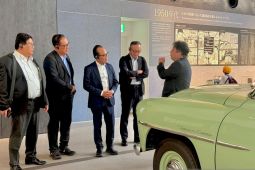
Jakarta (ANTARA) - The Indonesian government is drawing on Toyota’s experience in developing industrial capabilities to strengthen the competitiveness of the country’s automotive sector.
Secretary of the Coordinating Ministry for Economic Affairs Susiwijono Moegiarso said industrial innovation can be strengthened through advances in technology, human resources, and supply chain development.
“Toyota demonstrates how innovation, technology, human resources, and supply chains can drive global industrial competitiveness. This experience is relevant to Indonesia as it strengthens manufacturing and domestic value-added activities,” he said during a visit to the Toyota Commemorative Museum of Industry and Technology (TCMIT) in Nagoya, as reported in Jakarta on Sunday.
According to Moegiarso, Toyota’s decades-long experience aligns with Indonesia’s efforts to strengthen manufacturing competitiveness and has contributed to the development of the national automotive industry for more than five decades.
Toyota Indonesia has produced 10 million vehicles, with more than 3 million units exported to over 100 countries. Meanwhile, Toyota Group’s cumulative investment in Indonesia has reached approximately Rp100 trillion (US$5.4 billion), supporting an ecosystem that involves more than 360,000 workers.
The local content level across Toyota’s production ecosystem in Indonesia has also exceeded 80 percent.
The ecosystem is supported by more than 240 Tier-1 suppliers and around 520 Tier-2 and Tier-3 suppliers, strengthening linkages between the automotive industry and the domestic components sector.
Moegiarso said these achievements reflect Indonesia’s evolution from an automotive market into a key production and export hub for Toyota, while underscoring the need to strengthen the industry ecosystem as it shifts toward more environmentally friendly vehicles.
He noted that the development of electrified vehicles presents opportunities for Indonesia to expand the industrial value chain, including through the development of batteries, components, recycling capabilities, and human resources.
“The transition to electrified vehicles opens up opportunities to strengthen the supply chain from upstream to downstream, including the development of batteries, components, recycling capabilities, and human resources. Indonesia possesses immense potential to become a key player in the global electrified vehicle value chain,” he continued.
Regarding the development of electrified vehicles, PT Toyota Motor Manufacturing Indonesia (TMMIN) announced a strategic partnership with Contemporary Amperex Technology Co. Ltd. (CATL) to develop electrified vehicle battery production in Indonesia, with an investment of Rp1.3 trillion (US$71 million). TMMIN announced the partnership in April 2026.
Moegiarso said the production initiative covers the development of battery cells and modules, with Indonesia projected to serve as a hub for exporting Toyota batteries to global markets starting in the second half of 2026.
Furthermore, the government seeks to work with industry players to strengthen manufacturing competitiveness, expand export markets, and improve the sector’s ability to adapt to technological changes.
Moegiarso’s visit to TCMIT also served to strengthen dialogue between the government and Toyota on manufacturing industry development, technological innovation, supply chains, vehicle electrification, human resource development, and export expansion.
Related news: Govt offers incentives for Toyota to relocate production to Indonesia
Related news: Toyota Tsusho to invest $100 million in Indonesia's tin, copper
Translator: Bayu Saputra, Resinta Sulistiyandari
Editor: Primayanti
Copyright © ANTARA 2026
KioskNews shows a cleaned-up reading view extracted from the publisher’s page — the original always lives on their site, not ours.