At a Nepal hospital, hope slowly fades days after catastrophe
Days after Nepal’s worst natural disaster in a decade, Kathmandu’s biggest hospital was overrun — not with patients, but with families desperately looking for them.
Sign In or Create an Account
On Saturday, Sukuntala Bhatta was one of those family members. She paced outside with her husband and other relatives, scanning hospital records, buttonholing staff and waiting in hope that her 22-year-old son, a hotel worker near the China-Nepal boundary, had survived the flash flood that unleashed devastation on both sides of the border earlier this week.
One challenge was complicating her search. The hotel where Bhatta’s son, Om Prakash Bhatta, worked was situated on the Chinese side. She didn’t know how to contact Chinese authorities for information about him. Nor did she know if her son — if he was alive — would be taken to Nepal, or if he was perhaps in a hospital in China somewhere, and out of reach.

Get a dash of perspective along with the trending news of the day in a very readable format.
By signing up you consent to receive the above newsletter from Postmedia Network Inc.
A welcome email is on its way. If you don't see it, please check your junk folder.
The next issue of NP Posted will soon be in your inbox.
We encountered an issue signing you up. Please try again
“It’s already been four days,” she said. “We don’t know who to contact. We don’t know anything on the other side.”
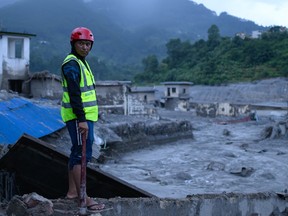
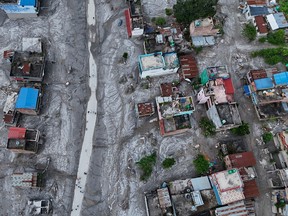
As the scale of the disaster that unfolded in the two countries becomes clearer, desperation is rising among the families of the nearly 3,000 still missing — a toll that authorities expect will continue to climb in the coming days. Rescue efforts are complicated by immense logistical challenges, with entire villages cut off from road access and at least hundreds of victims likely still trapped under sheets of rubble, mud and water.
For families of those missing or dead, new challenges are setting in. Many of those affected by the disaster, like Bhatta’s son, worked at hydropower projects, hotels, or tour companies operating along the rugged border between China and Nepal, adding to the logistical and bureaucratic complexity of the rescue operation. Others lived and worked in remote villages now cut off completely from contact — and in some cases from rescue teams.
“It was a horror to walk around. It looks like a bomb blew up,” said David Fisher, head of the Nepal delegation for the International Federation of Red Cross and Red Crescent Societies. Fisher was in Nuwakot on Saturday, a heavily affected district in Nepal still partially accessible by road. “There’s nothing left. People have lost everything.”
On Saturday, Nepali Foreign Minister Shisir Khanal said the country was seeking specialized foreign assistance to help in the rescue and recovery effort, including technical assistance to help open tunnels where people were trapped, heavy-duty drones to help with supply drops to stranded areas and forensic assistance to help identify the dead.

“The scale of devastation is extremely huge, and support and assistance are required, not just in the phase of rescue and relief but more so in the phase of reconstruction,” Khanal said during a press briefing on Saturday.
Outside another wing of Tribhuvan University Teaching Hospital, a grim scene was unfolding. On a wall, hospital officials had posted photos of recovered bodies, many mutilated after being washed away by the flood. Crowds of family members gathered around the images, trying to discern the faces of loved ones.
Rabina Sunar, a farmer from the nearby village of Dhading, had traveled to Kathmandu by motorbike with upwards of 30 other villagers in search of news of friends and family along the flood-stricken river. She scanned the photos and discovered her 34-year-old brother among them.
“I don’t know what to do now,” she said. Police outside told her she could recover her brother’s body inside the hospital. Workers inside told her she would have to travel to a faraway recovery site where the bodies were being kept. “There is no proper communication.”
Terrifying footage shows a flash flood sweeping through the Nepal–Tibet border, trapping people on rooftops and balconies. At least 469 have been killed, with hundreds still missing. pic.twitter.com/xRgRWmwut7
— Weather Monitor (@WeatherMonitors) August 28, 2026
For Bhatta, hope was slipping away as the days went by. Earlier Saturday, she said she went to a Nepali consular office in Kathmandu in search of help, but it was closed. She said she would try the Chinese embassy next, but even there she was unsure where to begin. Her husband, Uma Kanta Bhatta, said he also didn’t know where to turn.
The floods were the family’s second exposure to one of Nepal’s worst-ever natural disasters. In 2015, they were living in a village a few hours outside of Kathmandu that was flattened in a devastating earthquake that left 9,000 dead. The family survived, but their house was destroyed. They moved to Kathmandu to rebuild their lives.
Uma Kanta, 55, said he and his wife opened up a grocery in the capital. With help from the government, they pieced together enough funds to build a small hut in their old village, which they visit sometimes. In the meantime, he’s devoted much of the last decade to raising his son, as well as a daughter, who is three years older.
“I’m getting old, I can’t work as much,” he said. “I have two children and I was educating them, and now my son has disappeared.”

—With assistance from Kanupriya Kapoor.
Our website is the place for the latest breaking news, exclusive scoops, longreads and provocative commentary. Please bookmark nationalpost.com and sign up for our daily newsletter, Posted, here.
Join the Conversation
This website uses cookies to personalize your content (including ads), and allows us to analyze our traffic. Read more about cookies here. By continuing to use our site, you agree to our Terms of Use and Privacy Policy.
KioskNews shows a cleaned-up reading view extracted from the publisher’s page — the original always lives on their site, not ours.