Malaysia’s education system can no longer keep fooling itself —Ahmad Ibrahim
NOVEMBER 16 — Malaysian education is in the grip of a dangerous collective delusion.
Domestic exam results grow ever more dazzling — the number of SPM candidates scoring all A’s has climbed from around nine thousand a decade ago to over thirteen thousand, and national average grades improve year after year.
Yet the same students’ performance in the PISA international assessment keeps sliding — mathematics scores fell from 440 in 2018 to 397, with sixty-five per cent of students failing even to reach the basic threshold for applying mathematics to everyday problems.
This absurd situation — blooming at home, wilting abroad — was finally named by former minister Khairy Jamaluddin, who recently punctured the bubble with the phrase “grade inflation” and called on the nation to confront a “problem that has existed for years.”
The question is whether Malaysia truly has the courage to admit this reality.
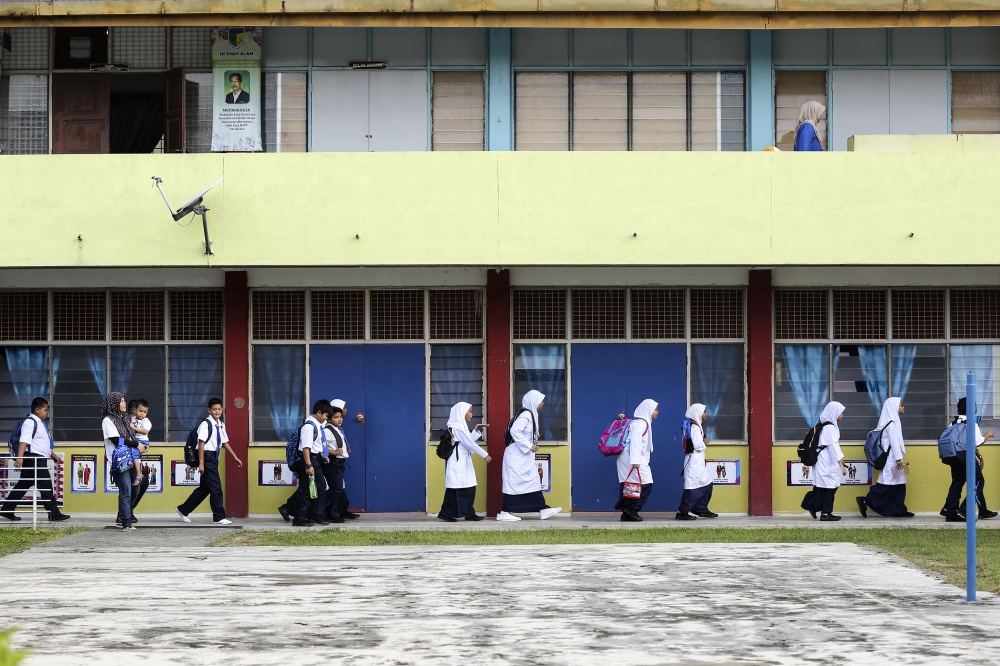
The author argues that improving SPM results mask weaknesses in Malaysia’s education system, calling for reforms including transparent grading. — Picture by Yusof Mat Isa
Some argue that lenient grading is common practice in many countries and need not be treated as a crisis.
This argument dodges the core issue: widespread does not mean acceptable.
Grade inflation in American universities has long since eroded public trust in higher education — nearly eighty per cent of Harvard students received top grades in 2023, forcing the institution to reinstate grade caps by 2027.
Researchers in New Zealand have likewise warned that the A grade is shifting from “a mark of excellence” to “the most common grade,” with public trust dissolving in its wake.
When everyone is excellent, excellence loses its meaning.
More importantly, Malaysia’s grade inflation is not an isolated technical problem of scoring.
It is a symptom of a whole system of distorted incentives.
When social mobility depends heavily on a piece of paper, when university admissions and the job market over-rely on academic credentials, exams cease to be a test of learning and become a currency of survival.
Teachers bear the pressure of student evaluations; administrators assess departments by pass rates.
The result is an institutional conspiracy: rather than fail students and invite trouble, let everyone through.
The cost of this conspiracy is ultimately borne by the students themselves.
Young people who breeze through domestic exams with easy A’s discover, only upon entering the international arena, that what they excel at is “answering questions according to the answer scheme,” not “using knowledge to solve unfamiliar problems.”
Academic research has long pointed out that when Malaysian teachers set their own questions, they often mistake verbs like “analyse” for markers of higher-order thinking, while what is actually tested remains memory and recitation.
When PISA asks students to “model complex situations,” only 0.6 per cent of Malaysian students reach that level, against an OECD average of eight per cent.
This is not because Malaysian students are not clever enough.
It is because they have never been truly trained to.
The solution is not simply to claw back a few A’s — that would only create new injustices.
Princeton University’s 2004 grade quota experiment is a cautionary tale: while Ivy League peers continued to grade generously, Princeton students were disadvantaged in the job market, and the university was forced to abandon the quota by 2014.
What is truly needed is a three-pronged approach.
First, transparency.
The Malaysian Examinations Board has the right to keep grade cut-offs confidential, but the public has the right to know what an “A” actually means.
The Ministry of Education should publish technical reports explaining the basis for each year’s standard-setting and submit them to independent academic scrutiny, rather than hiding behind the Official Secrets Act to deflect questions.
Second, diversified assessment.
When the fate of SPM hinges on a single standardised exam, teaching inevitably degenerates into exam drill.
Malaysia once attempted to break this pattern through school-based assessment, but teachers lacked the capacity to design higher-order thinking questions, and school-based assessment ultimately became a formality.
Reform requires accompanying teacher training and resource investment, not a ministerial circular.
Third, reconstructing the signal.
University admissions and employer recruitment need to move beyond the “how many A’s” mindset and build a more three-dimensional evaluation system.
As a former education ministry official has argued, Malaysia needs a “national big data system” to track and recognise students’ diverse abilities, rather than pinning all hopes on an increasingly distorted score symbol.
The purpose of education is not to produce beautiful transcripts, but to cultivate people who can think, judge, and act in the real world.
As SPM A’s grow easier and PISA scores grow uglier, Malaysia is spending a generation’s worth of time proving a simple truth: if you treat exam scores as the goal of education itself, you will end up with beautiful numbers and barren minds.
It is time to stop fooling ourselves.
*The author is affiliated with the Tan Sri Omar Centre for STI Policy Studies at UCSI University and is an Adjunct Professor at the Ungku Aziz Centre for Development Studies, Universiti Malaya. He can be reached at [email protected].
** This is the personal opinion of the writer or publication and does not necessarily represent the views of Malay Mail.
KioskNews shows a cleaned-up reading view extracted from the publisher’s page — the original always lives on their site, not ours.