Jacobina: More than a biscuit, the pride of Mendez town

Already have Rappler+?
to listen to groundbreaking journalism.
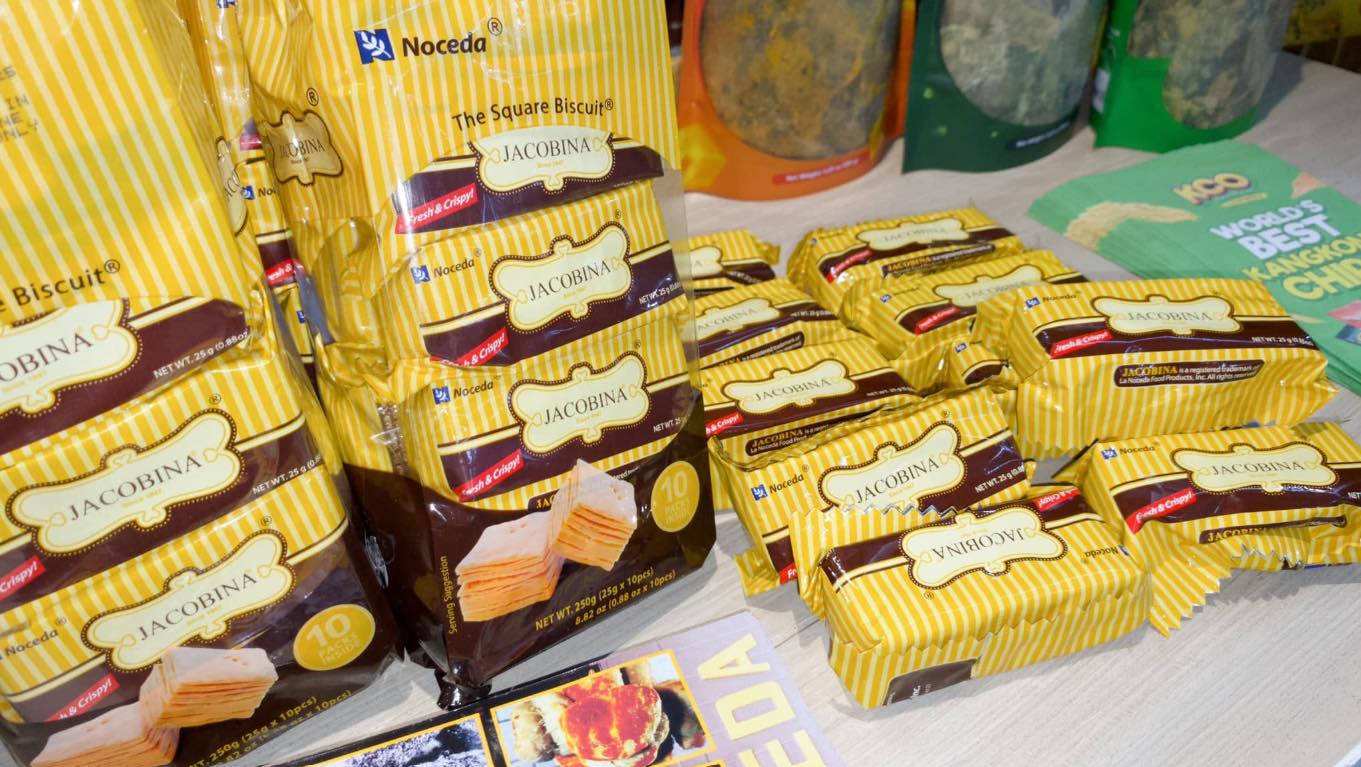
HOMEGROWN. Jacobina cubed biscuits do the rounds of food expositions as a proud product of Cavite.
Photo from the Cavite Tourism FB
The history of the delicacy traces back to 1947, when Paterno Noceda introduced Jacobina at his small bakery in Mendez, Cavite
AT A GLANCE
- Jacobina, a cubed biscuit from Mendez, Cavite, is a beloved snack and cultural symbol, often associated with special occasions and local pride.
- The biscuit's popularity began in 1947 at Noceda Bakery and has since become a staple in Filipino households, passed down through generations.
- Despite its expansion to international markets, Jacobina remains a significant part of Mendezeño heritage, often enjoyed with coffee and incorporated into various dishes.
This is AI-generated. Read the article for full context. Report any errors.
To many families in Mendez and across Cavite, the cubed biscuit known as Jacobina is more than just a snack paired with coffee — it is a staple during special occasions and a cherished pasalubong that carries a piece of home.
For older residents like the Matienzo grandparents, who have lived in the town for over 60 years, the biscuits bring back fond memories of a simpler era when Jacobina cost just a centavo apiece.
Over the decades, Jacobina has become almost synonymous with Mendez itself. Members of the local Bautista family note that whenever people learn their hometown, they usually bring up the biscuits immediately.
“’Pag sinabing Jacobina, Mendez agad [ang] naiisip,” they said. (When you say Jacobina, Mendez immediately comes to mind.)
Bringing it along during travels or giving it to friends has become a customary way of sharing their local pride.
Chief of Staff Ronald Perey of the local government of Mendez recalls how three local bakeries — Noceda, Las Suerte, and San Agustin — originally produced the cubed biscuits.
Although Las Suerte eventually closed and San Agustin continued to serve local buyers, it was Noceda Bakery that truly popularized Jacobina nationwide.
Today, the municipal government regularly presents Jacobina alongside kapeng barako to visitors as a defining symbol of Mendezeño culture.
This connection endures across generations. Younger Mendezeños are introduced to Jacobina by their parents and grandparents, making it a familiar fixture at home. Many develop a deep fondness for Jacobina over time, often incorporating it into creative dishes like avocado with milk or giving it as gifts to colleagues and friends outside town.
From a small bakery to a town’s pride
The history of the delicacy traces back to 1947, when Paterno Noceda introduced Jacobina at his small bakery in Mendez. The name was officially registered as a trademark in 1955 with the Philippine Patent Office (now the Intellectual Property Office of the Philippines).
According to current co-owner Felecitas Noceda Panganiban, local lore suggests the biscuit was named after a beautiful woman who once visited the town. The exact origin story remains a fond piece of local mystery.
As demand surged, La Noceda Food Products Inc. was founded in 1975 to scale production, helping Jacobina reach Filipino communities in the United States and other international markets. To accommodate growth and satisfy modern sanitary requirements, manufacturing was relocated in 2017 to a larger facility in Palokpok, Mendez.
Despite its global expansion, Jacobina remains rooted in Mendez, serving as a proud symbol of local heritage and a favorite treat for travelers from near and far. – Rappler.com
Neo Croox is a Rappler intern from the University of Santo Tomas.
KioskNews shows a cleaned-up reading view extracted from the publisher’s page — the original always lives on their site, not ours.