Lime bike jousts? Why youth culture is embracing the medieval era

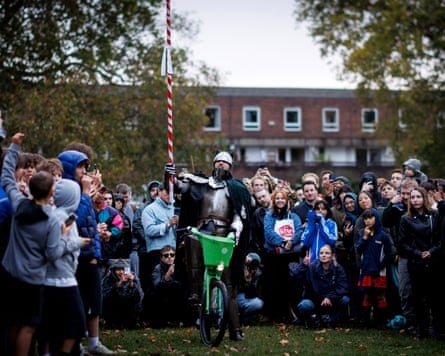
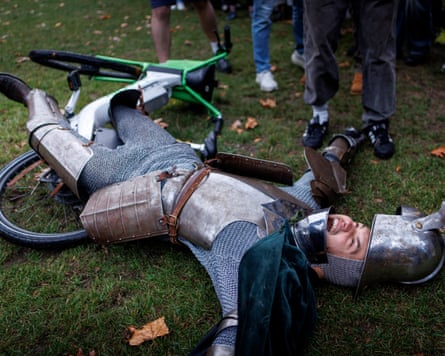
Medieval knights used to joust on warhorses with wooden lances, but this week in east London, two men jousted on Lime bikes with PVC pipes. This contemporary spin on a medieval spectacle is just one example of the spirit of the middle ages erupting into the zeitgeist.
As part of Frieze art fair, the artist Corbin Shaw staged a show called Feast of Fools. The “‘anti-Frieze” Frieze show took inspiration from a medieval festival where, as Shaw put it to GQ, “the peasant class could insult the rich”. In the video for Troye Sivan’s latest song, Party, the Australian pop star postures as a medieval knight.
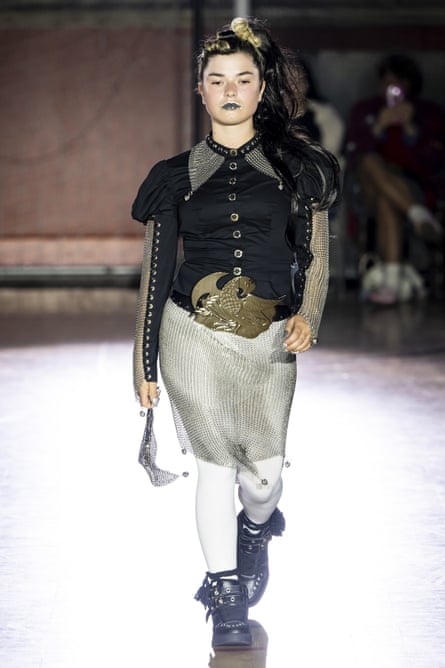
On catwalks at Givenchy, Louis Vuitton and Max Mara, from wimples to chainmail, it’s been called “medievalcore”. In the new film The Uprising, actor Andrew Garfield has been leading the rabble in Paul Greengrass’s retelling of the Peasants’ Revolt. Sports Banger, the political collective that makes punchy T-shirts, has offerings that read: “Peasants’ Revolt 1381. Let’s finish the job”.
Why is the medieval era being mined by contemporary culture? Simon Trafford, a senior lecturer in medieval history at the University of London Institute of Historical Research, says “it’s always there”, but it’s more “a matter of which particular bit of it we decide to borrow from at any one time”.
“Some of the way modern artists and fashion designers are using the medieval is focused on joy and playfulness,” says Marion Turner, a professor of English literature and language at the University of Oxford. They’re not, she adds, “saying: ‘This is what I actually think the medieval world was like.’”
Bridget Dalton, a semiotician and cultural analyst at Truth Consulting, says: “It’s fun. It can be camp and it can be macho and it can be sexy as well.” In the video for Party, a victorious, post-battle Sivan gallops to celebrate with a hedonistic, homoerotic knees-up in a castle. In one piece of choreography, Sivan is used like a battering ram.
Dalton describes another emerging medieval strand as “wenchcore”, which offers “a more acceptable voracious sexuality, the ribald, singing, dancing, drinking, doesn’t-need-to-be-perfect idea of womanhood and of masculinity … more of just whatever goes”. It could be seen as the perfect, medieval-inflected answer to Brat. The middle ages, says Trafford, “gives us a sort of fantasy other space”.

Many buzzy modern ideas feel medieval-tinged: seasonality, an emphasis on nature, folklore and locality, which take on different emphases in our technological, globalised times. Community, is a focal point in much of this contemporary medievalism. The joust in London was geared towards accessibility in the week that Frieze, described by 24-year-old jousting artist Jack Lowden as “expensive and inaccessible”, took place. “So many members of the community came out,” he says.
There’s also an anti-authoritarian streak in medievalism, from Shaw to The Uprising in which a Ploughman takes his grievances to London in a move to restore egalitarianism to 14th-century England. With its own “no kings” moment, Garfield told the Washington Post recently he saw it as “prescient and kind of predictive” of the No Kings movement in the US.
There is, says Turner, an “interesting parallel” in the pandemic. “After the plague swept across Europe, there was massive social change, prompted by population decline, wage rises and new social mobility.” The peasants’ revolt “is absolutely that generation after the plague”. In the UK, in the post-Covid era, “people feel like they just don’t want to put up with what they used to put up with before the pandemic”.
Another parallel could be the advent of printing then versus the advent of the internet and AI now. For Turner, “AI is more extreme in its negative effects, but again there are parallels with the squashing of individual creativity by big technology”.
While rightwing politics often looks back to the middle ages for its own ends, within today’s youth-centric medievalism there’s a reclamation of the symbols of Englishness. As Shaw, whose cult-favourite T-shirt reads “Eng ‘lish’”, told GQ: “I hate the ruling classes of England, but there’s a lot of reasons to be proud to be English, we have to take these symbols back.”
According to Dalton, “watching youth culture embrace the medieval is a way to talk about Britain without flying a St George. It’s a very interesting route to reparative ideas about what it means to be British.”
For Trafford, “you will always be able to cherrypick … the little bits that play to your cause.” Marine Le Pen might be drawing on Joan of Arc as “this massively militant Christian figure”, while “you can definitely find that more friendly, more conducive society if you happen to be a leftwing person.” There’s a medievalism for everyone.
KioskNews shows a cleaned-up reading view extracted from the publisher’s page — the original always lives on their site, not ours.