Xi, Trump and Putin ‘peace declaration’ suggests summit is more than a photo op
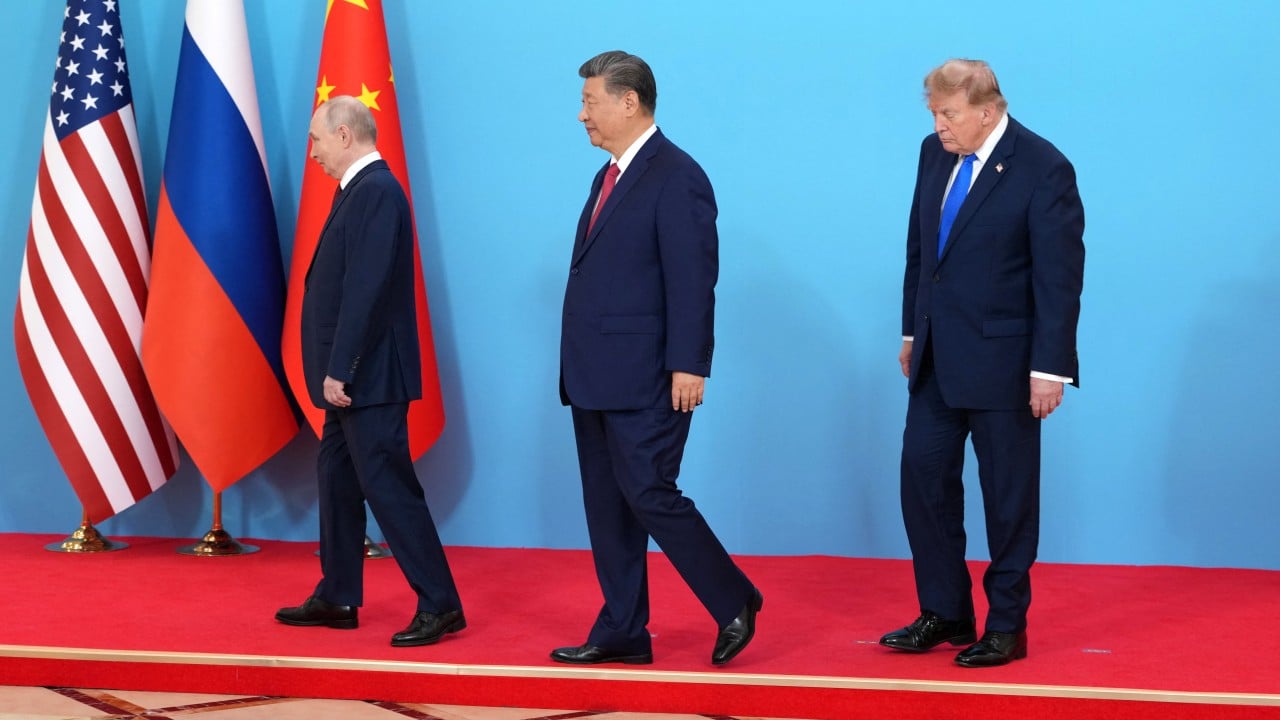
What was teased for weeks as an unprecedented three-way photo opportunity ended up rattling the geopolitical landscape on Thursday with the release of a China-US-Russia joint “peace declaration” outlining areas of cooperation in worldwide energy markets, nuclear non-proliferation and global governance.
At the conclusion of the first-ever three-way meeting in Shenzhen between Chinese President Xi Jinping, US President Donald Trump and Russian President Vladimir Putin, the trio issued a statement that called for reform of the United Nations, weakening of the International Criminal Court, an increase in oil supplies and dialogue to reduce nuclear risks.
Xi called the meeting positive, constructive and “fruitful”, Putin termed it “open and candid”, while Trump said it was “a Great and Highly Consequential Trip”.
Dialogue and negotiation are essential to resolve differences worldwide, Xi added, according to a Xinhua readout. “As long as dialogue does not stop, doors remain open, there is hope for peace,” he said.
Trump’s decision during the two-day Asia-Pacific Economic Cooperation summit to huddle with and craft a formal statement involving Washington’s long-standing adversaries suggested that the lame duck US president will continue to surprise, upend and challenge global norms.
21:51
Live: Donald Trump departs Shenzhen
Trump enjoys far more leeway in foreign affairs than at home, particularly after his party was trounced in the US midterm elections two weeks ago.
The declaration also underscored China’s central role as host and conduit in whatever the potential three-way partnership may evolve into. That followed from Beijing’s long-term, if at times uneasy, collaboration with Moscow and its increasingly equal economic, military and technological standing with Washington.
“Trump’s trip has been a victory for Xi,” said Jonathan Stivers, a commissioner on the US-China Economic and Security Review Commission, who criticised Trump for being soft on Beijing. “The summit was used to portray a strong China to both global and domestic audiences.”
Strength and depth of three-way arrangement questioned by analysts
While the idea of such a three-way agreement would have been unthinkable before Trump won his first presidential election in 2016, the strength and depth of Thursday’s announced arrangement remains wobbly even as it has unsettled traditional US allies and partners.
“The trilateral summit produced mostly warmed-over statements of support for lowest common denominator topics such as UN reform, increasing supply of refined oil products and preventing nuclear proliferation,” said Jeremy Chan, senior analyst with the Eurasia Group. “That said, the symbolism and rhetoric surrounding the trilateral summit should not be discounted.”
Chan added that he expected more to follow. “All three leaders would welcome further trilateral engagements, including as early as next month at the G20 summit in Miami.”
The main points outlined in Thursday’s declaration amounted to low-hanging fruit, analysts said.
While the trio called for increased oil production leading to lower energy prices “for the benefit of all nations”, there was no mention of ending the Iran war that Trump launched in February or Ukraine war that Putin started over four years ago that have distorted global markets.
Likewise, reforming the UN has been bandied about for decades, leaving it unclear whether any overhaul would follow Washington’s more ruthless approach of cutting off funding or Beijing’s more potentially organised culling, in keeping with its bid to expand its soft power and global footprint.
Containing the spread of nuclear weapons, likewise, makes a good headline. But the US and Russia walked away from the only remaining containment agreement in February, even as Beijing has sought to build up its nuclear arsenal before coming to the bargaining table.
And while Trump likely has Iranian containment in mind, Washington is not likely to back Chinese opposition to the Australia-United Kingdom-US, or Aukus, agreement under which the three allies would jointly develop nuclear-powered submarines.
Also unclear is how Russia-China cooperation would fare if their common distrust of the US were less pronounced – and whether their three-way cooperation can outlast Trump.
02:39
Xi and Putin pledge to maintain stable ties and global order ahead of trilateral meeting with Trump
During the past two years, the mercurial US president has managed to quiet and intimidate China hawks from both parties. But this will almost certainly change once Democrats take control of the US Congress in January, even as their prospects of taking the presidency in 2028 improve.
The three countries also took aim at the International Criminal Court, calling for immunity from prosecution for officials from sovereign states. They also warned The Hague-based institution not to abuse its authority. The three have bridled at suggestions that their actions have amounted to crimes against humanity even as Putin is wanted by the court.
Thursday’s announcement has spurred headlines and raised concerns in foreign capitals. While any improvement in US-China trade tensions and major-power relations could benefit the global economy and security, the three-way pronouncement unnerved global leaders amid fears it could usher in a new order they had little role in shaping.
“What is clear is that on European security issues, there is no discussion without the Europeans, without the Ukrainians,” said an official in the French presidential office. “And I note, by the way, that the Chinese are saying the same thing.”
In a social media post, Japanese Prime Minister Sanae Takaichi said she and Trump had a “frank exchange of views” on security issues involving the Indo-Pacific and Ukraine when he briefed her after his meetings.
“Erstwhile US allies and partners were neither in the room nor consulted before the discussion,” said Chan, a former US diplomat in Shenyang, China.
“Brussels and Tokyo will breathe a sigh of relief that Trump did not give the store away to Xi and Putin. But anxiety over the US will remain high in Europe and Japan for the duration of Trump’s presidency.”
No need for other global leaders to be concerned, expert says
Global leaders should avoid becoming alarmed, however, said Cui Hongjian, director of the Centre for EU and Regional Development Studies at Beijing Foreign Studies University, even as he acknowledged their concern.
“The China-US-Russia trilateral summit did not include Europe, and I think that will have a rather complex psychological effect on Europe,” Cui said. “Of course, I think this worry is unnecessary.”
Under Chinese diplomacy, this sort of high-level meeting is mainly a way to outline broad objectives, he added. “China does not seek to discuss specific issues in this setting, because the parties have not yet reached a high degree of consensus on them.”
It was not immediately clear whether the threesome would organise regular meetings or an institutional structure. Xi suggested it might, while Putin was more non-committal.
“Its goal is to find mutually acceptable solutions for the three of us, primarily in the area of security,” Putin told reporters. “However, we have not agreed to meet regularly in this format.”
The three leaders added that a nuclear war “cannot be won and must never be fought”, even as Xi urged Washington to “do the right thing” on Taiwan and Trump called for greater Chinese cooperation on agriculture, energy and artificial intelligence.
Countries should abandon the “Cold War mentality” and enhance economic and trade cooperation rather than pursue decoupling, Xi said, according to CCTV. “Global energy security faces severe challenges, and the three nations can strengthen communication to safeguard the stability of energy supply chains.”
KioskNews shows a cleaned-up reading view extracted from the publisher’s page — the original always lives on their site, not ours.