Coalition of ‘disillusioned’
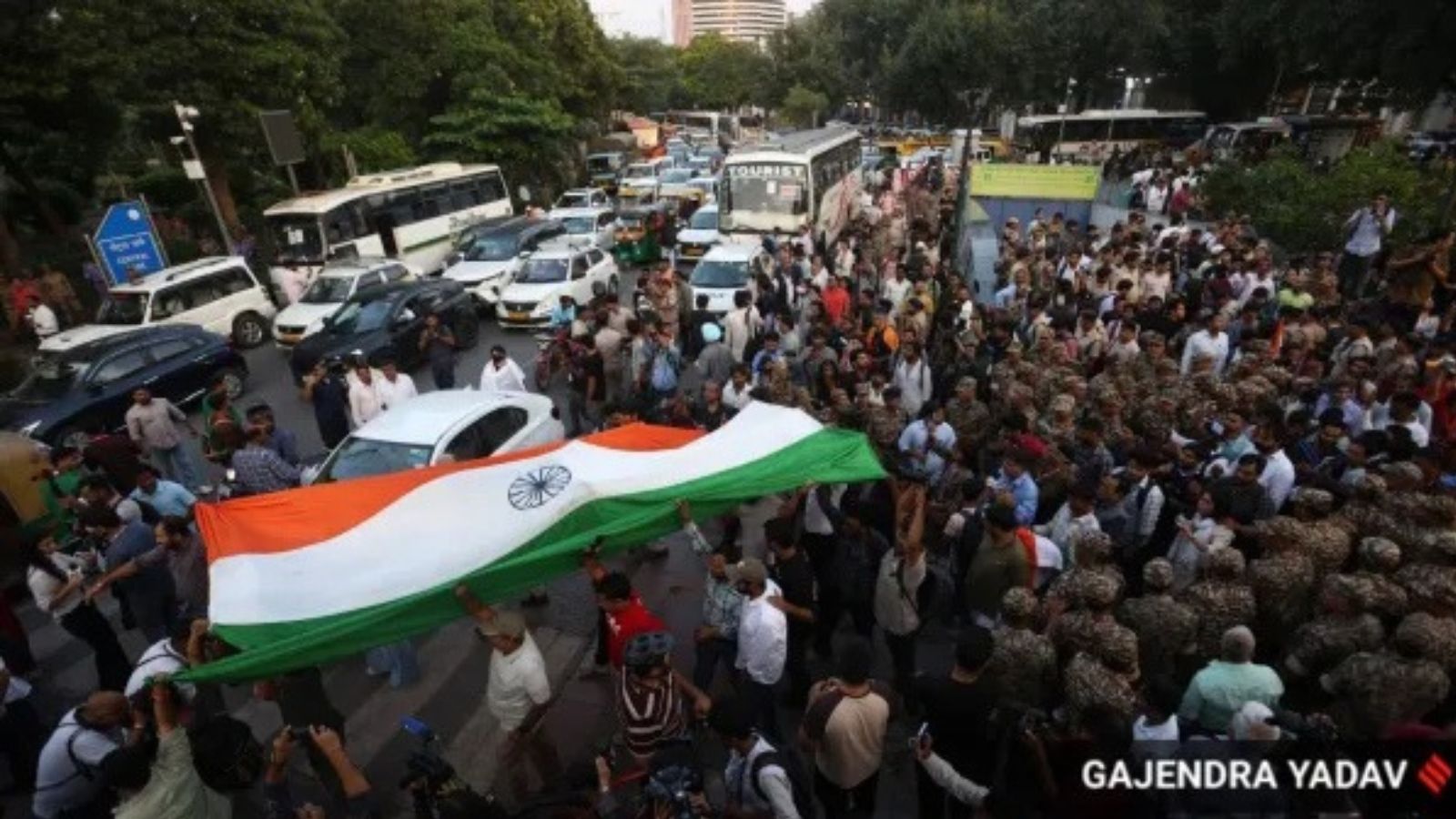
Three months ago, the E20 rage on social media spilled over to Jantar Mantar, with claims that the fuel mix of 20% ethanol and 80% petrol corroded vehicle engines and reduced mileage. The government paused higher blending and even discussed bringing back E10, the 10% ethanol blend, to prevent engine damage in older vehicles.
Then came the CJP protests over NEETcancellation. The crowd at Jantar Mantar on July 20 was a diverse coalition, organic, forcing the government to engage with the CJP. The protesters extracted the resignation of Education Minister Dharmendra Pradhan. The government also turned to Nandan Nilekani, who had held Cabinet rank during the UPA years, to restore credibility in the examination system. Now, protests have erupted against the SIR of electoral rolls, which has knocked 13 crore voters off the draft rolls. The demands are to restore every eligible voter to the rolls, get Chief Election Commissioner Gyanesh Kumar to resign, and rebuild trust in the electoral process.
Removing the CEC is not easy. The Constitution sets a high bar, and the procedure is the same as that for removing a Supreme Court judge. An earlier attempt to remove the CEC in March 2026 failed after a notice signed by 130 Lok Sabha MPs and 63 Rajya Sabha MPs was rejected by the Speaker and the Chairman of the two Houses, respectively.
Technically, the government does not have the power to remove the CEC. But in realpolitik, such technicalities can be overcome, say bureaucrats. The CEC can always resign. The leadership at the helm of the government and the BJP, however, is convinced that Gyanesh Kumar should stay. They know he has gone overboard and been overzealous in his effort to “clean up” the rolls. In talks with NDA allies, the leadership appears to have acknowledged his high-handedness. Yet it continues to dig in its heels. For now, it is throwing its weight behind him. The government and the BJP probably view the nature and strength of the protests in July and those taking place now differently. The July 20 protest was sui generis—unique, a movement of its own kind. The cancellation of NEET was merely the trigger. But young people who feel hopeless for a variety of reasons stepped out to brave the odds. The protests brought together a broad cross-section of society: young people—half of India’s population is under 30—Gen Z, anxious young adults, student unions, LGBTQ+ and queer rights groups, concerned citizens and parent groups, as well as those affected by the cancellation of state recruitment or college entrance examinations.
This was a wake-up call. Frustration over many issues coalesced into one demand: Pradhan’s resignation. The government was spooked. Pradhan quit.
Arvind Kejriwal, Bhim Army’s Chandrashekhar Azad, Sharad Pawar, Mahua Moitra and Shiv Sena (UBT)’s Sanjay Raut all turned up at Jantar Mantar to express solidarity with the youth and the CJP. Their presence was incidental to the larger movement and did not, in itself, seem to worry the government.
The protests against the CEC and the SIR are being viewed by the government and the BJP more through a political prism. The BJP sees shuddhata, or purity of electoral rolls, as integral to its ideology. But can this be achieved without harassing eligible voters?
Also, for the BJP, the Congress’s current democratic fight for an independent and accountable Election Commission sits uneasily with the Congress’s own record. For instance, the Congress fielded former CEC T N Seshan against L K Advani in the 1999 Lok Sabha election. Later, the Congress-led UPA government appointed another former CEC, M S Gill, as a Cabinet minister. In 2009, it rejected CEC N. Gopalaswami’s recommendation to remove Naveen Chawla as an Election Commissioner, only to appoint Chawla as CEC later that year, while the general election was under way. This history fuels the BJP’s resentment, particularly when the Congress speaks up for the independence of Election Commissioners.The government and the BJP believe they can take on the Congress and the Opposition politically over the SIR issue by framing it as a loser’s complaint, presence of the usual Left suspects, and appeasement of illegal immigrants. Hence, their response to the two sets of protesters has been markedly different. They clamped down heavily on the CJP and youth protests on October 10, but allowed the INDIA bloc to gather in large numbers and march in and around Connaught Place on October 12.
At the same time, the detentions last weekend and the daily cycle of protests since then have pushed the government on the defensive. There is a concern that the protests, if left unchecked, may gather momentum and draw into their fold all and sundry who are losing faith in the Viksit Bharat dream. As a government official put it, the youth are “disillusioned”. There are too few jobs, wages are flat, and prices are rising. Anxieties are mounting, stock market gains have evaporated. All this could transform into a “coalition of the disillusioned”. The worry for both the BJP and the government is that this disillusionment and discontent could steadily acquire salience and permanence.
The writer is Managing Editor, The Indian Express. Off the Record is a fortnightly column
KioskNews shows a cleaned-up reading view extracted from the publisher’s page — the original always lives on their site, not ours.