High-tech workers warned of China travel
BEWARE: Professionals traveling to China should consider bringing a dummy phone that does not contain business secrets or sensitive personal information, the MAC said
By Shelley Shan / Staff reporter


Three cases have been reported so far of Taiwanese high-tech professionals who were prevented from returning after traveling to China, the Mainland Affairs Council (MAC) said yesterday.
MAC Minister Chiu Chui-cheng (邱垂正) told lawmakers at the Legislative Yuan’s Foreign Affairs and National Defense Committee that the cases were reported since February, but did not provide further details.
Democratic Progressive Party (DPP) Legislator Chang Hung-lu (張宏陸) said China’s new regulations governing the entry and exit of personnel, which took effect in September, authorize immigration officers to inspect data stored on travelers’ electronic devices.
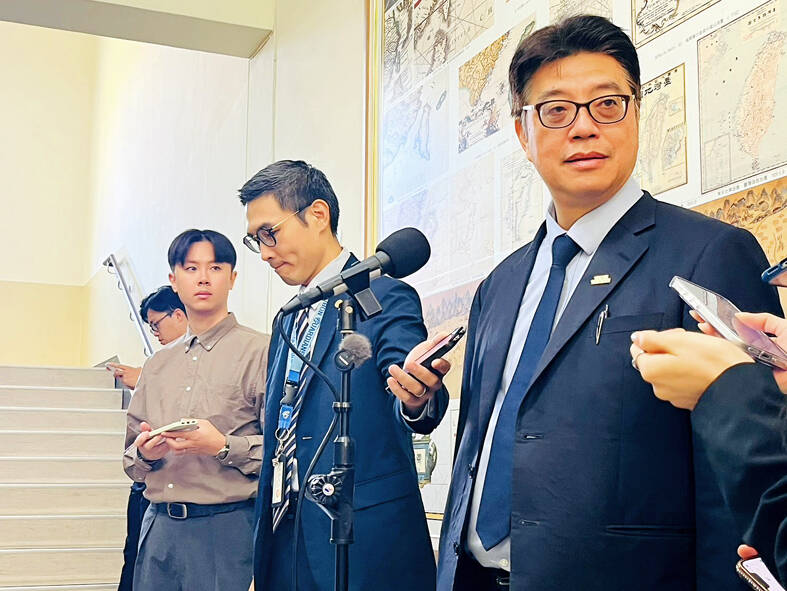
Mainland Affairs Council Minister Chiu Chui-cheng, right, answers questions from reporters at the Legislative Yuan in Taipei yesterday.
Photo: Chen Yu-fu, Taipei Times
China could gain access to sensitive information simply by enforcing the regulations, Chang said.
“It has taken years for Taiwan to become a key player in the world of technology. The government should raise awareness among publicly listed and over-the-counter companies about the risks,” he said, adding that many small and medium-sized enterprises do not understand the seriousness of the issue.
Chiu advised high-tech professionals traveling to China to bring phones that do not contain business secrets or sensitive personal information, or to consider holding video conferences instead.
“They should avoid going on business trips to China, as there are still risks and uncertainties involved,” he said.
Meanwhile, Chiu told Taiwan People’s Party Legislator Hsu Chung-hsin (許忠信) that Alice Huang (黃樂) — an alleged Chinese spy targeting Nvidia CEO Jensen Huang (黃仁勳) — had visited Taiwan three times in 2024 and five times last year, citing National Immigration Agency records.
There was no record of her entering Taiwan this year, he said.
“Alice Huang applied to enter Taiwan as a businessperson from Hong Kong. She was not flagged at the time and was allowed to enter as a business traveler. Now that the government has obtained relevant identity information, we will subject this person to closer scrutiny ... if her entry were deemed to compromise national interests, endanger public safety or disrupt public order,” Chiu said.
At a news conference yesterday, MAC Deputy Minister Liang Wen-chieh (梁文傑) was asked when the government first became aware that Alice Huang might pose a national security threat.
He was also asked whether the US had issued warnings to Taiwan or provided information about Alice Huang, and whether Hong Kong and Macau residents would face stricter screening when applying to enter Taiwan.
Liang said that the council had not received any information concerning Alice Huang and could neither confirm nor deny reports that she was a spy.
He said the council was more concerned about systemic issues, including whether Taiwan’s export controls on high-tech products had loopholes, whether such products had been exported through improper channels, whether the loopholes could raise concerns in the international community and undermine international confidence in Taiwan.
KioskNews shows a cleaned-up reading view extracted from the publisher’s page — the original always lives on their site, not ours.