Summer’s loudest insect is coming. It could save us from a deadly crisis
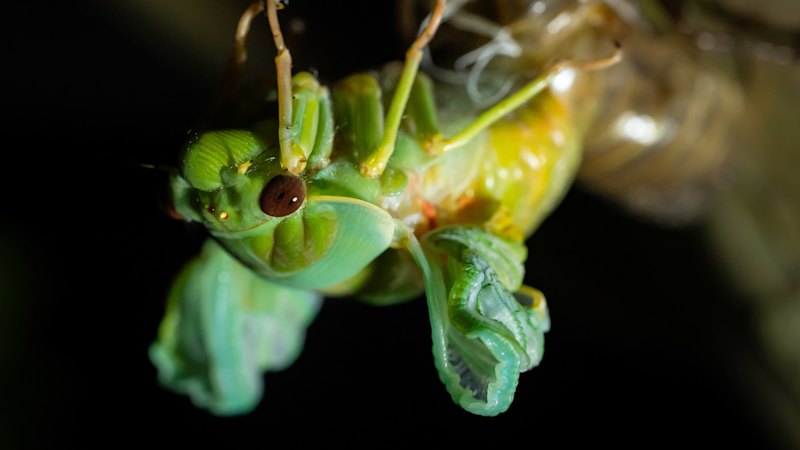
It’s the most vulnerable and dangerous event in a cicada’s life.
After years underground, the insect’s thick body bursts backwards from its subterranean armour and the scrunched, fleshy, feeble wads on either side of its body begin pumping with hemolymph – yellow insect blood. Over hours, they inflate and harden into powerful wings.
These wings are critical to a cicada’s short life and the male’s hell-raising quest to find a mate. That’s why the creatures have evolved an adaption that minces bacteria alighting on their wings.
No chemical or antibiotic is required – it’s the structure of the wings themselves that kills microbes.
The Australian discovery that cicada wings can kill bacteria on contact has led to a flurry of research pursuing new ways to prevent disease in these dangerous days of antibiotic resistance.
About 5 million deaths a year are associated with drug-resistant infections as bacteria evolve to evade current medicines, and pharmaceutical companies baulk at backing new antibiotics because they’re not profitable.
In the ongoing arms race between people and bacteria, scientists are looking to bold new ways of busting bugs. And it turns out the roar of cicadas each summer may just be a battle cry in favour of humans.
Killing without chemicals
Australian husband-and-wife research duo Dr Gregory Watson and Dr Jolanta Watson, from University of the Sunshine Coast, discovered this incredible property of cicada wings more than a decade ago.
They became intrigued by the fact the wings of dead cicadas didn’t seem to be contaminated or consumed in the same way as their bodies. They decided to study the wings under an atomic force microscope, which reveals the world in nanoscopic detail.
The wings, they found, were covered by extremely tiny rods called “nanopillars”. Working with an international research team, the Watsons discovered these nanostructures shred microbial membranes by stretching and tearing cell walls, spilling bacterium’s guts on contact.
This extraordinary structure makes a cicada wing as hospitable to a bacterium as a bed of nails is to a bubble. It was one of the first natural surfaces discovered that could kill bacteria. The hunt soon began for a way to replicate these invisible structures for biomedical use.
“What we’re trying to do now is translate the discovery from the lab to the real world – and that’s always a challenge,” says Distinguished Professor Elena Ivanova of RMIT University, a nanobiotechnologist who has collaborated with the Watsons.
“We are still working on upscaling, trying to develop new nanofabrication technologies to make exactly the pattern which will kill bacterial cells,” she says.
In 2022, Ivanova and a Japanese-Australian research team announced they had developed a lab-made texture inspired by insect wings that could be transferred onto plastic, and one day used in antibacterial food packaging. The material killed up to 70 per cent of bacteria on contact.
In 2023, her group developed a surface of tiny titanium spikes, inspired by insect wings, that could be etched onto implants, such as replacement hips, to defy infection. When tested against multi drug-resistant Candida – a fungus that often inflicts infections in hospital – half the fungal cells died. The other half were damaged and unable to cause infection.
Ivanova is aiming for total eradication. And there’s no evidence yet, she says, of microbes out-evolving the killer surfaces.
“We showed that in our original paper on cicada wings that the cells of Pseudomonas aeruginosa could be killed in just 15–20 minutes, which means that the cell is rupturing so fast that it doesn’t have an opportunity to adapt,” she says.
Ancient fossils, new technology
Curator of paleontology at the Australian Museum, Dr Matthew McCurry, joined the effort to investigate the nanostructures after discovering them fossilised in ancient cicada wings.
In 2022, he and his colleagues announced they had detected the antimicrobial structures on remarkably well-preserved wings in McGrath’s Flat, near Gulgong in NSW, dating back 11 to 16 million years.
“Now I’ve become interested in these structures more broadly,” he says. “I’m sampling across many different cicada species from around the world to see if there’s any variation in these microstructures.”
Just this week, McCurry started scanning the first of 50 to 60 different cicada species. The wings are sprayed with an ultra-thin (three nanometres thick) coat of platinum and placed under a scanning electron microscope, which needs a conductive surface to work.
The unique design of each species’ bacteria-killing wings are then revealed.
“This is important because people are trying to replicate these antimicrobial surfaces for use in hospitals,” McCurry says. “I think it’s useful for us to know the breadth of diversity of morphology that is around in cicadas … maybe it’ll help us to better design those surfaces.”
Insect wings in your mouth
Drawing from different species has already paid dividends in previous research. Cicada wings, for example, are effective against gram-negative bacteria, which have thin, elastic membranes, but are not so effective against gram-positive bacteria, which have stronger cell walls.
“Golden staph cannot be killed on cicada wings because the stress which is imposed on Staphylococcus cells is not enough. They’re very rigid,” Ivanova says.
Dragonfly wings, however, have sharper nanopillars and are better at busting the thicker-walled gram-positive bacteria. Ivanova and her colleagues have managed to recreate the texture on strips of black silicon, “the first synthetic analogue of dragonfly wings, which is highly bactericidal against different cell types”.
The Watsons have also shown gecko skin kills bacteria, and US scientists are looking to create fabrics based on the infection-repelling denticles of a mako shark’s hide.
Ivanova’s current focus is crafting dental implants with insect-inspired antimicrobial textures on their surfaces.
“We are trying to eliminate all bacterial contamination on the implant, which is extremely important, particularly if you consider our ageing population or immunocompromised people,” she says. “And our mouth is the first entry for all the bugs.”
The Examine newsletter explains and analyses science with a rigorous focus on the evidence. Sign up to get it each week.

KioskNews shows a cleaned-up reading view extracted from the publisher’s page — the original always lives on their site, not ours.