NP View: Mark Carney has delivered little. It’s time he answered for that
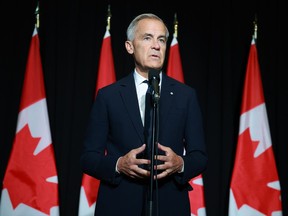
Mark Carney has been a “wartime” prime minister for all of his 18 months on the job. He has been astute enough that trade conflict with the United States has bolstered his support in Canada with the prime minister fully wrapped in the flag.
Sign In or Create an Account
To question Carney’s actions or motives at such a time is seen as treasonous in some quarters yet it is precisely because of the immense power and support now resting with the prime minister that questions should be asked. Canadians have put their faith in Carney and it is only right and proper to ask whether that faith has been misplaced.
A new Angus Reid poll shows the prime minister is so popular that should an election be called, the Liberals would win by a landslide. And yet all we have is a tariff war with Donald Trump.

The National Post newsletter that doesn’t hold back, giving readers the unvarnished truth on media, politics and culture.
By signing up, you consent to receive the above newsletter from Postmedia Network Inc.
A welcome email is on its way. If you don't see it, please check your junk folder.
The next issue of Right? will soon be in your inbox.
We encountered an issue signing you up. Please try again
Apart from “Elbows Up,” one of the prime minister’s main themes has been: build big, build bold and build fast. Paradoxically, to achieve that aim he instituted another layer of bureaucracy with the Major Projects Office. The Building Canada Act was passed last year with the purpose of streamlining federal regulatory processes but, as the C.D. Howe Institute pointed out this week, it is just another hurdle to overcome.
“None of these mechanisms address the fundamental sources of uncertainty in Canada’s regulatory system: political decision-making over individual projects and open-ended criteria that require regulators to consider broad public policy objectives,” says the C.D. Howe analysis.
The new “streamlined” system didn’t work for Saskatchewan-based potash giant Nutrien, which chose to build a new export terminal in the U.S., almost certainly because of onerous regulations in Canada, a University of Saskatchewan agriculture economist told the CBC.
Canada is not building big or bold and certainly not fast.
The prime minister likes to boast, as he did on Thursday in Banff, where he was attending a two-day cabinet retreat, that the economy is in a “position of strength,” job growth is outpacing the U.S., foreign investment is booming and non-U.S. exports have doubled.
And yet, as Statistics Canada reported earlier this year, Canada continues to underperform the U.S. on the most important economic indicators. When measured by labour productivity and per capita income, Canada is a laggard.
“Considering the importance of productivity growth to long-term improvements in living standards, the relative decline in productivity growth is the principal reason why Canada is falling behind, regardless of how economic performance is measured,” says the C.D. Howe analysis.
Pivoting away from the U.S. is a key strategy for Carney that has allowed Mexico to overtake Canada as the main buyer of American goods: U.S.-Mexico trade reached a record US$94.8 billion in July with Canada second at US$62.8 billion. But a consequence of this strategy has seen Canada reaching out to the likes of the United Arab Emirates and China.
Trade with the UAE would attract billions of dollars in investment, open new markets and create jobs, said the prime minister last year. But this is a country involved in a catastrophic war in Sudan, that stifles internal dissent, and abuses women’s and other human rights.
In January, Carney visited Beijing as part of establishing a new “strategic partnership.” This is the country that imprisoned the two Michaels, has an appalling human rights record and “is the most active state conducting FI (foreign interference) activities in Canada, in scale and scope of activity,” as the Canadian Security Intelligence Service notes.
Walking away from Canada-U.S. trade negotiations might have been the right thing to do at the time and it has certainly not damaged Carney’s reputation. But pivoting away from the U.S. should raise questions for Canadians about our commitment to human rights and the dignity of all people when the government so readily reaches out to countries where repression is so widespread.
The place for such accountability is Parliament. It is objectionable that the prime minister has not recalled the House in this time of crisis. News conferences and videos are not the arena for careful scrutiny of his actions.
Canadians appear to support Carney’s retaliatory tariffs despite the high cost to this country. But Carney should explain to the House — and face questions from the Opposition — on what those costs entail. Trevor Tombe, a University of Calgary economist, expects the poorest Canadians to be hit the hardest by counter-tariffs. At a time when paying the rent and putting food on the table is getting increasingly expensive, should we really be putting added pressure on the poorest among us?
The Opposition would also rightly quiz the prime minister on why the trade deal fell apart. Was it because of Ontario’s auto sector and if so, why is that more important than other industries in Canada?
Canada is changing, more rapidly than we would perhaps like, in ways that are unexpected and with consequences for those least able to endure them. Carney has persuaded a majority of the country to support his mandate of change but his record so far has not been a success.
It’s time for Carney to answer some tough questions.
National Post
Join the Conversation
This website uses cookies to personalize your content (including ads), and allows us to analyze our traffic. Read more about cookies here. By continuing to use our site, you agree to our Terms of Use and Privacy Policy.
KioskNews shows a cleaned-up reading view extracted from the publisher’s page — the original always lives on their site, not ours.