Super-rich cashing in on climate crisis, report finds
The world’s wealthiest people are not just profiting from the polluting causes of climate breakdown, they are also increasingly cashing in on the catastrophic consequences, a study by Oxfam showed.
The global equality organization has found that the richest 0.1 percent of the world’s population are heavily invested in disaster preparedness, recovery and reconstruction — a market that is projected to grow from US$70 billion to US$92 billion a year by 2029.
This gives the planet’s wealthiest and most powerful people a “double dividend” from the climate crisis and, more alarmingly, an incentive to delay or disrupt action to solve the problem, the non-governmental organization said.
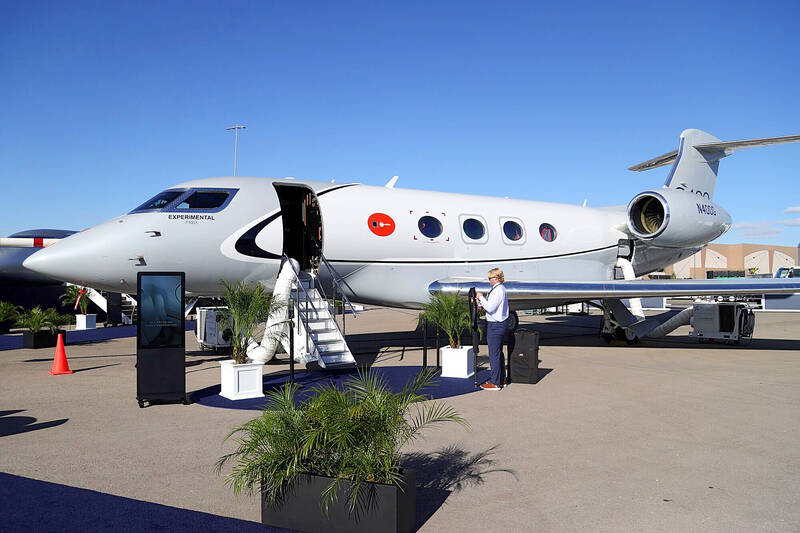
A Gulfstream G400 private jet is pictured during an event at the Henderson Executive Airport in Nevada on Monday last week.
Photo: Bloomberg
It also worsens global inequality as those least responsible for global heating end up having to pay those most responsible in terms of higher food prices, repairing homes damaged by extreme weather or relocating to other areas.
Oxfam chief influencing officer Jean McLean accused billionaires of turning chaos into profit.
“The super-rich benefit at both ends of the crisis: First, through continued investment in polluting industries, and second, through investment in the booming ‘adaptation economy’ — recovery and rebuilding services are sold back to a warming world,” she said. “The populations who contributed least to the climate crisis are absorbing its worst consequences, while those who caused it are best equipped to protect themselves.”
The richest 0.1 percent on the planet, a group of 8 million people, are responsible for more carbon emissions than the poorest 3.5 billion combined, the report says.
As a result, the richest group have reportedly contributed by 125 times more than the average person to extreme heat events.
That is partly due to lifestyles. For example, private jets release more carbon dioxide in two seconds than most of the world’s people emit in an entire year, but the biggest impact of this group comes from their investments.
Oxfam’s new destroy and rebuild index identifies 217 corporations that either fuel climate breakdown or do business in adapting to it through provision of cooling devices, flood barriers, firefighting equipment, transportation, food, insurance and loans.
Last year, these companies made an average of US$1.8 billion and paid out US$1 billion in dividends to shareholders. Six major asset managing firms, which advise wealthy investors, are on this list in their own right and are heavily invested in other members. Two of the biggest, BlackRock and Vanguard, have shares in 92 percent of the companies in the index, worth a total of more than US$1 trillion, Oxfam said.
Similarly, it said that crises — caused by extreme weather or war — have tended to boost the profits of major food trading companies that are dominated by billionaires, whose wealth has increased by US$120 billion since 2020.
When drought, floods or storms hit crops, any subsequent increase in food prices tends to disproportionately benefit big corporations and their investors at the cost of small producers and regular consumers, Oxfam said.
The group cited the case of a 231 percent surge in cocoa prices after extreme weather in west Africa in 2024, saying that local farmers saw none of the gains.
Such inequality has consequences. The annual emissions for the richest 1 percent would cause 1.9 million excess deaths due to heat, Oxfam said, based on estimated impacts on human health, agricultural productivity and sea level rise.
More than three-quarters of those deaths would occur in low and middle-income countries, which are far less responsible for the crisis, because they produce only 8 percent of emissions.
Wealthy nations and wealthy people are somewhat insulated — at least for now — from the climate crisis, because they are more likely to be able to afford higher food prices, robust houses, emergency evacuation, private healthcare and personal security.
That makes them less likely to use their considerable lobbying power to support climate action, and might even encourage them to slow or block emissions cuts that could affect their personal wealth, Oxfam said, adding that instead, some use disasters to push privatization agendas or encourage poor nations to take out loans.
Alex Maitland, one of the lead authors, said the richest people were not just passive beneficiaries of the climate crisis.
“This is deliberate,” he said. “When you take into account their political influence, this is pretty damning evidence that they’re able to orchestrate that is happening.”
Oxfam is demanding higher taxes on the rich, private jets, oil and gas companies, and polluting companies. The group calls on the British government to improve international climate financing commitments based on grants rather than loans, and to end profiteering from climate disasters.
Nafkote Dabi, the climate change policy lead at Oxfam International, said: “What’s complex about talking about climate change is everyone likes to think it’s a shared problem, but it’s not. Addressing the climate crisis is really easy. Control the richest, curb their power, curb their emissions, and also tax their wealth.”
KioskNews shows a cleaned-up reading view extracted from the publisher’s page — the original always lives on their site, not ours.