At Delhi’s Durga Puja pandals, spotlight on legacy, traditions and causes
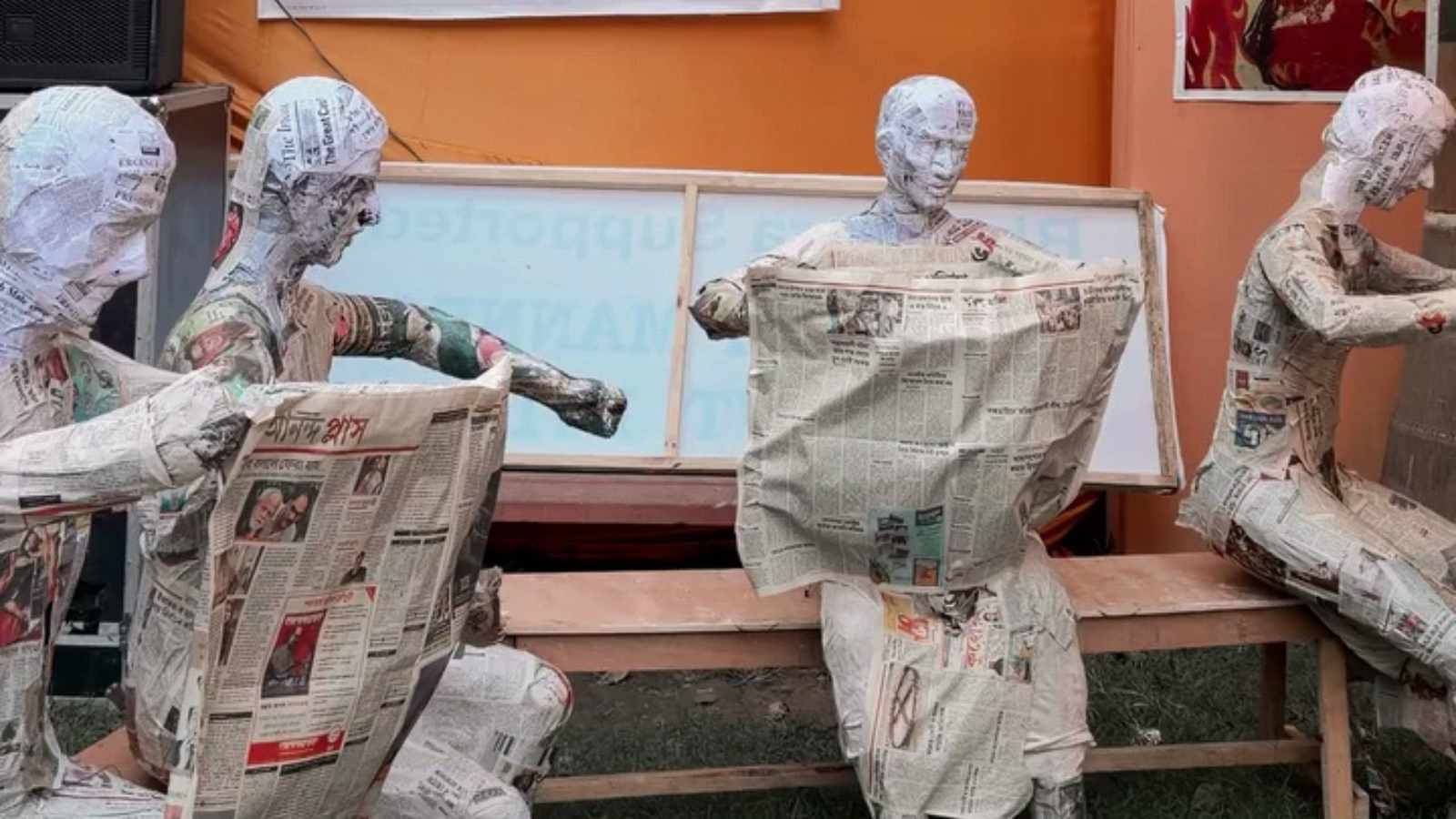
Not just the idol of the goddess but an iconic North Kolkata lane, which has been recreated at Arambagh Durga Puja Samiti’s pandal in Central Delhi’s Paharganj, catches one’s eye upon entry. The “culturally rich” Shyambazar, according to samiti’s chairman, Abhijit Bose, is also close to Rabindranath Tagore’s ancestral home — Jorasanko Thakur Bari.
“We have tried to recreate the same ambiance — the alleys, how a man sits at a tea stall or his balcony reading a newspaper, how the day starts early,” Bose explains.
The lane serves as a window into this year’s pandal theme — “Power of Print Never Fades”, a tribute to newspapers and print culture. Its centrepiece is a printing press.
Describing further, Bose says, “This model of a printing press shows newspapers rolling out, a newsagent sorting copies behind it and a cyclist running to deliver it to every home. We have also added the elements of the typography to showcase how the letters have evolved over time.”
He adds, “A small track plays, opening with the sound of old radio stations and, in places, the Doordarshan news tune. Front pages from the Emergency, Independence and Rabindranath Tagore’s death are on display, some sourced from the Parliament Library and the National Library…… When you enter the pandal, you see how letters are moving into the digital age.”
Bose also recalls evenings from his childhood when people gathered to read the newspaper. “I grew up in Odisha. Our newspaper used to arrive a day late. And to read that newspaper, there used to be a long queue…..Two or three people read a single newspaper together.” He quips that in the current digital age, no one even remembers in the afternoon what the morning news was. “We want to drive the point that digital cannot displace or replace newspapers,” he says.
Bose says the samiti started themed pujas in Delhi-NCR in 2013 and has since taken up many themes, including Bengal’s Jatra folk-theatre last year.
Story continues below this ad
But Arambagh is not the only pandal in Delhi that uses the festival to stir discourse.
At CR Park in South Delhi, two committees — both in their 51st year — have turned to traditional crafts and eco-friendly material to create the pandals and send out a message.
At the Park Mela Ground, Avik Mitra, assistant treasurer of the CR Park Mela Ground Durga Puja Samiti, says this year’s theme is “Mati, Manush, Mohon”.
“Mati” represents the clay of the idol, “Manush” the craftspeople who made the pandal, and “Mohon” means something deeply enchanting. The colour palette follows a red theme. “The palette that we have used is made up of red and white which is inspired from the sarees worn by Bengali women, the Lal Paar Saree (traditional Bengali red and white saree),” he says. There are also touches of dark green. “The dark green color underlines that we are using eco-friendly material,” Mitra adds.
Story continues below this ad
To make the pandal eco-friendly, the decorations are cut from biodegradable foam boards, the idol is made of clay, and the colours on the faces and hands come from fruits and vegetables.
He adds, “The committee feeds almost 8,000-10,000 people a day during community meals. Covering the space with waterproofing material and carpets alone cost us approximately about Rs 40 lakh.” However, sponsorship carries much of the load, he says. The idols are made in the colony, at the Chittaranjan Park Kali Mandir, where a dedicated space is set aside for the purpose.
On the preparation time, Mitra says, “It’s a very long process. We start our meetings like two to three months prior. Then we decide on the budget, then we form a committee wherein every department has people assigned to it.”
At the Durga Puja pandal in K-Block of CR Park, the materials used for the pandal are sourced organically. “We have created the entire pandal with jute and bamboo,” says General Secretary Saurav Chakravarty. “The artisans arrived from villages around Kolkata about a month before the festivities began. “Everything at the pandal is hand-crafted.”
Story continues below this ad
For Chakravarty, the point is to revive crafts that are slipping away. “Everybody has forgotten how to use bamboo. Everybody is now focusing on modernisation. Hence, we want to promote the traditional artisans,” he says.
KioskNews shows a cleaned-up reading view extracted from the publisher’s page — the original always lives on their site, not ours.