Environmental Impact Assessment: Taiwan’s secret symphony
From cricket songs to underwater fish choruses, bioacoustics is revealing Taiwan’s biodiversity and helping scientists track environmental change
By Steven Crook / Contributing reporter


The natural world is a noisy place, but our ears miss much of this soundscape. Because the human hearing range is roughly 20Hz to 20,000Hz, we’re effectively deaf to a vast spectrum of acoustic signals generated by living organisms.
Through high-frequency acoustic messages, insects court mates, warn rivals and express distress. Bats’ echolocation clicks are as high as 120,000Hz. Elephant herds coordinate via low-frequency rumbles. Blue whales and fin whales produce pulses and moans as low as 10Hz, which human ears can’t process.
A handful of scientists in Europe were working on aspects of what’s now called bioacoustics — the study of animal sound production, perception and communication — as long ago as the 1920s, but it wasn’t until 1969 that the International Bioacoustics Society was established to formalize it into a recognized academic discipline.
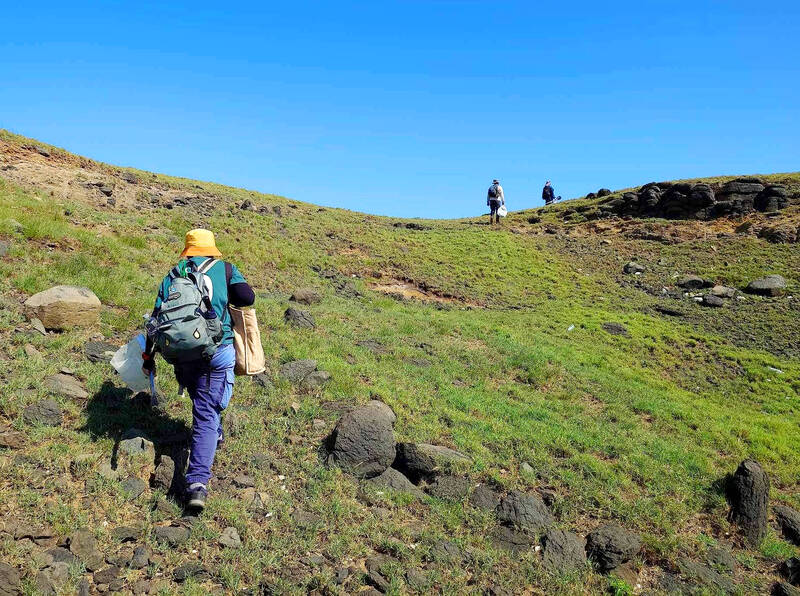
The Back to the Wild team hikes to a survey location on the uninhabited island of Xijiyu in South Penghu Marine National Park.
Photo courtesy of Liao Yi-chang
Among Taiwan-based researchers active in the field is Liao Yi-chang (廖一璋). In addition to being an assistant project scientist at the Department of Entomology, University of California Riverside, Liao runs Back to the Wild Insect Ecosurvey Co, a company that’s conducted bioacoustic investigations at several locations around Taiwan.
Back to the Wild focuses on insect surveys and taxonomy, Liao says. Much of its survey work is funded by the Ministry of the Interior’s Marine National Park Headquarters, which oversees both South Penghu Marine National Park and Dongsha Atoll National Park. Taiwan Semiconductor Manufacturing Co (TSMC) is another source of financial support.
“We also receive smaller grants from local governments to support specific surveys,” Liao adds.
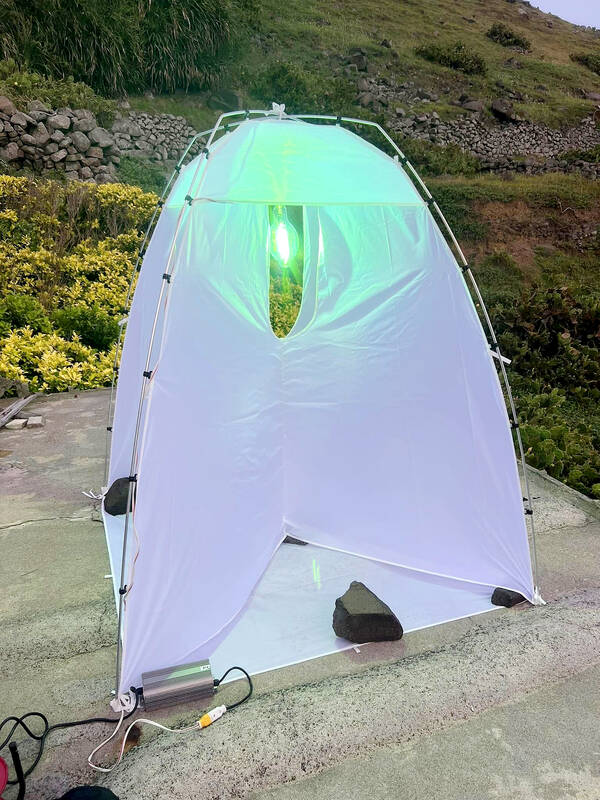
On Dongyupingyu in South Penghu Marine National Park, Back to the Wild used a light trap to collect moths, beetles, crickets and katydids. They brought these insects back to the lab to rear them and record their calls, helping refine their bioacoustic survey methods.
Photo courtesy of Liao Yi-chang
“Mountains and forests are our favorite habitats to survey, but farmland is also an important part of our work,” he says.
Reaching locations deep in Taiwan’s interior often requires hiking, yet Liao says that remote islands are actually more difficult to survey.
“Ferry services are often canceled due to bad weather, which makes it difficult to plan and arrange our field surveys,” he says.
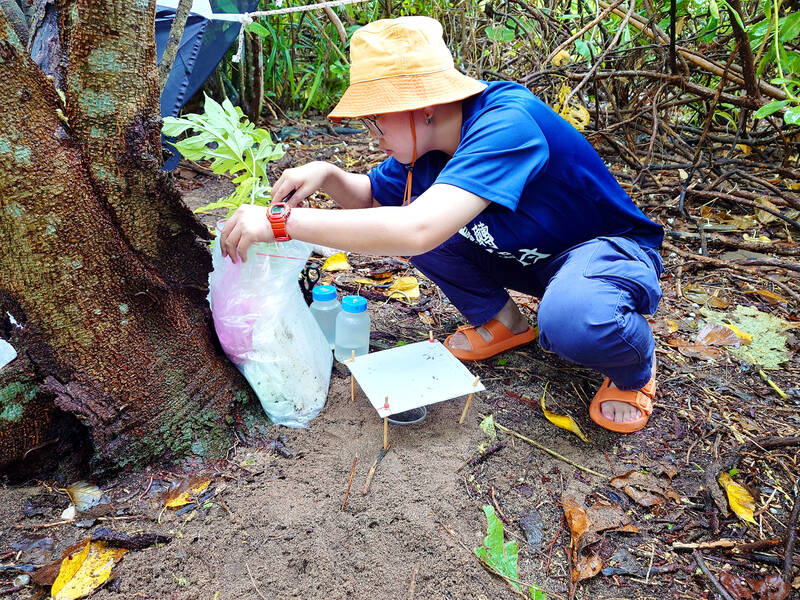
On Dongsha Island, a Back to the Wild researcher sets up a pitfall trap. The white square is a rain cover, under which a plastic cup half-filled with alcohol collects ground-dwelling insects.
Photo courtesy of Liao Yi-chang
Precipitation can cause other problems, Liao says.
“Rain noise can easily overwhelm insect sounds, and insects also tend to produce less sound during heavy rain,” he says.
UNSEEN YET AUDIBLE
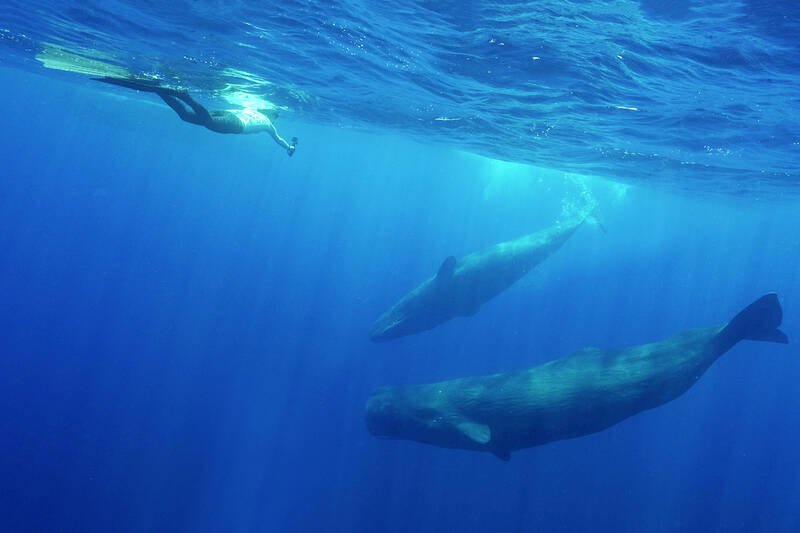
A researcher photographs a sperm whale in this undated photograph.
Photo courtesy of Yan Yu-chun
Occasional frustrations notwithstanding, “we love exploring the insect diversity of Taiwan and discovering what species are out there,” Liao says.
Working on a small island in Penghu County, his team identified the “song” (made by rubbing one forewing against the other) of Teleogryllus oceanicus, a cricket species widely distributed across the Pacific islands but never recorded in Taiwan.
“Finding it in Penghu, just west of Taiwan, suggests there may also be undiscovered populations on Taiwan’s main island,” Liao says.
Asked if he has any dream locations where he wants to carry out a bioacoustic survey, but hasn’t yet had the opportunity, Liao responds: “Kenting National Park is one of them. It’s located in a tropical climate zone and has an incredibly high diversity of insects, including many unique acoustic species.”
Pointing to the number of AI-based tools already available for identifying bird and frog species by sound, Liao says Back to the Wild is now working to develop similar technology for Taiwan’s insects.
The miniaturization of equipment has significantly advanced the field of bioacoustics.
“Many insect survey tools have become much lighter in recent years,” Liao says. “The heaviest piece of equipment is probably the generator for our light traps, but nowadays we mostly use lithium batteries instead.”
Asked whether acquiring the necessary hardware or securing sufficient computing capacity to process audio files consume most of the company’s budget, Liao says that human resources are actually its biggest cost.
“We need people with professional knowledge of insects and who are physically fit enough to handle demanding fieldwork. I have to say, people who are willing to spend so much time exploring the wild are becoming harder and harder to find,” he says.
BENEATH THE WAVES
The rapid expansion of wind energy in the Taiwan Strait has raised concerns over the ecological impact of installing hundreds of turbines in waters that teem with life. Among the region’s crustaceans, fish and marine mammals are rare creatures like the critically endangered Taiwan white dolphin (Sousa chinensis taiwanensis) and the vulnerable Indo-Pacific finless porpoise (Neophocaena phocaenoides).
To evaluate these impacts, scientists first need a reliable baseline — and this is why a five-year recording of fish vocalization (2014-2018) reported in the June 2021 edition of Ecological Indicators is of special significance.
Recognizing that “data on species-specific temporal and seasonal changes are still extremely limited,” the paper’s authors speculated that “the daily and seasonal rhythm of fish chorusing might be influenced by ordinary environmental factors, such as temperature, winds and tides” as well as “extraordinary and episodic events, such as intense sediment transport by strong currents, caused due to flooding events or tropical storms.”
More than a decade ago, scientists confirmed that moonlight and water temperature strongly influence when and how intensely various fish species synchronize their acoustic displays.
The authors of the 2021 Taiwan Strait study report increased fish chorusing during the full and new moon, and that the restart of choruses in early spring and their cessation in winter always took place after a full moon.
When the ocean became colder than 21 degrees Celsius “fish choruses tended to reduce in duration and intensity, and a further decrease in temperatures resulted in a total ceasing of fish calls.”
In 2015 and 2016, fish chorusing occurred until early January. In 2017, however, chorusing activity ceased for the winter as early as November. This shortening of the chorusing period, due to cooler waters, “may affect spawning activity and, thus, fish abundance,” the authors speculate.
The study also details how high-energy events such as typhoons and major storms lead to cessations of or reductions in fish chorusing activity. There are two reasons for this. First, churned sediments reduce the amount of lunar illumination underwater, disrupting visual cues. Second, fish temporarily cease vocalizing when they’re unable to compete with the sheer noise of the storm.
The end of the five-year study coincided with the government’s allocation of 5.5 GW of offshore wind capacity across several sites off Miaoli, Changhua, and Yunlin counties. As of this fall, the majority of these wind farms are either fully completed and operational, or in their final construction stages. Now that an acoustic benchmark exists, years from now we’ll have a better idea if they’ve upset the ocean’s ecological balance.
Steven Crook, the author or co-author of four books about Taiwan, has been following environmental issues since he arrived in the country in 1991. He drives a hybrid and carries his own chopsticks. The views expressed here are his own.
KioskNews shows a cleaned-up reading view extracted from the publisher’s page — the original always lives on their site, not ours.