India's Nuclear Punch: Atom Bombs Backed By Long-Range Missiles
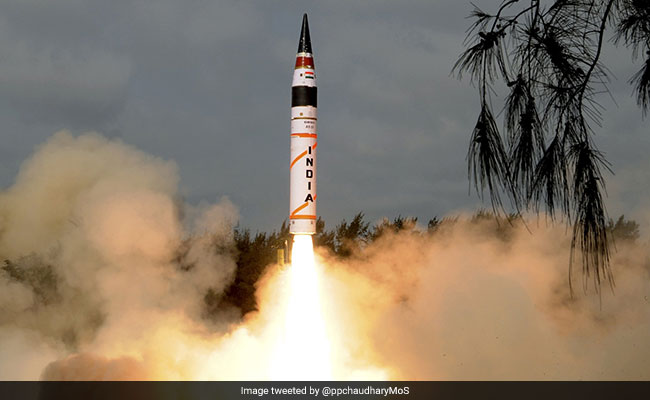
An estimate by overseas scientists suggests that India has about 190 atom bombs, but bombs are no good unless they can be effectively and accurately delivered on the enemy at will and deep inside enemy territory. Not only does India have potent atom and hydrogen bombs, it also has long range missiles to carry out a punishing strike on the enemy.
A new assessment published by the regarded Bulletin of the Atomic Scientists (BAS) says India continues to modernise and expand the systems that can deliver nuclear weapons, even as New Delhi maintains its long standing doctrine of no first use.
The report, authored by Hans M Kristensen, Matt Korda, Eliana Johns and Mackenzie Knight-Boyle, estimates that India may have assembled up to 190 nuclear warheads and today operates a diverse mix of aircraft, land based missiles and sea based systems that together form a fully operational nuclear triad.
The authors underline a crucial point. India never publicly discloses the true capabilities, deployment patterns or actual operational ranges of its strategic weapons. In fact, the report notes that India maintains significant opacity around its nuclear arsenal, making independent assessment difficult. Publicly known ranges are therefore broad estimates and may not represent the full capability of the systems.
READ | 'Weapons Of Peace': A Look At How Many Atomic Bombs India Has
According to the report, India currently fields two categories of aircraft believed to have a nuclear delivery role. The Mirage 2000 fighter, acquired from France and upgraded over the years, remains a principal nuclear strike aircraft. The Jaguar strike aircraft, jointly designed by Britain and France and inducted into the Indian Air Force decades ago, is also assessed to retain a secondary nuclear mission. The report says that the Rafale fighter, also purchased from France, could increasingly assume this role in the future as older Jaguars are retired.
India's airborne nuclear capability stands in contrast to the United States, whose nuclear capable aircraft include the B-2 and B-21 stealth bombers as well as advanced fighter aircraft. China relies on bombers such as the H-6 series and is developing newer long range platforms. Pakistan's nuclear delivery capability rests primarily on fighter aircraft and a growing missile force. India, however, has built a balanced combination of aircraft, land based missiles and submarine launched missiles designed to ensure survivability in the event of conflict.
The backbone of India's strategic deterrent is the Agni missile family, developed largely through indigenous effort by the Defence Research and Development Organisation (DRDO). Unlike countries that benefited from decades of strategic alliances and technology transfers, India had to master a wide range of missile technologies on its own. That journey produced a spectrum of missiles ranging from the short-range Prithvi and Agni-I to the far more capable Agni V.
The report identifies six operational nuclear capable ballistic missile systems. These are the Prithvi II, Agni I, Agni II, Agni III, Agni IV and Agni V. Another missile, the Agni Prime or Agni P, is nearing full operational deployment. Public estimates cited in the report place the range of Agni I at about 700 km, Agni II at more than 2,000 km, Agni III at more than 3,200 km, Agni IV at more than 3,500 km and Agni V at less than 6,000 km.
Using those publicly available range estimates, the Agni V can cover all of Pakistan, the entirety of China, most of Central Asia, large parts of Russia, Southeast Asia, the Middle East and significant portions of Europe if launched from suitable locations within India. The report specifically notes that the longer reach of Agni V allows deployment deeper inside India, farther away from vulnerable border regions.
It also highlights the missile's canister design, which enables a much shorter reaction time.
India's missile force is increasingly sophisticated. The report notes that Agni V has demonstrated Multiple Independently Targetable Re-entry Vehicle technology, or MIRV capability, allowing multiple payloads to be directed toward separate targets. Though the authors estimate the missile would likely carry only a limited number of warheads, the technological achievement marks another step forward in India's strategic capabilities.
The sea based leg of India's deterrent has matured rapidly. The report records the commissioning of the third indigenous nuclear powered ballistic missile submarine, INS Aridhaman, in April 2026. It joins INS Arihant and INS Arighaat and strengthens India's ability to maintain a credible retaliatory capability. Additional submarines are under construction while longer range submarine launched ballistic missiles such as the K-4 are progressing toward broader deployment.
The authors describe India's nuclear triad as operational, consisting of aircraft, land based missiles and sea based deterrent forces. They note that submarine launched systems are essential because they provide survivability during wartime. Nuclear powered submarines can remain hidden at sea for extended periods, ensuring that even after absorbing an attack, India retains the capability to retaliate.
That retaliatory philosophy sits at the heart of India's nuclear doctrine. The report reiterates that India has long adhered to a no first use policy. However, it also notes that India has steadily developed capabilities designed to guarantee an assured second strike. In practical terms, that means India pledges not to initiate a nuclear conflict but reserves the ability to respond with overwhelming force if attacked with nuclear weapons.
Former President and missile scientist APJ Abdul Kalam often used a memorable phrase while describing the Agni series. He famously remarked that the Agni missile could carry not only a strategic payload but also "a bouquet of flowers" to an adversary, a reminder that the technology itself is a delivery vehicle whose significance depends on political intent.
The BAS report arrives in the aftermath of heightened regional tensions. It refers to India's Operation Sindoor against terrorist infrastructure in Pakistan following the Jammu and Kashmir's Pahalgam terror attack in 2025. While the report discusses missile strikes during that operation, it is worth recalling that India has also demonstrated remarkable precision with systems such as the BrahMos missile, showcasing the growing sophistication of its conventional long range strike arsenal.
What emerges from the report is a picture of a nation that has painstakingly built a comprehensive strategic deterrent. Fighter aircraft acquired from abroad such as the Mirage 2000, Jaguar, Sukhoi-30 and Rafale provide one layer. Indigenous Agni missiles form another. Nuclear-powered ballistic missile submarines patrolling the Indian Ocean complete the triad.
No nation publicly reveals the complete truth about its strategic arsenal, and India is no exception. Yet the broad contours are clear. India today possesses not only nuclear weapons but also a robust and increasingly sophisticated family of delivery systems designed to ensure that any adversary contemplating nuclear aggression must reckon with the prospect of a punishing second strike.
KioskNews shows a cleaned-up reading view extracted from the publisher’s page — the original always lives on their site, not ours.