Tripling renewable energy capacity by 2030 may still not be enough to meet climate goals: IRENA chief
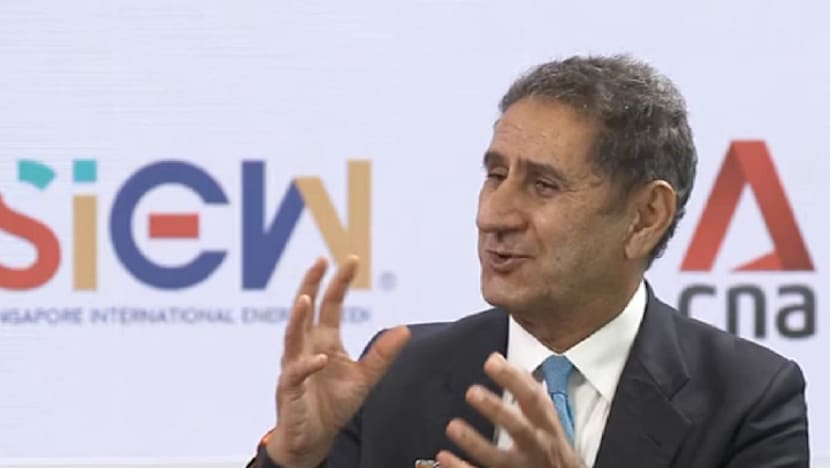
Rising energy demand, driven by changing lifestyles and the growth of AI, is adding pressure to the global energy transition, IRENA chief Francesco La Camera told CNA's Roland Lim.

IRENA chief Francesco La Camera speaking to CNA's Roland Lim. (Image: CNA)
New: You can now listen to articles.

This audio is generated by an AI tool.
27 Oct 2026 03:34PM
SINGAPORE: The world is moving closer to its 2030 renewable energy capacity target, but even achieving that goal may not be enough to meet global climate objectives, the International Renewable Energy Agency (IRENA) chief has warned.
This is because energy demand is growing faster than expected, while progress in energy efficiency continues to lag, IRENA director-general Francesco La Camera said on Monday (Oct 26).
At the COP28 climate summit in Dubai in 2023, countries committed to tripling global installed renewable energy capacity to 11.2 terawatts (TW) by 2030.
“We are getting closer and closer to the (target of) 11.2TW by 2030,” Mr La Camera told CNA on the sidelines of the Singapore International Energy Week (SIEW).
“We will not get there exactly but very close to it.”
However, the original target was based on projections about future energy demand that have since changed.
“The demand has been rising faster because of the change in lifestyle – more heating, more cooling,” he said, pointing to artificial intelligence as a contributing factor.
In recent years, the AI boom has driven rapid growth in energy-intensive data centres, adding to global electricity consumption as demand for computing power surges.
Countries at COP28 also committed to doubling the global average annual rate of energy efficiency improvement by 2030 but Mr La Camera said progress has been slow.
“We have had not very good progress in energy efficiency. This means that the gap between supply and demand has been widening,” he said.
He added that even meeting the tripling target might not be sufficient to keep the world on a pathway consistent with the Paris Agreement’s climate goal of limiting global warming to well below 2 degrees Celsius above pre-industrial levels, while pursuing efforts to limit the increase to 1.5°C.
The agency is working on a roadmap to bring the global energy transition back on track, he said.
RECORD GROWTH FOR RENEWABLES, BUT STILL NOT FAST ENOUGH
Mr La Camera’s warning comes even as renewable energy installations continue to reach record highs.
The world added 692 gigawatts of renewable power capacity in 2025, accounting for 85.6 per cent of all new power capacity installed globally, according to IRENA.
Total renewable power capacity reached 5,149 gigawatts by the end of last year, an annual increase of 15.5 per cent.
Mr La Camera pointed to the continued growth in green energy installations despite successive global crises, including the COVID-19 pandemic, the war in Ukraine and the Middle East energy crisis, as evidence of the transition's resilience.
He added that the upheavals also highlighted the energy security benefits of renewables.
“Now, with all these crises, one after the other, we see that people are relying on renewables, on a decentralised energy system that appears to be intrinsically more secure than fossil fuel,” he said.
However, Mr La Camera stressed that a global shift towards a cleaner energy system would be a gradual process, requiring sustained efforts.
“We are the International Renewable Energy Agency, but we never asked for (completely) phasing out fossil fuel because we know that is impossible to do in the short term,” he said.
CAN RENEWABLES MEET GROWING DEMAND FROM AI?
With AI and data centres driving demand for uninterrupted electricity, questions remain over whether renewables and battery storage can replace conventional gas-fired power generation.
Mr La Camera said they could, pointing to a major data centre in China’s Qinghai province that uses a combination of concentrated solar power, solar photovoltaic systems, wind and hydropower.
He also argued that renewable energy combined with energy storage could be a more attractive option than building new gas-fired power plants.
However, he acknowledged that energy needs and circumstances vary across countries and regions, and that natural gas would still be needed during the transition.
Beyond emissions reduction and energy security, Mr La Camera said the cost of electricity would play an increasingly important role in determining countries’ economic competitiveness.
“What makes the economy competitive? The quality of products, the promotion of products, but also the cost of the electricity that we need for producing the goods,” he said.
KioskNews shows a cleaned-up reading view extracted from the publisher’s page — the original always lives on their site, not ours.