What six failed predictions taught Australia about its future
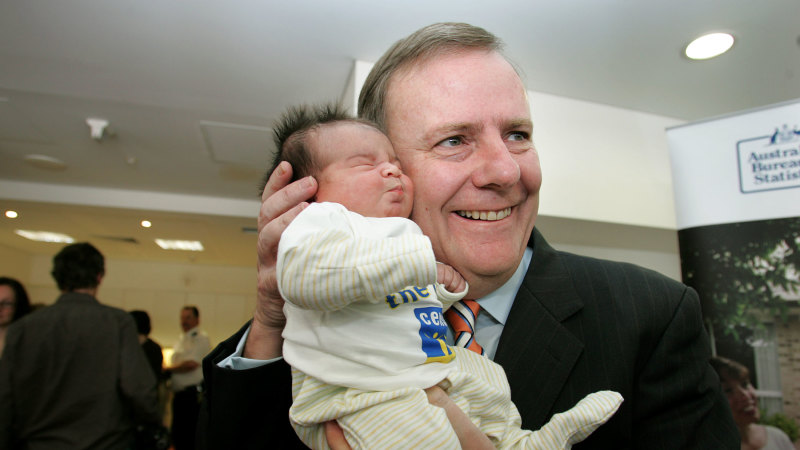
There is one certainty about Jim Chalmers’ upcoming intergenerational report – it will be wrong.
Brimful with huge projections about how the federal budget, the economy and Australian society will look by the mid-2060s, it will outline a future markedly different to what we are experiencing today.
But, like the six previous iterations of this report that was first produced by Peter Costello in 2002, its prognostications are unlikely to be correct. And that is not a problem.
Costello’s idea was to examine the budget’s long-term demographic pressures by focusing on productivity, participation in the workforce and the nation’s population. They remain key to the document.
That first intergenerational report predicted the budget would remain in surplus until 2017 before a demographic tsunami overwhelmed the nation’s finances. In his second report in 2007, the tsunami had been delayed, with surpluses forecast until at least 2022.
But a year later an American investment bank called Bear Stearns collapsed, precipitating what we now call the global financial crisis and a 15-year string of budget deficits.
That’s the danger with making long-term prognostications. Something unforeseen can upend them all.
In his first report, Costello noted that it provided plausible insights into the nation’s fiscal future. “The results indicate a possible future, but within a wide band of uncertainty,” he said.
Costello and every other treasurer – Wayne Swan, Joe Hockey, Josh Frydenberg and Jim Chalmers – who has released an intergenerational report have warned that the nation would eventually face sizeable budget deficits.
Costello’s two reports forecast surpluses before running into deficits that would ultimately hit 5 per cent of GDP. Hockey, Frydenberg and Chalmers never forecast a surplus – just a sea of red all the way out to the 2060s.
While Swan’s 2010 report missed the current deficit, it was the only one to forecast there would be surpluses in 2022-23 and the following year.
Highlighting just how events can throw out forecasts, Frydenberg’s intergenerational report of 2021, compiled during the pandemic, forecast a deficit of 4.6 per cent of GDP for 2022-23. Instead, Chalmers would oversee a surplus of 1 per cent of GDP.
Deficits mean debt. And only the Chalmers report of 2023 – largely because it was so recent – has got close to accurately predicting the current level of net debt.
Swan believed the value of government assets would outweigh its debts to the tune of 5.5 per cent of GDP by 2026-27. Hockey was a little more circumspect, tipping net debt of 5 per cent of GDP for the same year before a rapid improvement.
But political failure – in Swan’s case, an overhaul of mining taxes, and in Hockey’s case, his unloved 2014 budget – coupled with the hit to the government’s finances by COVID and the financial crisis left debt growing far greater than any treasurer had expected.
Getting a grip on the budget’s key spending pressures has also been extremely difficult.
Every intergenerational report focuses on spending on welfare, the health system, defence, aged care and education. Since 2015, the National Disability Insurance Scheme has been included.
The budget’s single largest expense, outside the GST which flows to the states, is the age pension. Here, governments have made unexpected savings.
Costello’s first report forecast that by 2032, the age pension would cost 4.4 per cent of GDP, or about $135 billion. Chalmers’ last report forecast the cost of the age pension at 2.4 per cent of GDP, or less than $80 billion.
The Rudd government’s decision to lift the age pension access age to 67 and the increase in the superannuation guarantee levy to 12 per cent have helped keep a lid on the age pension.
Costello’s first report also expected health spending to reach about $226 billion, or 7.3 per cent of GDP by 2032. Hockey’s 2015 report, following on from his contentious 2014 budget, sliced this to 4 per cent.
One of the reasons for this big fall is the emergence of another expenditure – the NDIS. Costello and Wayne Swan didn’t have to account for it in their reports as it did not exist. Hundreds of billions of dollars that would have once been counted as health spending are now tied to the scheme.
That pressure was finally addressed in this year’s budget with the deep cuts in NDIS spending outlined by Health Minister Mark Butler.
The other area that has caught treasurers is defence. The first three intergenerational reports had defence spending constant at 1.8 per cent of GDP by the early 2030s.
But the geopolitical turmoil of the past decade has forced all governments to increase their expected spend on defence, which in Chalmers’ 2023 report was pushed up to 2.3 per cent of GDP by 2032.
The intergenerational reports do not cover all government spending. While most reference the nation’s interest bill in passing, Chalmers’ 2023 edition noted the pressure this was putting on the budget.
A bonus of Costello’s string of budget surpluses was that they were occurring during a period of higher interest rates on government debt.
The interest on 10-year Australian government bonds is now above 5 per cent. Just ahead of the global financial crisis, they hit 6.8 per cent.
After the crisis and all the way through to the COVID pandemic, government interest rates fell to record lows. That collapse helped protect the budget.
In 2018-19, for instance, the federal government paid $19 billion in interest on gross debt of $542 billion. By 2022-23, when debt reached $890 billion, the interest bill had actually fallen to $18.9 billion.
Those days, however, are over.
Chalmers’ first intergenerational report noted that lower-than-expected interest rates had helped him and previous treasurers. That won’t be a feature of this report, which will have to take into account the spike in government interest rates around the world.
Another issue facing Chalmers, and which has been glossed over since the very first intergenerational report, is productivity.
Costello’s report was released just after the largest lift in global productivity in decades.
Government policy changes were a key driver of this improvement. Tariffs were cut, competition policy overhauled, and stringent industrial relations regulations loosened.
But it was also a period of rapid technological change, the traditional basis for productivity improvements. The most obvious was the advent of the personal computer in workplaces and homes.
That computing power helped businesses improve their operations. The shift to just-in-time inventory management helped reduce costs and lift productivity.
That first intergenerational report assumed this nirvana would continue. It didn’t.
Productivity growth has slumped since that 2002 report, here and in every developed nation in the world. The industrialisation of China, when it became the world’s manufacturing hub, hid the problem for almost two decades.
Every intergenerational report was predicated on a productivity improvement that never materialised.
But the reports have been pretty accurate in something close to everyone’s heart – their lifespan.
Costello’s first report estimated that the average lifespan of a man born in 2022 would be 80.7 years and 85.7 years for a woman.
By 2022, the Australian Bureau of Statistics estimated the lifespans at 81.2 (men) and 85.3 (women).
Even taking account of the COVID pandemic, which reduced average lifespans after a spike in deaths related to the contagion, the original Treasury forecasts have held up particularly well.
The only misstep was the 2015 report, which has average lifespans 82.6 for men and almost 87 for women. This was the report that, at the time, assumed the government’s plan to lift the retirement age to 70 would be in place.
That increase in the retirement age was the first policy dropped by Scott Morrison when he became prime minister.
One of the biggest errors, which has gained a particularly political edge, is the nation’s population.
Costello’s first report forecast that by 2050, the country would be home to 25.7 million people. That mark was reached in mid-2021 (and would have been earlier but for the closure of the national border to deal with the COVID pandemic).
When Swan’s 2010 intergenerational report estimated the population would reach almost 36 million by 2050, it unleashed a debate over a “big Australia” which has run ever since.
Each report is underpinned by an assumption of net overseas migration. Again, these have been wrong, almost immediately.
Costello’s first report was predicated on a net 90,000 arrivals from overseas. The year he released that report, net overseas migration was 110,000.
Five years later in 2007, the migration intake assumption was increased to 110,000. It was actually 244,000.
Swan and then Hockey increased the expected overseas intake, reaching 235,000 in Frydenberg’s 2021 report (and continued into Chalmers’ 2023 version). It was assumed that once the nation’s borders were reopened there would be a short-term surge in migrants.
But as Chalmers and the entire Albanese government are now finding, the short term is looking much more permanent. In 2023, the year of the report’s release, actual net overseas migration reached a record 530,700.
Population growth is not just driven by migrants, but natural increase – births minus deaths – has also been weaker than expected.
There have been fewer births, and more deaths, over recent years than recent intergenerational reports had forecast.
Another issue has been the nation’s fertility rate.
A higher fertility rate benefits the long-term economic forecasts in the budget, increasing the number of potential workers (and taxpayers) and potential consumers.
There had been a lift in the fertility rate of Australian women in the final years of the Howard government and into the Rudd and Gillard administrations. That was baked into the 2010 and 2015 intergenerational reports.
But even as Treasury was expecting a 2010s baby boom, Australian couples were giving up on having children. Both Frydenberg and Chalmers forecast much lower fertility rates, but even they have proven to be too optimistic.
An expected boom turned into a bust, with the nation’s fertility rate at its lowest level on record.
It was just the latest in a series of forecasts, assumptions and prognostications that have failed to materialise.
Yet, that’s not the overall point of the intergenerational report. Every treasurer knew the chances of nailing an accurate forecast were remote.
The aim is to start a conversation about the long-term state of the budget. And that, from Costello to Swan to Frydenberg to Chalmers, has been achieved.
Cut through the noise of federal politics with news, views and expert analysis. Subscribers can sign up to our weekly Inside Politics newsletter.

KioskNews shows a cleaned-up reading view extracted from the publisher’s page — the original always lives on their site, not ours.