UNDP highlights seaweed processing to strengthen Indonesia economy
Jakarta (ANTARA) - The United Nations Development Programme (UNDP) assesses that increasing the value added to seaweed through processing, technology, market access, and investment can strengthen coastal economies while boosting Indonesia's competitiveness.
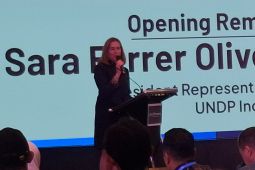
UNDP Indonesia Resident Representative Sara Ferrer Olivella stated that Indonesia possesses significant potential to strengthen its position in the global seaweed industry, moving beyond raw production and export volumes.
"The opportunity lies in shifting from being a leader in volume to a leader in value by mobilizing investment and innovation to create higher-value products, better jobs, and higher incomes," Sara said in a statement on Friday.
The statement followed a visit by an Indonesian government and UNDP delegation to Sidoarjo, East Java, on September 17–18, 2026, to observe seaweed value chain development through the Archipelagic and Island States (AIS) Forum.
Data from the Ministry of Marine Affairs and Fisheries (KKP) shows that Indonesia's seaweed export value reached US$315.62 million in 2025, accounting for 5.0 percent of total national fishery product exports.
National seaweed production reached 11.65 million tons, representing 63.29 percent of total national aquaculture output in 2025.
UNDP noted that Indonesia accounted for approximately 69 percent of global seaweed exports in 2025, primarily supplying tropical seaweed varieties such as Gracilaria.
Sidoarjo serves as a key example of value chain development, where coastal ponds affected by the 2006 Lapindo mud eruption have been rehabilitated to cultivate Gracilaria seaweed alongside milkfish, restoring economic productivity to underutilized areas.
During visits to the Tlocor cultivation site and the Agar Makmur Sentosa Cooperative, the delegation observed harvesting, drying, cleaning, and pressing operations aimed at enhancing post-harvest quality and farmer skills.
Indonesian Deputy Foreign Minister Arif Havas Oegroseno emphasized that blue economy development must balance economic benefits with marine ecosystem protection.
"For Indonesia, the ocean is not merely a source of economic opportunity but also a vital part of our identity, food security, and the livelihoods of millions of people," Havas said.
To address challenges in productivity, infrastructure, financing, and market access, the UNDP and the Indonesian government are developing the Indonesia Seaweed Investment Partnership (ISIP) to mobilize investment and foster sustainable growth across the seaweed sector.
Related news: Australian biotech company partners with Indonesia on seaweed supply
Related news: Indonesia gains US market edge as seaweed tariff drops to zero
Translator: Aria Ananda, Yashinta Difa
Editor: Rahmad Nasution
Copyright © ANTARA 2026
KioskNews shows a cleaned-up reading view extracted from the publisher’s page — the original always lives on their site, not ours.