As Singapore moves to ease academic pressure, why are parents more stressed than ever?
SINGAPORE – For years, Evonne Chia resisted the idea of sending her daughter for tuition or enrichment.
While her friends enrolled their pre-school kids in extra classes, Chia, a 48-year-old property agent, and her husband chose to let their daughter play after school every day.
This changed when her daughter entered Primary 1. The seven-year-old struggled with her subjects, often crying over spelling despite her parents’ best efforts to help.
Watching her fall behind, Chia began to worry. “My kid felt very stressed. I also started feeling the stress,” she said. “So I started her on tuition and enrichment as much as I didn’t want to.”
Like Chia, more parents in Singapore are feeling more anxious than ever, despite the system’s reforms to reduce the focus on grades and examinations.
A 2026 study by the Institute of Policy Studies (IPS) found that more parents are worried about whether their primary school-going children will fall behind in the long run.
Seven in 10 said they would spend more on tuition and enrichment, with about half citing peer pressure as a reason for sending their children for extra classes. Yet nearly nine in 10 agree that children here spend too much time on such activities.
Over the past decade, Singapore has replaced precise numeric PSLE scores with broader achievement bands and removed mid-year examinations, among changes to move away from an over-obsession with academic performance.
But the competition has not disappeared. Instead, it may have taken on new forms, extending beyond examination results to the pursuit of non-academic talents.
Behind this lies a more fundamental anxiety: In a rapidly changing world, how can parents be sure they are doing enough to prepare their children for the future?
Rising affluence coupled with economic uncertainty have a part to play.
Sharon Koh, deputy director and principal therapist of non-profit organisation Counselling and Care Centre, said parental stress can increase with affluence, as parents feel pressure to do more and exercise more control.
Affluence can create more options, but more options can also lead to more anxiety, said Theresa Pong, founder and counselling director of The Relationship Room.
“When there are many possible pathways and resources available, parents can feel that they should be making the ‘right’ choices at every stage,” she said, adding that the abundance of information also makes it easier for parents to compare with others.
Koh said AI disruptions and resulting retrenchments can cause parents to worry about job stability.
Parents are preparing their children for a future that they themselves cannot fully predict, said Pong.
“This can lead to what I sometimes see as anxiety-driven parenting – not necessarily because parents are overly ambitious, but because they are afraid their child may be left behind,” she said.
Social media also adds to the demands of modern parenting.
Property agent Ken Tay, 40, fears that his nine-year-old son and six-month-old daughter will be exposed to harmful content, online scrutiny and body image pressures on social media.
Tay also does not want his son to become a “phone zombie”.
Even the recent reforms intended to make school life less stressful can make some parents uneasy.
With hardly any homework and no examinations until Primary 3, Chia fears that the lower primary years do not build strong enough foundations to prepare children for the demands of the PSLE.
“I would rather the child be stretched a little bit more every year, than suddenly being thrown into the deep end,” she said.
Strategic account manager Jolene Pang, 39, said the uncertainties that come with the changes in the school system, coupled with what she perceives to be a more challenging primary school syllabus, are her main causes of stress.
“When parents put up exam questions on social media for others to help with, many are so challenging even for adults to answer,” said the mother of two. “It seems like the exam questions involve wordplay rather than logic.”
The pressure has also shaped where her family lives. She moved her family from Queenstown to a rented home in one-north for two years, bringing them within a primary school in Dover she had her eyes on for her older child.
She values the school’s affiliation with a secondary school, which she hopes could give her children a “head start” and potentially allow them to grow up with the same friends.
Competition spreading beyond grades
The IPS study researchers – principal research fellow Mathew Mathews, research fellow Melvin Tay and senior research fellow Teo Kay Key – said the removal of certain assessments may have eased some immediate pressures, but parents are still managing a wider set of concerns.
These include whether children are keeping up, developing holistically, building relevant skills and remaining competitive for the future.
“In this sense, educational competition may have diversified rather than disappeared, moving into tuition, enrichment, school choice and alternative admissions routes,” the researchers said in their report.
This comes with a hefty price tag for some families.
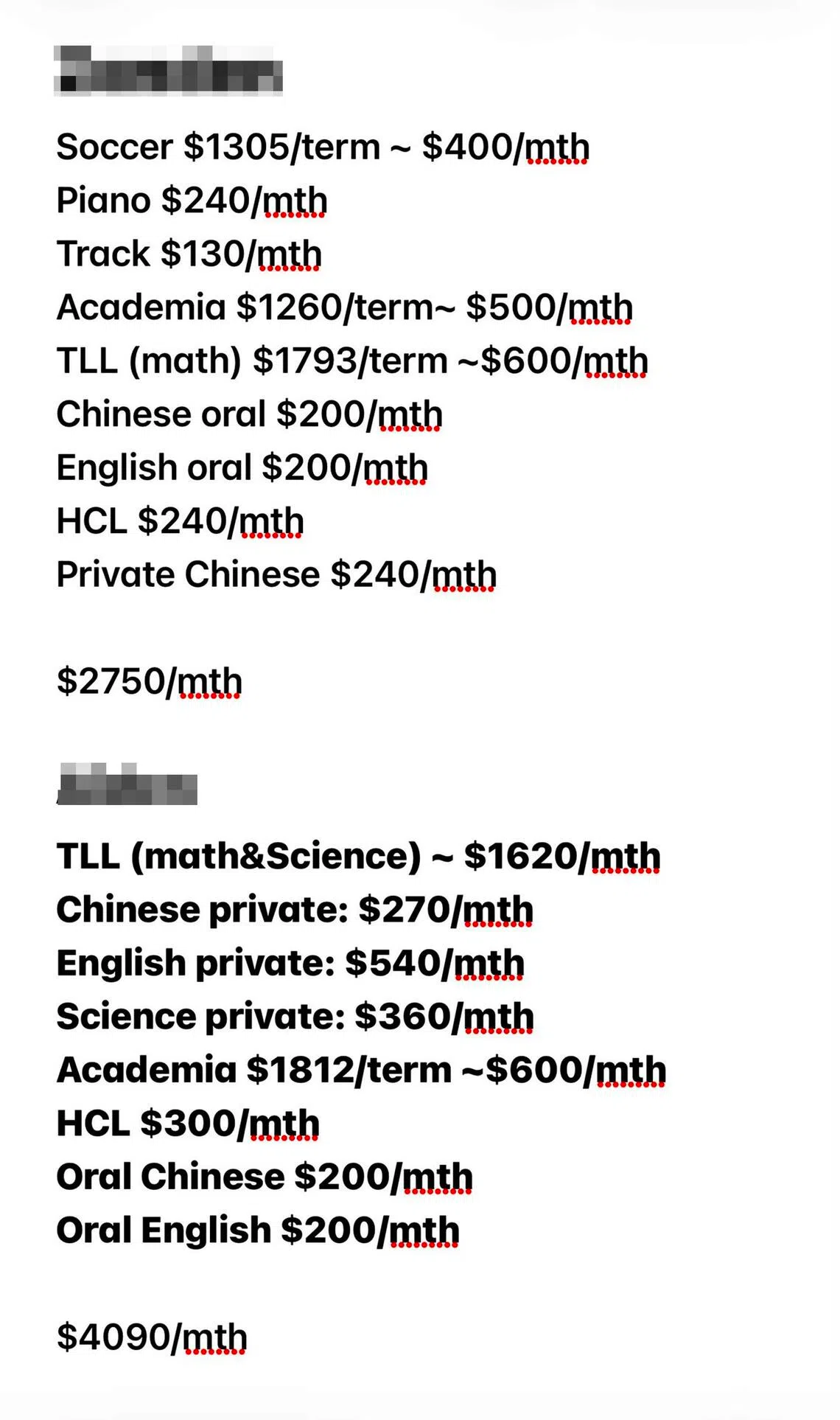
In 2026, Carolyn Ang, 41, who works in the banking industry, spent about $6,800 a month on tuition and enrichment for her two sons.
About $4,100 of that was for English, Chinese, mathematics and science tuition for her older son, 12, who sat the PSLE in 2026. Roughly $2,700 went towards sports, music and tuition for her younger son, 10.
“It’s not easy for them to (follow) the syllabus, so I think they need extra help… We just outsource,” said Ang, who considers tuition necessary given the demanding curriculum, especially with both parents working full-time.
She had never tallied her spending until recently. “That’s when I realised it was a bit shocking. I didn’t realise I spent that much,” she said.
Ang hopes her children can perform “above average” to enter a better secondary school, and seeing his friends attend tuition prompted her older son to ask for more lessons.
“Regardless of the price of tuition... So long as it helps, we will want our kid to be there. We want our kid to get the best,” she said.
Yet Ang said she does not worry excessively about their future, knowing that much of it is beyond her control. Instead, she and her husband focus on working hard so they can financially support whatever paths their sons choose, including studying overseas.
In 2026, financial executive Carolyn Ang spent about $6,800 a month on tuition and enrichment for her two sons.
PHOTO: COURTESY OF CAROLYN ANG
The Direct Schools Admission (DSA) exercise is also an area of competition, said Pang. The scheme, which was introduced in 2004, is meant to recognise students’ non-academic talents as a pathway to secondary schools.
She has heard of parents identifying external coaches in performing arts like ballet or sports like gymnastics, who also sit on the DSA selection panel for some top secondary schools, and enrolling their children in private centres to be trained by these coaches.
Even the early schooling years are not spared, with parents comparing enrichment programmes by government-funded pre-schools with those offered by more expensive private pre-schools, while places at some tuition centres can be difficult to secure.
“There’s a queue to get into competitive centres like Berries,” said Pang.
Preparing children for an uncertain future
Mathews, the IPS study’s lead researcher, said parents’ anxieties are shaped not only by what happens in schools, but also by broader uncertainties about their children’s future in a competitive economy.
Pang said she worries about the impact AI and technology will have on her children’s jobs in the future.
“With AI, everybody’s job is at risk. Parents feel it now, what more for their children,” she said.
She enrolled her son and daughter in a robotics trial class in 2026 as they were keen, but did not continue because of the complex curriculum and high cost – $1,080 for 12 sessions a child.
This left her thinking about the gap between families with the means and resources and those who cannot afford such opportunities.
Quah Saw Han, principal clinical psychologist at Community Psychology Hub, advises parents to focus on protecting their relationship with their children, and focus on what matters most.
Apart from academic outcomes, she encouraged parents to recognise children’s strengths and weaknesses, and give them room to fail and learn.
“It’s not about needing to get to the destination in the quickest possible time,” said Quah. “I’m all for having expectations, but do we need to get there in a hurry?”
With Chinese tuition now, Chia’s eight-year-old girl no longer cries over ting xie (Chinese spelling). Still, Chia hopes not to measure success with exam results.
She wants her daughter to develop critical thinking and problem-solving skills. “I don’t have an expected result for her. As long as she does her best, she doesn’t give up, she perseveres, I’m happy.”
KioskNews shows a cleaned-up reading view extracted from the publisher’s page — the original always lives on their site, not ours.