Expert Explains | Can India and Bangladesh reset ties under Tarique Rahman?
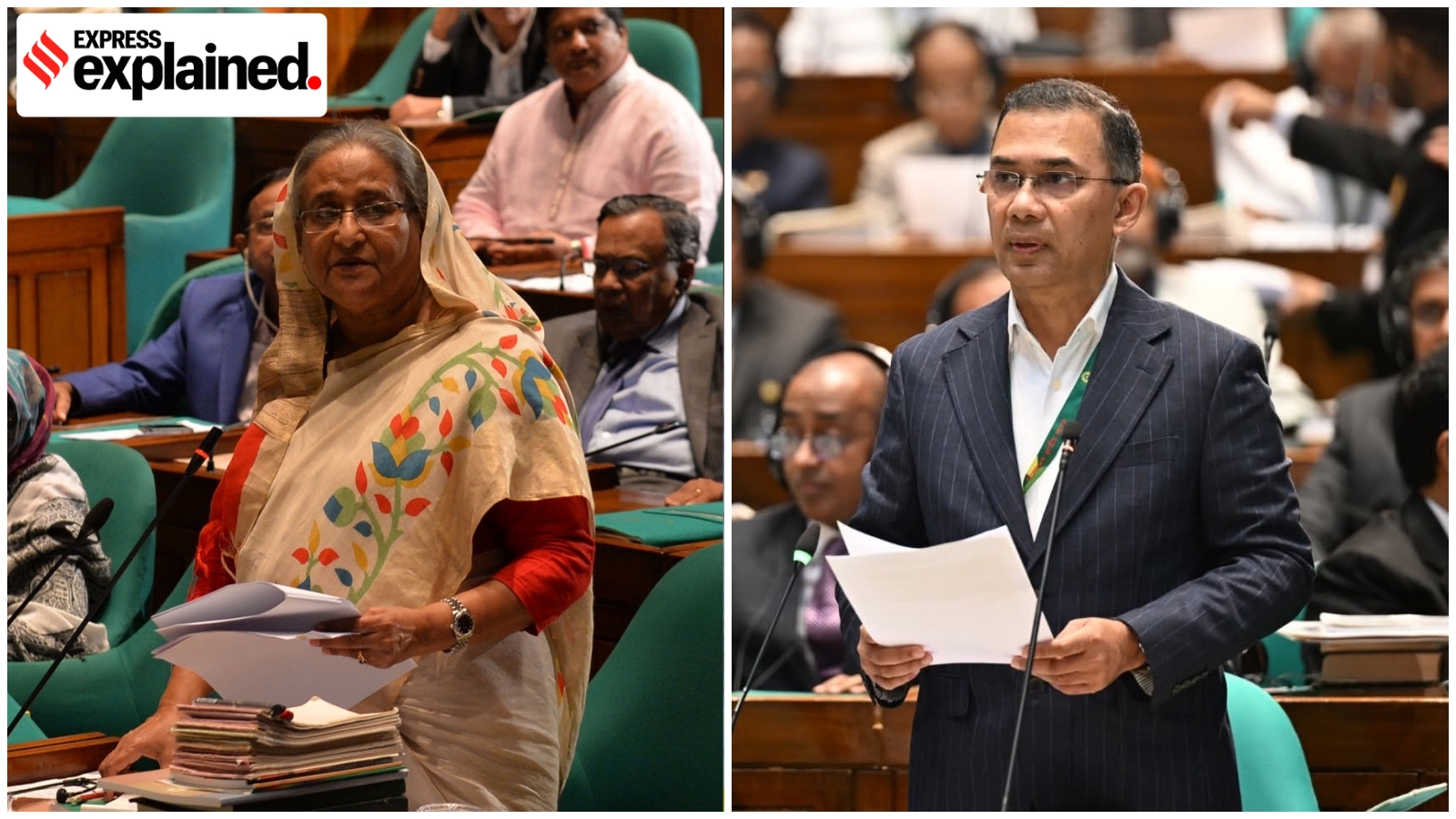
India and Bangladesh’s relations have been going through a turbulent phase. Sheikh Hasina’s recent statements from Indian soil have angered Dhaka and cast uncertainty over when Prime Minister Tarique Rahman will visit India. And there are the key longstanding issues of water sharing and illegal immigration.
Pinak Ranjan Chakravarty is a former Indian High Commissioner to Bangladesh, a former member of the Indian Foreign Service (1977 batch), and author of Transformation: Emergence of Bangladesh and Evolution of India-Bangladesh Ties. He spoke to Shubhajit Roy, Diplomatic Editor at The Indian Express, on September 3, about the state of the bilateral relationship and the challenges that lie ahead. Edited excerpts from the Explained.Live interview.
Give us some context on this new BNP government led by Rahman
Bangladesh is a very important country for us, with almost 180 million people. We share a 4,096 km border. Its history is marked by political turbulence, right from 1975 when Sheikh Mujibur Rahman was killed along with his family.
The two years we saw under Mohammed Younus were disastrous. Criminals and terrorists were freed and minority communities suffered. He was being dictated to by the Jamaat-e-Islami, which had taken over the student movement.
The election that happened was also flawed because the Awami League was not allowed to participate.
Current prime minister Tarique Rahman, the son of Khaleda Zia and the former military dictator general Zia Rahman, was in exile for almost 17 years because a military-backed caretaker government had convicted him of various charges of corruption.
Story continues below this ad
After the two years of the Mohammad Yunus regime, I think a deal was worked out between him, Tarique Rahman and the Americans.
This government is under a lot of pressure as the economic conditions have worsened. There is a shortage of electricity, cooking gas, fuel etc.
How is the current Bangladesh Nationalist Party government similar to or different from the Khaleda Zia government?
You really cannot apply that template of those years… and compare it with today. The BNP is a mosaic of business lobbies, pro-Pakistan lobbies, Jamaat-e-Islami lobbies. It has a few subdued people who want good relations with India.
Story continues below this ad
Sheikh Hasina being in exile in India has become a factor in bilateral ties. There must have been some pretty intense discussions in Dhaka. I think the anti-Indian lobby must have won out and prevented him [Rahman] from coming to India [for the BRICS summit].
India cannot be wished away by Bangladesh, or replaced by any other country because of our shared civilisational heritage. Millions of Bangladeshis come to India for medical treatment. There is a huge amount of trade and connectivity. This is a relationship that one can only ignore at one’s peril.
How do you assess the Indian approach towards the Tarique Rahman government?
India’s policies towards Bangladesh, and other neighbors, has been that we will deal with whichever government is in power. We have dealt earlier with military dictators, with caretaker governments and, of course, with elected governments.
Story continues below this ad
Now the ball really is in Dhaka’s court. India will not stop the normal relationship that goes on, in terms of people-to-people, business-to-business, education, etc.
Why is Sheikh Hasina important for India?
We had a good relationship with her government. There was no reason for the Indian government to say, no, you can’t bring Hasina here.
The Bangladesh President, who has been a senior BNP leader, said that Hasina being in Delhi should not affect our bilateral ties. I think that was the general approach that everybody felt would be followed. But some lobbies have gained ground and said that Hasina must be handed over.
Bangladesh has made several requests. But extradition is a judicial process and the Bangladesh government has not tried to initiate one.
Story continues below this ad
If Hasina is willing to go back, the government will not stop her. But India will want to know what they do with her. There are people, like the Jamaat e-Islami, who want to kill her upon arrival.
How has her August 5 address queered the pitch for a visit by Rahman?
I felt the government of India could have advised her. But today, amid social media, can you stop anybody from talking? How do we confine her? She’s not in custody or prison in India.
She said she would like to go back, whatever the consequences she faces. She’s now approaching 80 and her political career seems to be over. But the party [Awami League] wants her back because she’s a beacon of hope for them.
Is it possible to repair the ties?
Story continues below this ad
It is definitely possible, but it will require two hands to clap. India has made enough overtures. Now it’s up to Dhaka. They can say we will keep the relationship at a low key. Perfectly all right. We have seen such attitudes before. India will be mainly looking at basic pillars of the relationship.
Bangladesh’s main problem today is economic. We are providing fuel and electricity to the extent we can.
Give us a sense of the stakes in the security and strategic aspect of the ties
The worry is the release of a large number of Islamists and terrorists, who are reorganising. The UN has brought out a report talking about the revival of Al-Qaeda in Bangladesh. And the country has a history of Islamic extremism, which Hasina had managed to control. A revival of that kind of extremism, which will naturally spill over into India, will be utilised and exploited by Pakistan.
Story continues below this ad
Where do river water-sharing agreements stand? The Teesta agreement has not been signed since 2012 and the Ganga water treaty is up for renewal this year.
We share 54 rivers and have only one agreement which is due to expire in December (the Ganga water treaty). The Teesta agreement did not happen… because West Bengal objected.
The immediate issue is the Ganga waters treaty. There will be hard bargaining. Bangladesh may ask for more guaranteed flows of water, which may be very difficult for India to accept. Per capita water availability is not growing (climate change and shrinking glaciers are a factor) and demand is rising.
There have been several discussions on building canals, etc. to transport water during the lean season, but they have not worked because both sides have to agree to do all that.
Story continues below this ad
China, US and Pakistan are the three major actors in the relationship. How do you see their role in Bangladesh and impact on India?
China did not even recognize Bangladesh till about 1977. Its first stepping stone was the army, providing a lot of free arms. Around 80% of Bangladesh’s military hardware now comes from China.
Bangladesh has joined the Belt and Road initiative, through which China aims to create strategic influence and get a foothold. China is Bangladesh’s largest trading partner.
China also seeks a corridor into the Bay of Bengal. It has one through Myanmar but the country is disturbed by conflict. So it seeks another corridor, perhaps, through Myanmar into Bangladesh. This is where the Americans come in: they don’t want that to happen.
Pakistan has a one-point foreign policy and that is how to harm India. They want to convince Bangladesh to join hands with them. I doubt if Bangladesh will fall into that Pakistani trap, because that would again sour relations with India.
AUDIENCE QUESTIONS
How is Indian political discourse on Bangladesh perceived in Dhaka? Does this create a cycle that complicates the efforts to reset relations?
I think the asymmetry between India and Bangladesh is an issue. Bangladeshis resent that India is seen as trying to dominate it. They see India as a dominating factor in their own politics, which is not reciprocated in Indian politics.
Economic migration happens from Bangladesh, as well as minority Hindu migration linked to persecution and land grabbing. Politics in our country, particularly in certain areas, is dominated by the illegal migration issue because people are worried about demographic change. It’s also a matter of some worry for the Indian government.
Where do you see the India-Bangladesh relations in the next one to two decades?
Our geography is such that there is no escape from cooperation. There may be irritants. But we have to ensure that relations are normalised to the extent that both sides can cooperate.
Currently, they are struggling to manage relationships with China and the US because it’s the US which arranged this… deal allowing Tarique Rahman to come back.
So he also has to consider that the US would not like China to have a bigger footprint in Bangladesh. Those are the contradictions within Bangladeshi policy making circles.
KioskNews shows a cleaned-up reading view extracted from the publisher’s page — the original always lives on their site, not ours.