Snap Insight: US midterms – what an angry ‘lame duck’ president could mean for Asia
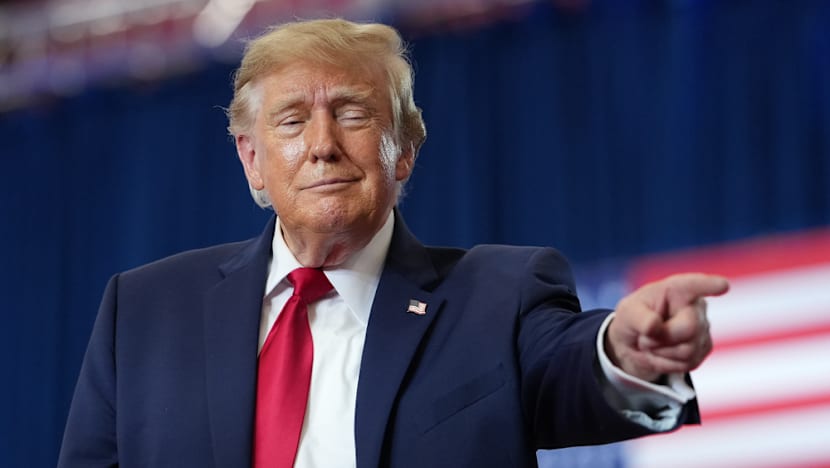
US President Donald Trump was sharply rebuked by American voters, and he could now turn his attention to foreign policy, says Kevin Chen from the S Rajaratnam School of International Studies.
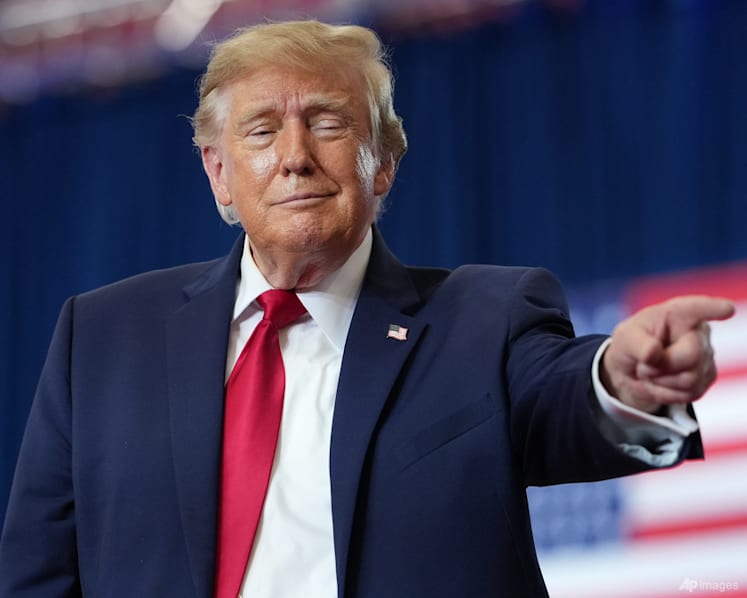
President Donald Trump gestures at a campaign rally at the Lubbock Memorial Civic Center, Tuesday, Oct. 27, 2026, in Lubbock, Texas. (AP Photo/Alex Brandon)
New: You can now listen to articles.

This audio is generated by an AI tool.

04 Nov 2026 04:53PM (Updated: 04 Nov 2026 05:07PM)
SINGAPORE: United States President Donald Trump was not on the ballot, but he had asked Americans to vote in the midterm elections as if he were.
The response was clear: Democrats have taken back control of both chambers of Congress from his Republican Party.
The election was effectively a referendum on Mr Trump’s policies: Voters were upset over his handling of the economy and related issues such as affordability. Disapproval of Mr Trump’s foreign policy, in particular the Iran War and its repercussions for energy prices, also soured voters from Republican candidates.
This frustration fuelled not just a blue wave, but a blue tsunami that Republican redistricting efforts could not block.
Democrats needed a net gain of three Republican held seats in the House of Representatives and four in the Senate to gain majorities. At the time of writing, Democrats had flipped 21 seats and seven seats in the lower and upper chambers respectively.
AN ANGRY DUCK
On paper, the Democrats will have powers to block Mr Trump’s domestic agenda and render him a “lame duck” for the remainder of his term.
With a House majority, Democrats will be able to oversee key spending bills and convene hearings to scrutinise Mr Trump’s actions. With control of the Senate, Democrats would also be able to block votes on Mr Trump’s nominees to key federal positions.
However, Mr Trump has demonstrated a willingness to bend political norms to achieve his ends. In 2019, when the Democrat-controlled Congress refused to fully fund his southern border wall, he declared a national emergency and diverted funds from other budgets to do so anyway.
Instead of a lame duck, Mr Trump might well be an “angry duck”, waging political war with his veto powers and bully pulpit.
LESS RESTRAINT IN FOREIGN POLICY
The big unknown may well be Mr Trump’s foreign policy plans. US presidents are given significant discretion in foreign policy, allowing them to meet foreign leaders and even launch limited military strikes without Congressional approval.
Past presidents have taken advantage of this discretion. Despite the Democrat victory in the 2006 midterms, for example, then President George W Bush went ahead with the controversial 2007 surge of American troops into Iraq.
Congress’ ability to restrain a president is limited without a two-thirds majority in both chambers, and even the sweeping victories in the midterms did not deliver that. This raises deep concerns over potential escalation in the Iran War, or even Cuba.
WHAT ASIA IS WATCHING
For Asia, there are unlikely to be immediate impacts.
Facing domestic constraints and potential congressional scrutiny, Mr Trump could try to bolster his diplomatic legacy by pushing dialogue with North Korea, which would worry South Korea. But Pyongyang seems to have no appetite to entertain this.
The US could pursue its threats to slap more tariffs on trading partners, for alleged participation in what Washington calls a “transshipment scam” to route Chinese goods to evade US tariffs. Section 301 tariff investigations into several Asian economies for industrial overcapacity are also ongoing, and any legislative challenge to them will take time.
There is also uncertainty over the election’s implications for US-China relations. Mr Trump’s two upcoming meetings with Chinese President Xi Jinping will take place before the House reopens in January 2027, making any legislative disruption unlikely.
In any case, before the Democrat-controlled Congress tries to insert itself into the relationship of “constructive strategic stability”, they would need to settle internal debates over their stance on China policy.
Yet, the divided government in Washington should not be seen as a reason for regional governments to dial back engagement. US national security interests, particularly over rare earths and supply chains, are not going to change overnight.
It is still more prudent to work with the US where interests align and build trust than to hold back and wait for a new occupant in the White House.
Kevin Chen is an Associate Research Fellow with the US Programme at the S Rajaratnam School of International Studies (RSIS), Nanyang Technological University (NTU), Singapore.
KioskNews shows a cleaned-up reading view extracted from the publisher’s page — the original always lives on their site, not ours.