CRASH TEST DUMMIES: Ordinary South Africans not present in safer cars AA forum — it’s a problem
Bobby Ramagwede, CEO of the Automobile Association (AA) of South Africa, told Daily Maverick that he has a standard email template that he sends to the Department of Transport. At the very top is a request to fix the passenger rail network.
“The difference – well one of the many – between South Africa and Europe is that they have trains, trams and then cars to choose from,” he explains on the sidelines of the Forum for Safer Mobility.
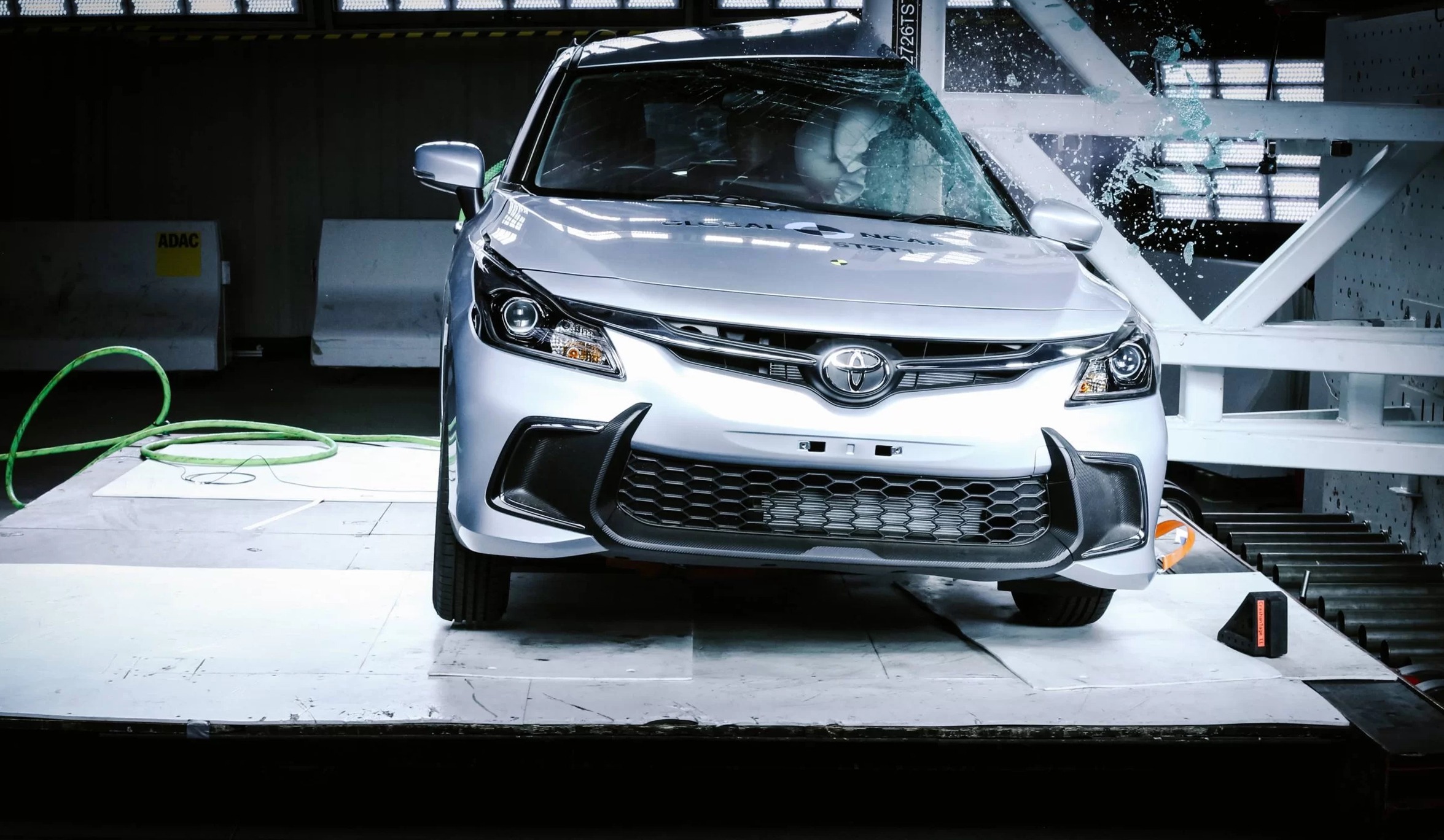
A highlight of the forum was the unveiling of a smashed Toyota Starlet, not with curtain airbags installed to make the grade for an additional star in the AA’s local testing – basically a PR exercise where selected cars cannot achieve higher than tw0 out of five stars if curtain airbags are not installed.
There was little (if any) material difference between the bend of the mangled side panel on the newly upgraded Startlet and the pictures of the model without the additional airbags.
Instead of addressing Daily Maverick questions about why the AA ignores the structural integrity of the vehicle’s high-tensile steel in its star ratings, Ramagwede evaded the failure of structural deformity by pivoting to biomechanical harm:
“This one still failed on on the deformity, yes. But you got to keep in mind that the Ndcap rating is a measure of the biomechanical harm done to the occupant as opposed to the structural deformation. It is important for structural deformation to occur within an acceptable range. But what’s most important is how far or to what extent does the biomechanical harm impact the dummy orthe human being inside the vehicle...”
Cool.
Finding accountability in unexpected places
On the Africa panel – which lacked sufficient community representation – Avis chief of retail and business development Ana Bonanni said unprompted, and with her whole chest, that safety is “embedded in our DNA” and represents “a collaborative effort across the industry”.
To this end, she doubled down on the fact that the rental giant pulls unsafe (read: cars exposed by independent testing as having a zero- or one-star safety rating) cars from its fleet and omits them from the next procurement decision.
Unfortunately, when Daily Maverick contacted Avis to enquire about renting a Hyundai Grand i10 (a car that famously scored zero in the AA testing), the contact centre operator said that it would depend on the model availability when I arrived at my chosen rental office, but assured that they do carry the model in the Group B listings.
/file/attachments/2997/overall-results-table-2026-scaled_353362.png)
It was indicative of the general panel vibe that exposes a highly fragmented industry view of what safer mobility means in practice, illustrating the complex trade-offs between regulatory standards, driver behaviour and commercial underwriting models.
Precious Nduli, chief commercial officer of Discovery Insure, provides the commercial perspective of the short-term insurance market, explaining that insurers look at safety through a fundamentally different mathematical lens than crash-testers.
She outlined the core actuarial formula that dictates how premiums are set:
“Premiums simplistically are a function of frequency and severity. Frequency means the likelihood of you having a claim and that’s literally driven by your risk profile as a driver.”
Discovery’s underwriting models prioritise human behaviour over the vehicle’s structural crash rating because driver behaviour is the overwhelming cause of road accidents.
“We actually understood and being insurers we are the coalface of risk,” she explained. “We actually understand that there’s a behaviour that drives the outcome of risk, understanding that over 60% of fatalities are a result of behaviours.”
Discovery does not use Global Ncap star ratings to calculate insurance premiums because the financial contract of insurance is tied to property (read: car) repair rather than the physical occupant.
So, why are we here?
Mokonyama Mathabatha, deputy director general in the Department of Transport, was representing Minister Barbara Creecy at the event and gave a government view of the vehicle safety conundrum.
“Vehicle safety and occupant safety should not be viewed as a luxury feature or additional cost,” he said on Creecy’s behalf. “It should be recognised as a fundamental public safety equipment.”
While the panel – including Ramagwede in response to Daily Maverick questions in the forum room – tried to pass the accountability baton from manufacturers to regulators and even to consumers, Ramagwede’s private argument constantly returns to the same single rail-centric talking point.
When Daily Maverick countered that airbags do not prevent accidents, Ramagwede shifted the focus back to claiming that we cannot focus on a single lever:
“I'm not going to prevent it with airbags, but I am going to minimise the fatalities. I am going to minimise the extent to which people are injured. That’s one of the multiple levers. I don't focus on one lever only.”
“If you want to fix mobility in this country, bring back functional passenger rail,” he says. “I should be able to traverse from Beitbridge to the end of [the line in] Cape Town on a train comfortably, affordably and safely.
“Once we’ve got that right, I can assure you you’ll address many other issues. My next mission is to get the trucks off the road.”
Maybe Ramagwede should call up Minister Creecy and ask her about the rail reforms currently underway to solve that exact problem. DM
KioskNews shows a cleaned-up reading view extracted from the publisher’s page — the original always lives on their site, not ours.