China’s humanoid robots hunt for work in South Korea as Seoul bets on physical AI
This article was first published by The Korea Times in a partnership with the South China Morning Post.
Chinese humanoid robot makers are accelerating efforts to gain a foothold in South Korea, moving beyond dance performances and showroom displays to factory trials and commercial deployments, as Seoul ramps up investment in physical artificial intelligence.
A growing number of Chinese robotics companies – including Hong Kong-listed UBTech Robotics, start-up Anyverse Dynamics, Shanghai-based AgiBot and leading robot maker Unitree Robotics – have flexed their muscles or announced projects in South Korea this year.
“China’s new generation of robot companies has global DNA and naturally looks overseas, and South Korea is one of the most important markets in the Asia-Pacific region,” said Ethan Qi, an associate director covering robotics at Counterpoint Research. The lack of locally built humanoid robots available at scale had created an opening for Chinese suppliers, he added.
Commercial foothold
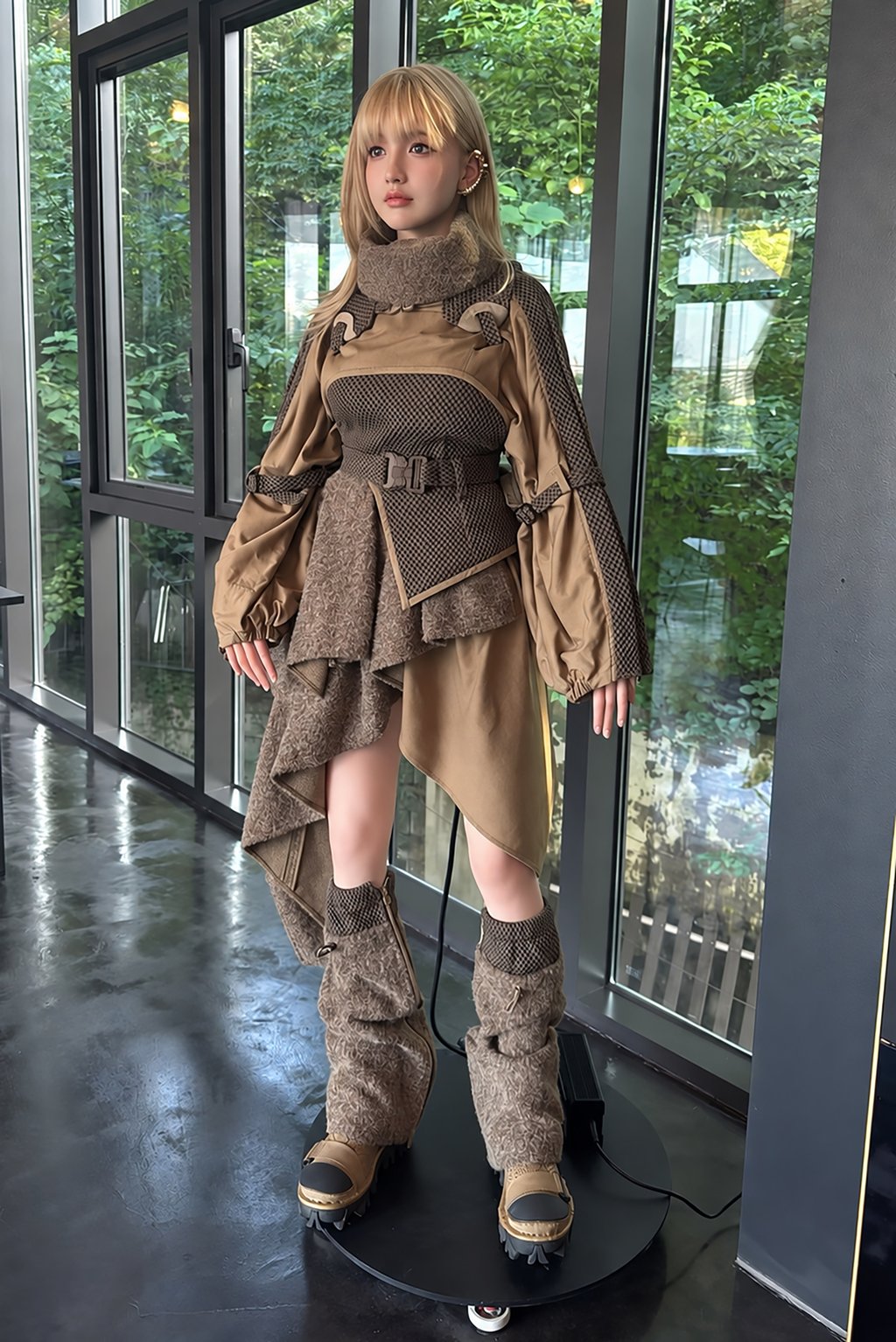
Representatives of Galaxy Robot Park, a robot-themed entertainment venue in Seoul, agreed to buy UBTech’s lifelike U1 model after seeing its debut in Shenzhen in June, according to Sean Qin, overseas head of the company’s commercial robots division.
The robot, designed with a female appearance and standing 1.68 metres tall, cost around 170,000 yuan (US$25,000) and was delivered to the park last month, Qin said. UBTech entered the South Korean market as early as 2019 and had since sold more than 10,000 robots to dozens of corporate and government customers, he added.
In July, UBTech, headquartered in China’s southern tech hub of Shenzhen, also announced plans to trial humanoid robots on a South Korean automotive parts production line with local partner Duksan JM Robotics and parts maker Ajin Industrial. Several UBTech models were undergoing on-site operational tests in the country, Qin said, without providing details.
“As a manufacturing powerhouse, South Korea already makes extensive use of robotic arms, autonomous mobile robots and other conventional systems,” he said. “The next step is to help workers become more productive in tasks that demand greater flexibility. That makes Korea a key market for UBTech and for humanoids more broadly.”
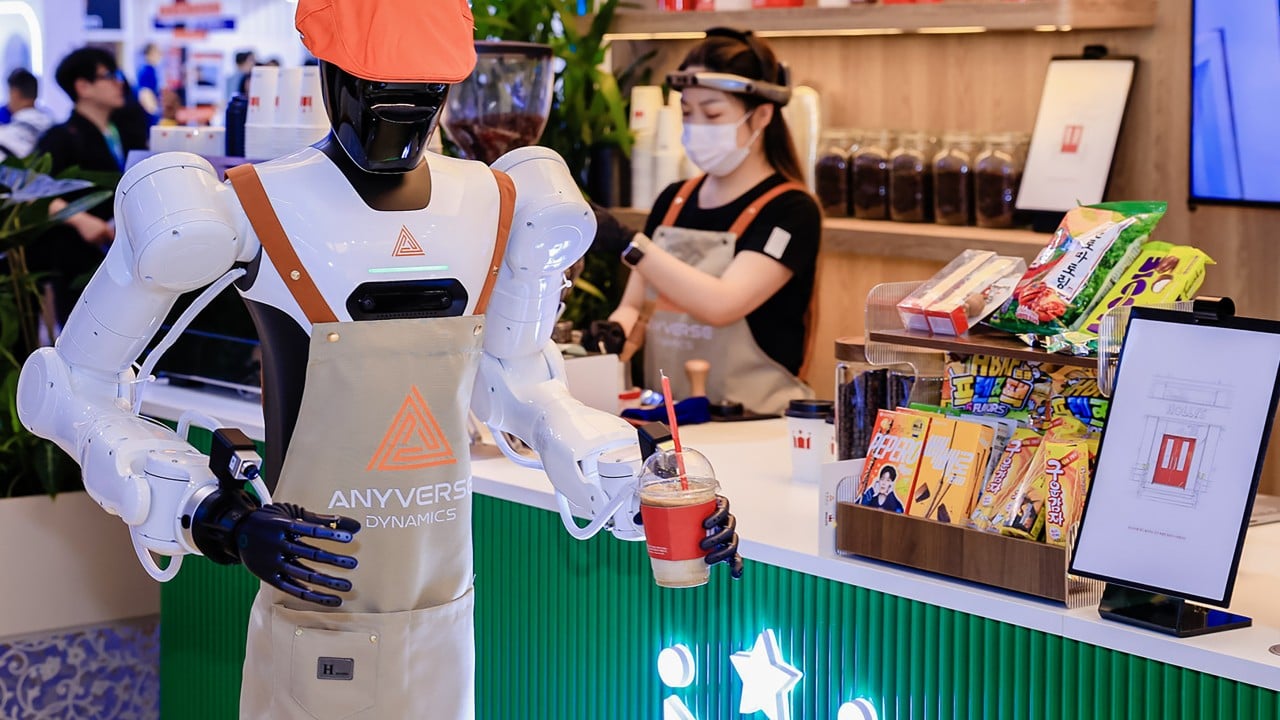
Zhang Yufeng, founder and CEO of Anyverse Dynamics, who previously worked with SK Telecom and Hyundai Motor, said South Korea was “one of our most important overseas markets”.
The Beijing-based start-up teamed up with South Korean coffee chain Hollys at the World Robot Conference in Beijing in August to test robots that serve drinks, clear tables and reset seats. The robots were currently undergoing trial operations at a cafe in Beijing, Zhang said.
South Korea ranked as China’s third-largest export market by value for “intelligent bionic robots” in the first nine months of 2026, behind the United States and Japan, according to Chinese customs data. Exports to South Korea totalled US$19.99 million, or 9.7 per cent of the US$206.95 million China shipped globally. China exported 16,559 robots to 108 countries and regions under the customs category, introduced this year, which covers humanoids and robot dogs.
Eight of China’s 10 top-selling humanoid robot makers had been testing the waters in South Korea through product certification, trademark filings and sales channels, according to a report by industry research platform Labsdeep that was cited by Electronic Times this month.
“We plan to begin trials in Korean cafes and other commercial service settings in the fourth quarter, before expanding into manufacturing,” Zhang said, noting that the company had been working on product certification for the market.
Seoul’s stringent Korea Certification requirements prompted UBTech to adapt its communications modules and radio frequency settings for local use, Qin said.
Factories as main testing ground
China’s robotics boom has spawned a wave of unicorn firms over the past two years, some of which have already begun shipping products at scale, backed by an extensive supply chain at home. Their push to find commercial applications to justify the investment and hype surrounding humanoid robots coincides with South Korea’s drive to deploy physical AI across its industrial base.
Seoul is prioritising the technology to strengthen manufacturing as its working-age population shrinks and potential economic growth slows. The government has proposed 3.1 trillion won (US$2.3 billion) in physical AI funding for 2027, more than triple this year’s level.
The Ministry of Trade, Industry and Resources’ Manufacturing AI Transformation programme, dubbed M.AX, supports AI adoption and factory trials involving robots, including humanoids, with a target of 500 AI factories by 2030. The ministry has budgeted 1.1 trillion won for AI transformation this year.
Industry Minister Kim Jung-kwan said in August that the government would support factories operated by AI and robots, helping South Korea become “a global leader in manufacturing AI transformation by 2030”.
South Korea’s industrial heavyweights are also moving quickly.
LG Electronics is building its Data Factory in Seoul to train robots for industrial and household applications, while testing robots on its own production lines. Samsung Electronics established its Robotics eXperience division in July, targeting manufacturing before expanding into homes and retail. A bipedal robot designed to operate round the clock in manufacturing and logistics could debut at the CES annual consumer electronics trade show in Las Vegas in January 2027, JoongAng Ilbo reported on Tuesday.
Hyundai Motor Group has begun training Boston Dynamics’ Atlas humanoids at its factory campus in the US state of Georgia, ahead of a planned 2028 deployment in manufacturing. Doosan Robotics has unveiled AI-powered sanding and palletising systems and is developing robot-control software, with support from Nvidia.
South Korea’s start-up ecosystem is also drawing fresh capital. AI and robotics accounted for 45 per cent of third-quarter investments tracked by The VC, a local start-up and venture capital investment database platform. Within physical AI, funding is flowing to robot makers as well as start-ups developing foundational models for robots and supplying training data.
The country offered a broad range of potential deployment sites in carmaking, shipbuilding and semiconductor manufacturing, Counterpoint’s Qi said. But gaining access was difficult for Chinese suppliers because they needed local customers willing to participate in proof-of-concept trials.
Partners and rivals
The growing presence of Chinese firms has stirred political debate. At a parliamentary audit on October 6, lawmaker Lee Jeong-heon of the ruling Democratic Party of Korea brought robots from China’s Unitree and AgiBot to challenge the government over South Korea’s competitiveness in physical AI.
Lawmaker Ahn Cheol-soo of the main opposition People Power Party questioned whether the robots had undergone security checks and accused the National Assembly of providing a stage for Chinese technology.
Deputy Prime Minister Bae Kyung-hoon, who is also the Science and Information and Communications Technology minister, urged South Korea to ramp up physical AI investment and development, pointing to China’s growing deployment of humanoids.
“China is also deploying more humanoid robots in the field and collecting data,” he said during a Physical AI Tech Week round table in Seoul on October 13, according to news outlet MoneyToday.
Bae questioned whether Korea’s plans were bold enough and called for higher targets to avoid regretting insufficient investment in the future. Companies also needed to shoulder greater responsibility because the government could not support every initiative, he said.
Park Young-hoon, head of the Korea Trade-Investment Promotion Agency’s Shenzhen office, said he also saw room for cooperation.
“Companies need to explore new business opportunities using Shenzhen’s local supply chains and innovation capabilities while competing with Chinese technology companies,” he told local media outlet Newspim in October.
Anyverse Dynamics’ Zhang said he saw the two countries’ industrial strengths as “highly complementary”. South Korea combined global leadership in advanced manufacturing with a capacity for AI innovation, while China offered a comprehensive supply chain, a deep pool of engineering and AI talent, and rapid product iteration, he said.
For UBTech’s Qin, policies favouring domestic companies have not deterred Korean customers from considering Chinese suppliers. “The Korean customers we have dealt with are open to working with Chinese robot makers,” he said.
KioskNews shows a cleaned-up reading view extracted from the publisher’s page — the original always lives on their site, not ours.