2 men die during traditional land dispute ritual in Sarangani
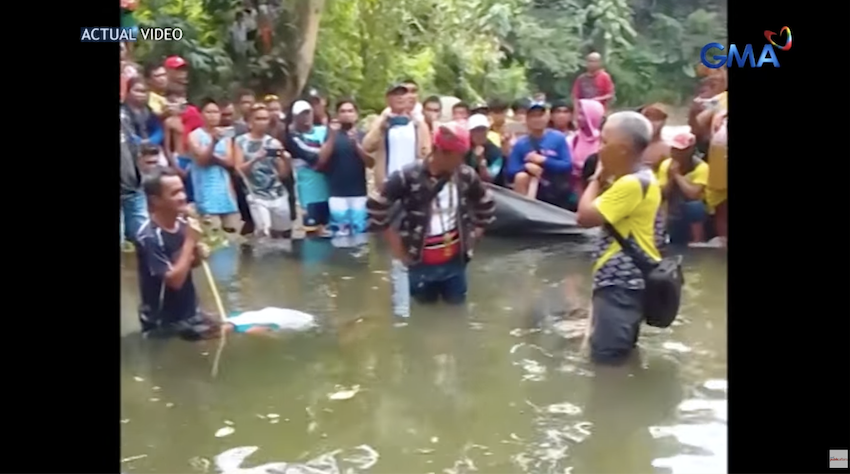
Two men died after participating in a traditional ritual to settle a land dispute between their families in Alabel, Sarangani.
According to “Kapuso Mo, Jessica Soho,” Gaspar Palasanon and his uncle, Tonny Mansag, were involved in a dispute over a roughly 15-hectare property. Their families agreed to settle the issue through a ritual known as sulif among the Blaan people and kallep among the Tagakaulo.
The ritual involved the two men staying underwater, with the first to surface declared the loser. The winner would then claim the disputed land.
Ritual ends in tragedy
The ritual took place near the Glamang River in Alabel. According to barangay officials, the two men remained underwater for several minutes, with witnesses growing worried as neither surfaced.
“Dahil sa tagal, nagduda na kami. Sumigaw pa ako na baka namatay na talaga silang dalawa,” Francisco, a witness, said.
Barangay officials said they declared the contest a tie after about 10 minutes. However, when the two men were pulled from the water, both were already dead.
The incident was described as the first time in the tribe's history that participants had died during the ritual.
“Unang beses talaga ito na may namatay at sabay pa,” Francisco said.
The families later brought the bodies home for their wakes and burials.
Families remember the two men
Gaspar's wife, Antonina, has struggled to accept her husband's death. She shared how he helped with household chores because of her disability.
“Simula sa nangyari sa asawa ko, hindi ko po talaga siya matingnan. Hindi ko po matanggap na ganoon ang mangyayari sa kanya,” she said.
Antonina said her husband supported the family, including their two children who were studying in college and high school.
Their daughter, Michelle, said they tried to stop Gaspar from joining the ritual, but he did not listen.
“Kaming mga anak niya, pinigilan namin siya. Pero hindi siya nakinig sa amin. Gusto niyang mag-sulif,” she said.
Tonny's son, Rogelio, recalled finding his father lifeless after pulling him from the water.
“Pag-angat ko sa kanya sa tubig, sir. Nung mahawakan ko po sir, wala na pong hininga po, sir. At yung katawan niya, sir. parang kahoy po, sir. Wala siya ng buhay,” he said.
Both families said they did not blame the barangay officials, noting that the two men had chosen to participate.
Dispute over ancestral land
The property at the center of the dispute is estimated to cover 15 hectares. Gaspar's family said they wanted to use the land to grow corn and coconut trees, while Tonny's family planned to share the proceeds among its members if the property was sold.
Michelle said their family had ties to the land because her grandfather and father had lived there. She also said Gaspar had heard that someone wanted to buy the property to develop it.
Tonny's family, meanwhile, maintained that the land had been given to their ancestors as bangon, or compensation for a killing within the community.
The term refers to a traditional form of compensation that may involve land, horses, or carabaos, according to an Indigenous Peoples Mandatory Representative (IPMR).
Lemon, Gaspar's uncle, disputed the Mansag family's claim to the property, saying the land had already been paid as compensation and belonged to Gaspar's family.
Barangay Captain Franklin said the dispute was discussed for four months, including three meetings before the barangay's conciliation panel and another meeting with him. However, the families could not reach an agreement.
The parties were advised to bring the matter to the municipal IPMR and the National Commission on Indigenous Peoples (NCIP), but they wanted to resolve it through their traditional practice instead.
Indigenous leaders explain the tradition
An IPMR said sulif has been practiced by their ancestors since time immemorial and is considered a last resort when disputes could not be resolved through discussion.
The Sarangani Province Indigenous Peoples Congress also described the practice as part of the community's customary justice system. However, a representative said it should not be used to determine land ownership because the history of a property and the people who can attest to it must also be considered.
In a previous case in 2016, a man named Carmelito said he participated in sulif after his son denied responsibility for getting a woman pregnant. Carmelito said he surfaced after about three minutes because he could no longer endure staying underwater. After losing, his son admitted what had happened, he said.
An IPMR explained that sand could enter a participant's nose, mouth and ears while underwater. The representative also shared the community's belief that a person who is not guilty may receive God's blessing and be able to breathe underwater.
In the case involving Gaspar and Tonny, the two men had reportedly spent the night near the river before the ritual. Barangay officials said rocks had been placed to raise the water level, which they described as reaching around knee height.
Officials acknowledged that they had not anticipated the contest lasting as long as it did. A tribal chieftain explained that the customary practice did not specify a time limit.
NCIP, legal provisions, and calls for safeguards
A lawyer from the Blaan community said the Indigenous Peoples' Rights Act (IPRA) recognizes Indigenous peoples' right to practice their customary laws, traditions, and justice systems.
However, the lawyer stressed that these practices must remain consistent with national laws, international human rights standards, and public policy.
“The IPRA has this qualification or caveat there, saying that all these customary laws, traditions, practices should be in line with our national law or our international human rights. And even our civil code, there is also a provision there, customs shall not be contrary to public policy, public order, or laws. So it is not an absolute,” the lawyer said.
The NCIP said it helped draft a compromise agreement after the incident. Under the proposed arrangement, the families wanted to avoid filing cases and instead share the disputed property equally, with each side receiving 50%.
The agency also said it conducted an investigation and forwarded its findings to its regional office for further coordination with its national office.
Meanwhile, the Sarangani Province Indigenous Peoples Congress appealed to the public not to mock the community or its traditions. Its representative also objected to the recording and online circulation of the ritual, saying it was sacred and should only have been witnessed by the participants and their families.
The deaths have prompted calls within the community to discuss safeguards for future rituals.
One said the tradition should not be discontinued but suggested setting a time limit of two or three minutes to prevent another tragedy.
Gaspar's daughter, Michelle, also appealed for the practice not to be repeated in a way that could cost more lives.
“Sana ay hindi na po maulit ang sulif, kasi kapag namatay ang isang tao, hindi na maibabalik ang buhay niya,” she said. —JCB, GMA News
KioskNews shows a cleaned-up reading view extracted from the publisher’s page — the original always lives on their site, not ours.