Behind India’s Russia-Ukraine peace proposal: Grain, crude oil — and Trump
Four years after Russia invaded Ukraine in February 2022, India, for the first time, is said to have put forward a “comprehensive” and “broad” proposal to end the war.
This was revealed by Ukraine’s Foreign Minister Andrii Sybiha last week, after Russian President Vladimir Putin had said that Prime Minister Narendra Modi has some “very good ideas”.
The broad contours of the proposal revolve around easing the especially intense fighting since July around the critical Black Sea region, which would allow Ukraine’s agricultural products to reach the world. Russia would halt attacks on Ukraine’s energy infrastructure, while Ukraine would refrain from attacking Russian positions along the line of contact.
This “limited” and “partial” ceasefire is what has animated the conversation between India, Russia and Ukraine.
Over the last four-and-a-half years, India emerged as a major buyer of discounted crude oil from Russia as much of the West shunned the country — much to Ukraine’s anger. Yet, it has kept communication channels open with Ukrainian President Volodymyr Zelenskyy. Prime Minister Narendra Modi has also told Putin that “this is not an era of war”.
This engagement with both sides is what has put India in a good position to put forward such a proposal. Here’s why the move matters, how India’s involvement has deepened, and the larger signal it sends — especially to the US.
The Black Sea hotspot
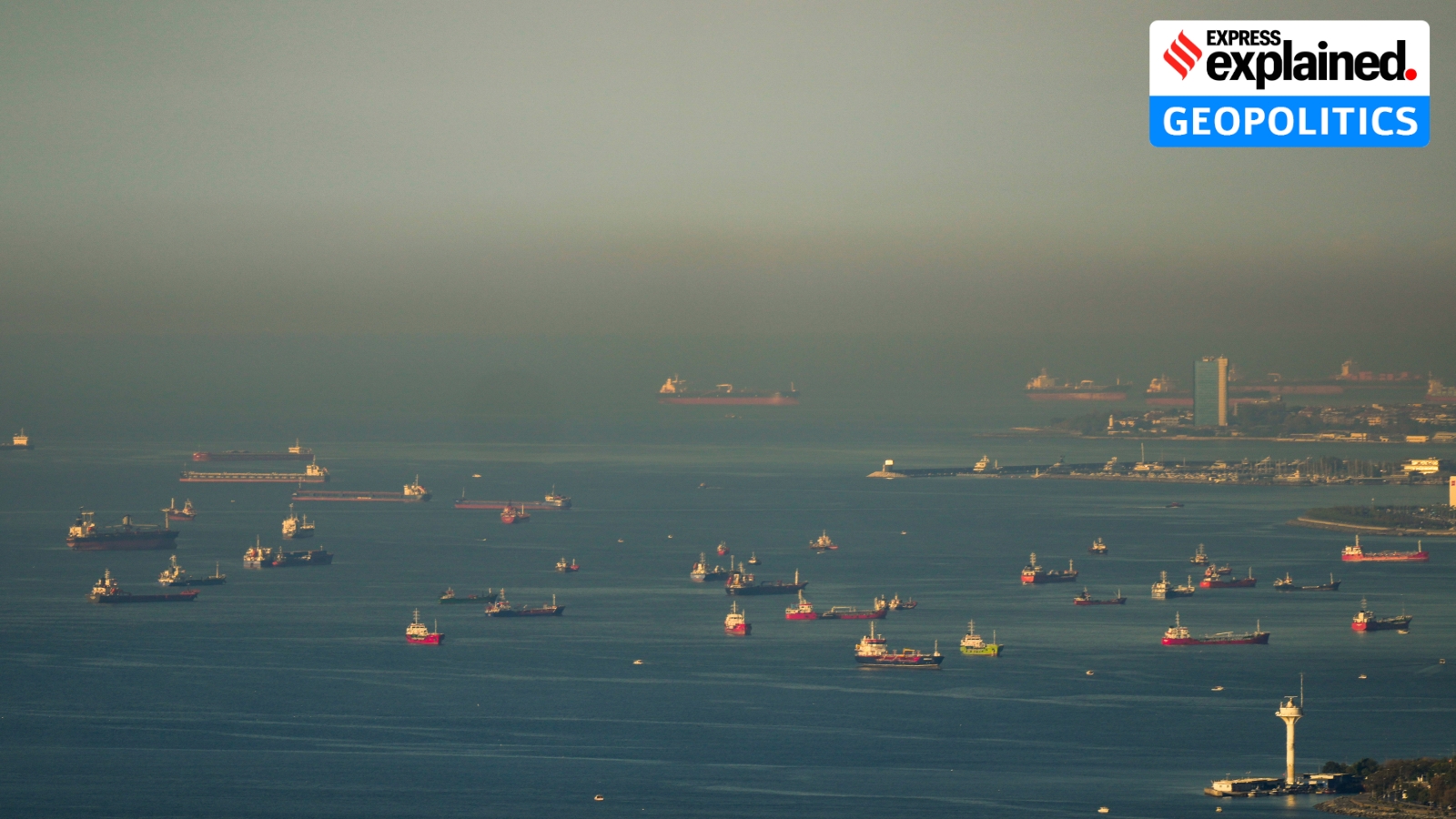
Of particular interest in the proposal is the larger Black Sea region — a key grain-export hub for the world. The fighting there could put at least 400 million people in Africa, West Asia and Asia at risk of food shortages, malnutrition and hunger.
Story continues below this ad
Ukraine, in particular, is a major agricultural exporter. Russia has targeted Ukrainian port facilities and vessel operations around the Greater Odesa region on the Black Sea coast. Ukraine has three key deep-water ports there — Odesa, Chornomorsk and Pivdennyi — which handle around 90% of its agricultural exports.
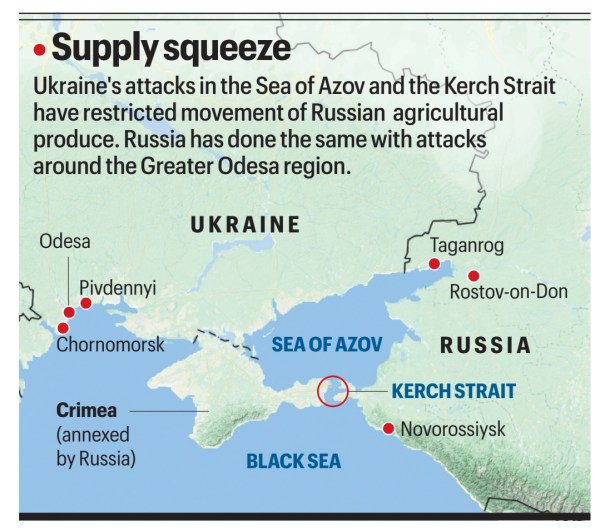 The Black Sea supply squeeze.
Between July 22 and August 31, the operations at these three ports declined sharply: average daily cargo handling fell from approximately 215,300 tonnes to around 14,000 tonnes, according to the Ministry for Recovery, Infrastructure and Transport of Ukraine.
In the 2025-26 marketing year, agri-food products accounted for more than 56% of Ukraine’s merchandise exports, generating $22.5 billion in export revenues. This revenue is essential for its economy.
Story continues below this ad
For the 2026-27 marketing year, Ukraine expects to produce approximately 81 million tonnes of grain and oilseeds, of which around 64.4 million tonnes will need to be exported. A complete blockade would undermine global food security. Additionally, under a prolonged disruption, the storage deficit in Ukraine could increase to almost 11 million tonnes by the end of autumn.
It’s not just Russia that is attacking such facilities, though. Since mid-July, Ukraine has also stepped up attacks on grain vessels, maritime infrastructure and ports on the Sea of Azov and the vital Kerch Strait that connects it to the Black Sea.
Russia exports significant volumes of grain through the Azov-Black Sea region — approximately 42-44 million tonnes, or 77-81% of its total grain exports, is transported through this area.
Western intelligence inputs also indicate that Russia is planning to accelerate attacks on Ukraine’s electricity grids and power plants ahead of the harsh winter.
How New Delhi stepped in
Story continues below this ad
In such a delicate and volatile situation, New Delhi’s proposal has many takers and supporters.
External Affairs Minister S Jaishankar said on October 4 that India has gone “beyond advocacy” to be a “little more involved” in the efforts to end the war.
Jaishankar said that New Delhi has been in conversations with both Moscow and Kyiv, trying to be “helpful” on the safety of shipping in the Black Sea, grain and energy exports and on “non-attack possibilities”.
Story continues below this ad
The latest round of conversations began in July, when there were attacks on civilian shipping by both Russia and Ukraine. In the course of those attacks, some Indian sailors were killed while others were injured.
With five deaths of Indian seafarers in the region in the second half of July, India summoned diplomats from both Russia and Ukraine and lodged a strong protest.
Indians constitute almost 12% of seafarers in the world — roughly one in every 10 seafarers is an Indian national. This means that an Indian national is likely to be present during any attack on a ship.
Story continues below this ad
Before this, India had mostly been involved in advocacy: On August 31, Modi had urged Putin to move from “endless war” to “end of war” when they met in Bishkek on the sidelines of the summit of SCO leaders.
Modi has been raising this issue with Putin ever since 2022 when he first said, “This is not the era of war.” In a meeting with Putin in Moscow in July 2024, Modi said “peace talks do not succeed amid bombs, guns and bullets”, and a “solution cannot be found on the battlefield”.
The Trump factor
The evolution from advocacy to actual deal-making has a broader implication — with respect to the US administration under President Donald Trump.
In recent weeks, the US Congress has empowered Trump to impose up to 100% tariffs on top buyers of Russian energy (India is one of them). Yet, just weeks later on Friday, Trump announced a surprise deal under which Russia will supply hundreds of thousands of tonnes of diesel to the US and global markets.
Story continues below this ad
Amid these contradictory signals — and a trade deal hanging in limbo — India’s efforts convey a seriousness as well as a signal that it is not taking sides in the war.
Meanwhile, Russian crude continues to make up a significant chunk of India’s crude oil imports. It surpassed $43 billion in 2025 and rose 25% during the first half of 2026, peaking at a record share of over 50% (about 2.47 million barrels per day) in July. The imports moderated to around 1.82 million barrels per day by September.
India is, of course, looking to avoid another round of US tariffs over its purchases of Russian oil. Last year, half of the exorbitant 50% tariffs imposed by Trump were for these imports.
Story continues below this ad
In this scenario, the proposal buys India the time and diplomatic space needed to negotiate the long-pending deal with the US on bilateral trade. With Prime Minister Modi expected to travel to the US for the G20 Leaders’ summit in December, this is an important move to secure some diplomatic space.
For many external observers, New Delhi is also perceived to be an idle bystander in the diplomatic chess board, even as Pakistan briefly stole the spotlight by brokering a US-Iran truce — which swiftly collapsed.
While New Delhi doesn’t want to be seen as being compared to Pakistan in deal-making, any possible truce in a limited peace deal between Russia and Ukraine will serve the Indian interest in securing its national economic and strategic interests, apart from taking care of Indian nationals on board the ships across the world.
KioskNews shows a cleaned-up reading view extracted from the publisher’s page — the original always lives on their site, not ours.