California teens build AI fall-risk system, win $100,000 scholarship


Their interest grew after seeing family members suffer serious injuries from falls.
Two California teenagers, Ruoqi Li, 16, and Jason Yang, 17, have developed an artificial intelligence-powered system designed to identify fall risks in older adults before a fall occurs.
According to Davidson Institute, the project, called SafeStrides, combines a smartphone application with wearable sensors to analyse walking patterns and provide an assessment of a person's fall risk.Li, a junior at The Harker School in San Jose, and Yang, a senior at Head-Royce School, developed the project as a way to make fall-risk assessment more accessible outside medical facilities. Their work has now earned them recognition as 2026 Davidson Fellows and a shared $100,000 scholarship in the engineering category.The teenagers said their interest in the problem was influenced by seeing family members suffer serious injuries after falls. As they researched the issue, they found that falls are a major cause of injury and injury-related death among older adults. The project description by the Davidson Institute says one in four older adults falls every year.With SafeStrides, instead of waiting for a fall to happen or relying only on occasional assessments at a clinic, an older adult could use a smartphone and wearable sensors at home for regular screening.
The system collects movement data and uses AI to identify changes that could indicate an increased risk of falling.
How SafeStrides works
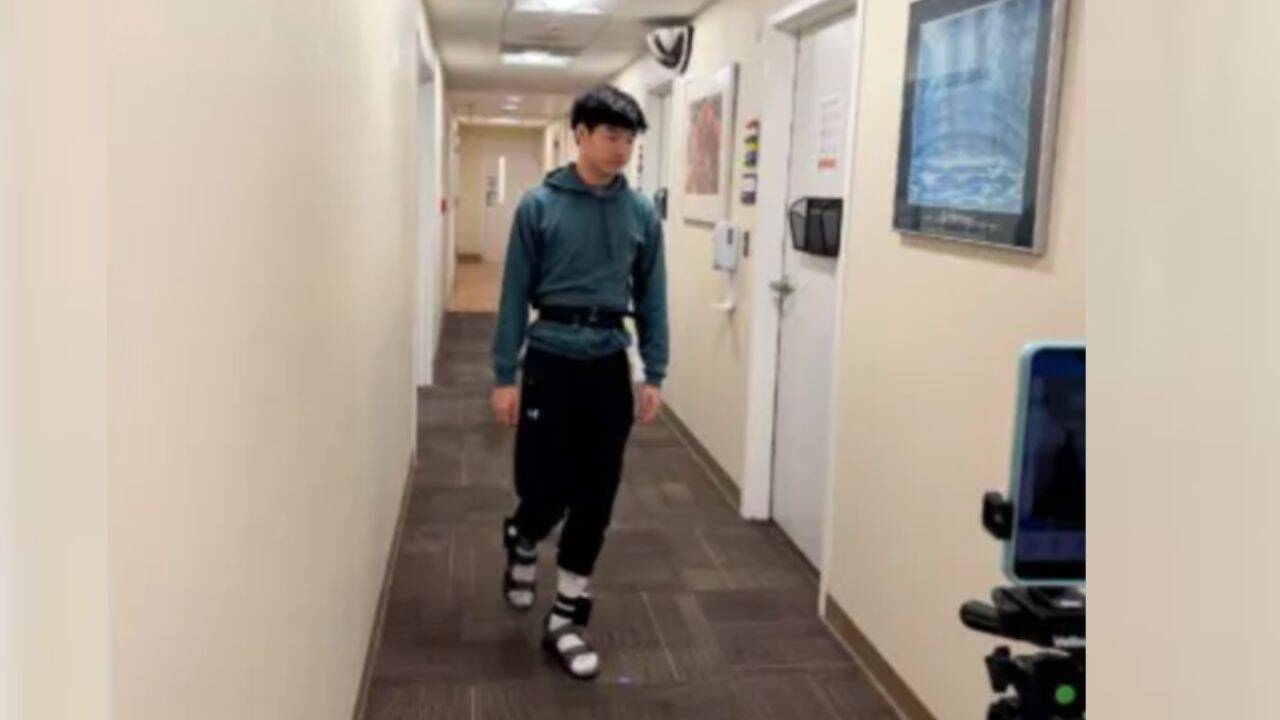
SafeStrides uses a smartphone camera and wearable sensors to study how an older person walks. During a short guided test, the application collects video and sensor data and combines them for an assessment.The wearable system uses inertial measurement units, or IMUs, along with pressure insoles. An IMU can capture movement-related information, while pressure insoles provide data about how a person places weight on their feet.
These different types of information are brought together so the system can examine walking and movement in more detail.The smartphone application synchronises the sensor data with a live camera feed. It then uses multimodal AI to produce an evaluation of fall risk. The system also gives practical suggestions related to mobility and home safety.SafeStrides is intended to identify changes months before a fall happens, allowing older adults to take steps towards improving mobility and safety.The system was developed to address limitations the teenagers identified in conventional fall-risk assessments. According to their project description, clinical assessments can require older adults to travel to medical facilities and can depend on physician availability. They also said many people are screened only once a year, which may make it harder to identify rapid changes in physical condition.
Building the system also required several rounds of engineering work.
From a bulky prototype to wearable sensors
Building the system also required several rounds of engineering work.
The first version of SafeStrides was an Arduino-based prototype. Although it worked, the teenagers said it was bulky and could only process the collected information after testing was completed.They then developed a second-generation system using IMUs, pressure insoles, an ESP32 microcontroller and Bluetooth modules. These changes allowed them to create a system that could collect and transmit sensor information in real time.A third generation focused on the physical design of the wearable system. The teenagers made it more compact and lightweight so it could be worn more comfortably and without getting in the way of normal movement.At the same time, they developed a cross-platform mobile application using Flutter. The app connects to the wearable hardware through Bluetooth and automatically synchronises high-frequency sensor streams with live camera footage.This created a single system in which movement captured by the wearable sensors and the smartphone camera can be analysed together. The teenagers describe this combination as a multimodal approach because it brings together different forms of data instead of relying on just one measurement.
Designed for use at home and in clinics
SafeStrides is intended to work both at home and in clinical settings. At home, the system could allow older adults to complete guided assessments without travelling to a medical facility.
The app can then provide an immediate evaluation and suggestions related to mobility and home safety.Meanwhile, medical assistants could use SafeStrides to conduct fall-risk evaluations without requiring direct physician involvement for every screening. The teenagers said this could make assessments more consistent and easier to carry out.Their project description says the system is designed for the world's 1.2 billion older adults.
They also said it could help shift fall prevention away from occasional screening towards more continuous monitoring.The approach is different from reactive medical alert devices, which are generally intended to notify someone after a fall has already happened.For Li, the Davidson Fellowship is also connected to her plans for the future. She said she wants to study an interdisciplinary subject combining artificial intelligence and healthcare and hopes to develop technologies that improve quality of life."To me, being recognized as a Davidson Fellow not only represents personal achievement but also inspires me to turn technical research into practical tools that help others, proving that young innovators can tackle society’s most urgent challenges. I am honored and excited to join the community of Davidson Fellows," Li said.Yang plans to study electrical or systems engineering and continue working on embedded technologies.
He has previously built circuits, developed real-time data processing systems and designed mechanical components for functional prototypes."I’m incredibly honored to be a Davidson Fellow. This recognition affirms our commitment to developing practical, human-centered technologies and raising awareness of early fall risk detection in older adults," Yang said."By making fall risk assessment more accessible and proactive, we hope to encourage earlier intervention and help more seniors maintain their safety, health and independence," he added.The Davidson Institute listed Li and Yang among the 2026 Davidson Fellows receiving a $100,000 scholarship in engineering. The fellowship recognises students aged 18 and younger for significant achievements and innovative projects.
KioskNews shows a cleaned-up reading view extracted from the publisher’s page — the original always lives on their site, not ours.