Graphs, Data, Perspectives | US Treasury yields at 25-yr high: What are bond yields, what happens when they rise

The yield on the 30-year US Treasury bond hit the highest level in around 25 years on Tuesday. This instrument is an IOU (I-owe-you) document used by the US government to borrow money from the market.
The yield denotes the return on investment that a lender can expect when loaning the money to the government for a particular length of time. So a 30-year bond refers to a loan the government repays over that same period.
Governments borrow money for all kinds of durations, ranging from a few days to several years. As the chart below shows, yields have been rising not just for long-term borrowing but across all durations.
Why do bond yields rise?
But why are bond yields going up? Doesn’t the government say upfront how much it will pay? When a government borrows it stipulates an exact amount — called the coupon — that it will pay at the end of each year to the bondholder (or lender). But, government bonds, especially those issued by the US government, are heavily traded in the secondary market, and it is in this trade that yields start shifting.
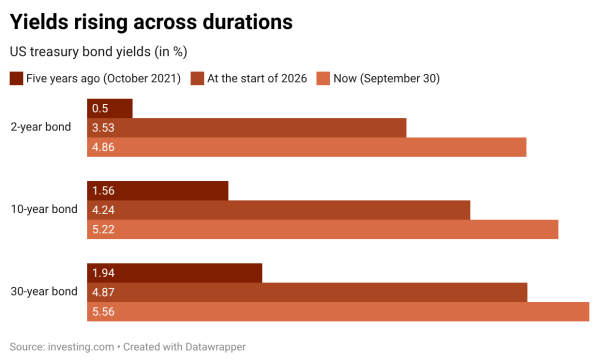 Bond yields are rising across durations.
Imagine the US government floating a one-year bond of $100 with a coupon of $10. In other words, the lender will get $110 at the end of the year. The rate of return is 10%. But suppose that soon after launching the bond, the US starts a war that spikes inflation — as it has done this year. Inflation basically means your money is worth less and less with the passage of time. As inflation starts to go up, it threatens to eat away or reduce the real value of that $10 the lender was supposed to get at the end of the year.
In such a case, the lender will try to sell the bond in the secondary market before inflation completely ruins the returns, and use their money to invest in other places which pay a better return.
But given the rising inflation, other participants in the bond market may not be willing to pay $100 for the same bond anymore. Instead, they may offer a lower price. That’s because at a lower price of the bond that same $10 “yields” a higher rate of return at the end of the year.
Story continues below this ad
As the price of the bond falls, based on what market participants demand as an acceptable rate of return, the yield rises. While this is not an exact example, it shows what has been happening lately. Investors are demanding better rates of return in nominal terms because inflation is threatening to eat into real returns (the returns after taking away the effect of inflation). Apart from inflation concerns, just the sheer increase in the demand for loans (by governments and businesses around the world) is also pushing up what lenders want as returns.
What happens when bond yields rise?
Rising yields on US bonds have two broad implications.
One, it signals higher borrowing costs for the US government. In other words, if yields on existing bonds are rising, the US government will have to match them when it goes to the market to borrow again. Like any other government, the US government, too, routinely goes to the market to borrow money — either to meet some new expenditure or to pay back old debt that is maturing.
Either way, higher borrowing costs typically imply that a larger portion of the US budget would have to be spent towards paying interest. That, in turn, leaves less money available for other priorities — say providing social security for US citizens.
Story continues below this ad
A recent explainer (linked just below) gives more details of how higher bond yields have impacted the US budget and interest payments.
Thanks to the US government’s increased borrowing each year (called the annual budget deficit) pushing the pile of existing debt to over $40 trillion as well as driving up bond yields, the total annual outgo towards interest payments from the annual budget has ballooned from around $600 billion before the Covid-19 pandemic to $1.2 trillion as of 2025 (see chart below).
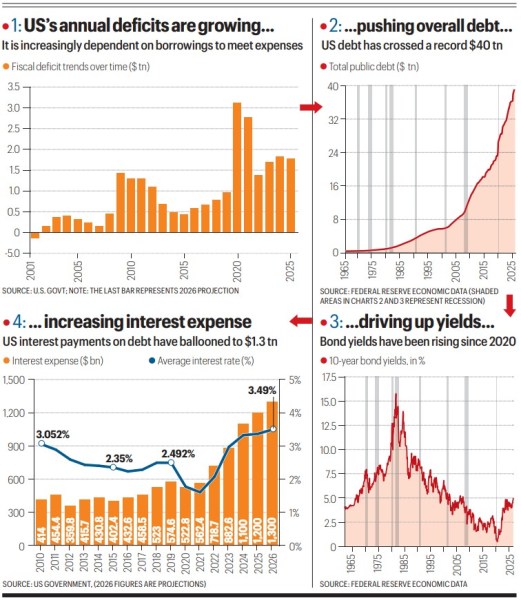 The cycle in the US.
Two, higher yields for the US government also signal higher borrowing costs for every other government and business, including higher interest rates on home loans.
Since lending money to the US government is the safest lending one can do — because everyone believes the US government will always pay back and never default on its debt — if the yield on US government bonds rises, it typically means all other kinds of loans also become costlier. In other words, lenders demand even higher returns for giving loans to other governments and businesses since they are all riskier than lending money to the US government.
Story continues below this ad
It doesn’t help matters that this is not a US-only problem at the moment: Governments of most of the big economies have high levels of debt and even companies, especially in the artificial intelligence domain, are set to borrow heavily to fuel the next stage of their growth.
Higher borrowing costs across the board threaten to drag down economic activity, and that is why rising bond yields are bad news in the current context.
KioskNews shows a cleaned-up reading view extracted from the publisher’s page — the original always lives on their site, not ours.