Move over, Schumer, a new crop of Democrats are arriving in the US Senate
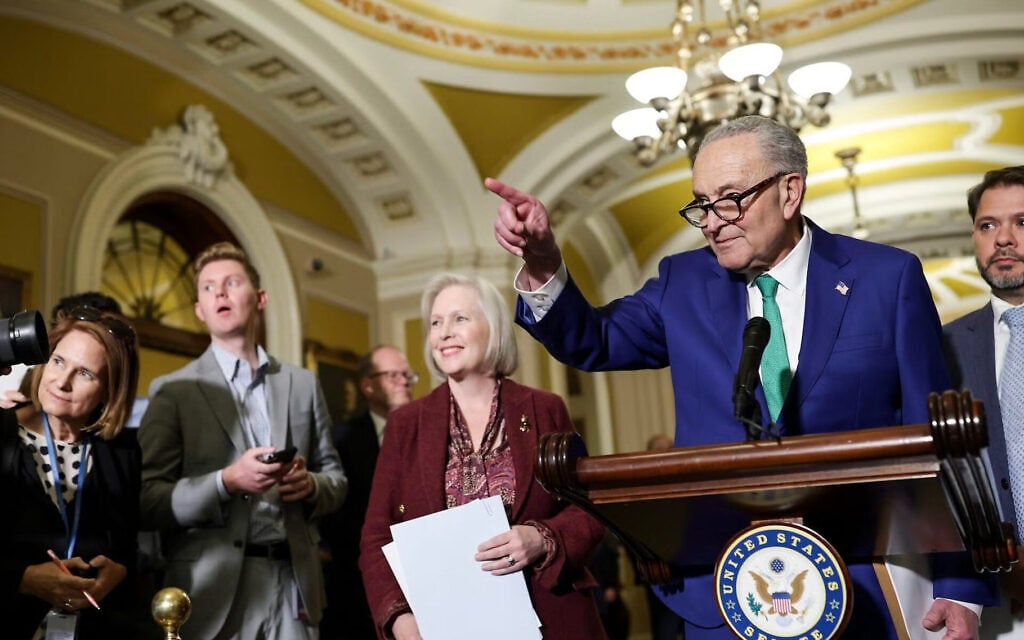
JTA — The clock may be running on Chuck Schumer, the most senior Jewish elected official in US history, as Democrats flipped at least seven Senate seats in midterm elections last week. The Democratic takeover of the Senate has led to some carping that he is too old, moderate or not aggressive enough against US President Donald Trump to continue as leader.
Schumer has led the Senate’s Democratic caucus since 2017, including as majority leader from 2021 until 2025. A pro-Israel stalwart who prides himself as a Shomer Yisrael (“guardian of Israel”), Schumer has found himself increasingly out of step on Israel-related matters with the party’s caucus and its voters. Progressives are also pushing for a bolder agenda that includes policies such as Medicare for All, which Schumer has not taken up.
No senator has launched an official opposition bid ahead of December’s leadership election, but one name has generated buzz: Maryland Senator Chris Van Hollen, an outspoken critic of Israel who has led efforts to investigate the country’s human rights practices and pressure its right-wing government. He has drawn blowback from some Jewish leaders in recent years over his criticism of Israel and of AIPAC, the pro-Israel lobbying group.
0:00 / 0:00
“Promoted: Theatron Hotel and Residences – Luxury Jerusalem Residences with Five-Star Hotel Amenities.

Van Hollen told reporters on Monday that he is in “listening mode” and “hasn’t shut the door” on a potential leadership bid, after previously saying he was too busy kicking the tires on a 2028 presidential run.
Vermont Senator Bernie Sanders, an independent who caucuses with the Democrats, and Michigan Senator-elect Abdul El-Sayed have both said they would back Van Hollen if he runs. Fifty-nine percent of Democratic voters said they want “someone else” to lead Senate Democrats versus 22% who prefer Schumer, according to a poll commissioned last month by a progressive PAC.
Get The Times of Israel's Daily Edition by email and never miss our top stories
By signing up, you agree to the terms
Political strategist Hank Sheinkopf told JTA that a Van Hollen leadership would “move the Senate more to the left, unquestionably,” and cautioned that Van Hollen would “permit” discussions that would jeopardize defensive military assistance to Israel.

But he noted that it was difficult to imagine Van Hollen winning the leadership position for a number of reasons, not least of which is that the Democrats just retook control of the Senate on Schumer’s watch.
“Unless the entire [class of] new Senate members are completely disloyal, it’s hard to imagine them saying no to Chuck Schumer and yes to Van Hollen,” he said. “Schumer just raised an extraordinary amount of money, has probably extracted pledges from them for committee positioning. You know, this is straight-ahead politics, not about ideology and not about Israel.”
Schumer, long an ally of Israel, broke with Prime Minister Benjamin Netanyahu in March 2024 when he said on the Senate floor that Netanyahu had “lost his way” and called for the country to hold new elections. Schumer also called for a two-state solution to the Israeli-Palestinian conflict and said the US should use its leverage to push for its goals in the region if Netanyahu remains in power.
But Schumer’s leadership since then has not quieted critics who say that he should have done more to exert pressure on the Israeli government during its military campaign in Gaza and West Bank settlement expansion. He is among the small minority of Senate Democrats who have continued to vote against Bernie Sanders-led resolutions blocking weapons sales to Israel; all but seven out of 47 voted with Sanders earlier this year.
Van Hollen, meanwhile, has consistently voted to block those transfers and has said he would oppose selling offensive weapons to Israel “so long as Israel is violating international law and American law.” Van Hollen also said this year that there is “an important distinction” between selling offensive and defensive weaponry, and that he supports selling components for the Iron Dome missile system given that Israel is in “a tough neighborhood.”
Hadar Susskind, president and CEO of progressive Zionist group New Jewish Narrative, told JTA that Van Hollen would “meet the moment” and “prioritize and steer toward real, meaningful things that can leverage US influence” as majority leader.

“I think he has always been and remains a proponent of a strong US-Israel relationship — but one that is different than what we’ve seen between Trump and Netanyahu,” Susskind said.
“There are people who perhaps would stand up there and simply say, ‘OK, the Israeli government’s been doing bad and we don’t support it.’ Van Hollen is much more thoughtful than that,” Susskind said.
Van Hollen was long seen as a pro-Israel politician in his time as a Maryland congressman, though pro-Israel groups criticized him after he called for a ceasefire to end the 2006 Lebanon war.
In 2019, he opposed anti-BDS legislation, clarifying on the Senate floor that he disagrees with boycotting Israel but asserting that people should not be punished by the government for doing so. Schumer supported that legislation, which facilitated states’ ability to pass laws banning business with supporters of the boycott, divestment and sanctions movement against Israel.
Van Hollen has taken a more vocally critical stance on Israel and the pro-Israel lobby since the Israel-Hamas war started in 2023. Ron Halber, CEO of the Jewish Community Relations Council of Greater Washington, took aim at Van Hollen’s outspoken criticism of the Israeli government during a JCRC event last year, which prompted a Van Hollen spokesperson to call Halber an “apologist for the Netanyahu government” who is out of step with his constituents. Halber called the comment “laughable,” and other Jewish leaders responded with outrage, while Susskind rushed to Van Hollen’s defense, saying he had “always been there for his Jewish constituents and in support of the people of Israel.”
Speaking at this year’s J Street national convention, held in Washington by the liberal Jewish Middle East advocacy group, Van Hollen panned AIPAC and said that it is neither pro-Israel nor pro-American, drawing pushback from some Jewish leaders.
Neither AIPAC nor J Street returned a request for comment on the possible battle for leadership in the Senate.

J Street’s president Jeremy Ben-Ami has written positively about Van Hollen, calling him “a true friend of Israel” in a 2024 opinion piece for the Washington Jewish Week. The piece came in response to an editorial claiming that Van Hollen is “not our friend” because of his “self-righteous spewing of anti-Israel accusations and positions,” and Ben-Ami countered by pointing to Van Hollen’s record of voting to send “tens of billions of dollars” in aid to Israel.
Van Hollen voted yes on a $14 billion security assistance package to Israel in February 2024, even as he accused the country of committing “war crimes.” Van Hollen has since accused Israel of “ethnic cleansing” and said he agrees with organizations and scholars who say that Israel’s actions in Gaza meet the legal standard for genocide.
Israel has vehemently denied allegations of genocide, saying that its military operation was aimed at destroying the Hamas terror group and freeing hostages kidnapped during the October 7, 2023, massacre that sparked the war.
This week, Van Hollen led a letter signed by a dozen Senate Democrats, addressed to House and Senate leadership, about the 2027 National Defense Authorization Act, urging them to remove provisions on US-Israel military and intelligence cooperation.
Senate Democrats will pick their next majority leader in a December vote. A number of them have said they want new leadership and a fresh voice to steer the caucus and direct its legislative agenda.
Still, Schumer says he is “confident” that he will win the leadership election. Jim Kessler, vice president of the Democratic think tank Third Way and a former Schumer aide, agrees with him.

Kessler told JTA in an email that it’s “hard to imagine anyone mounting a serious challenge to Schumer after he led the most successful midterm for Democrats in 50 years.”
“He can say, well look at me, I was the leader when we had this big win,” said Democratic strategist Steve Jarding, in a JTA interview.
Schumer played an active role in recruiting candidates who won Senate seats in red and purple states, such as Sherrod Brown of Ohio, Roy Cooper of North Carolina, Josh Turek in Iowa and Scott Colom in Mississippi.
“It’s hard to imagine them saying no to Schumer and yes to Van Hollen,” said Sheinkopf, who pointed out that a number of the new Senate Democrats are moderates.
Progressive critics have said Schumer’s choices were too old and too moderate, and pointed out that his top choices in Michigan (Representative Haley Stevens) and Maine (Gov. Janet Mills) were unsuccessful. Van Hollen said during an event on Tuesday that Schumer and the Democratic Senatorial Campaign Committee “sided with the crypto industry and AIPAC against” a pair of progressives who were elected, including presumably El-Sayed. (The Schumer-aligned Senate Majority PAC spent $30 million boosting El-Sayed in that election after he won the primary.)
Jarding, a past executive director of the South Dakota Democratic Party, opined that it would be “good for the party” for another senator to “emerge and at least test Schumer.” Should that happen, Jarding said, the leadership race could be “much closer than people think.”
“There’s a lot of people in that caucus that want a change. They may not say it publicly, but I know people in that caucus that want a change,” Jarding said.

Michigan Senator Elissa Slotkin, who is Jewish, has said she would “certainly not vote for” Schumer without seeing a satisfactory 100-day plan from him, according to Politico.
Minnesota Senator-elect Peggy Flanagan said one day after her election that “it’s time for new leadership.” She has not said who she would support instead of Schumer, but told Politico that she has been “very impressed by Senator Van Hollen’s leadership.”
Incoming freshmen Troy Jackson of Maine and Juliana Stratton of Illinois have explicitly said that they would not support Schumer, while Annie Andrews of South Carolina says it is “time for a generational change on both sides of the aisle.” New Hampshire Senator-elect Chris Pappas has been noncommittal, saying that “this is a moment to see a passing of the torch.”
Kansas Senator-elect Adam Hamilton, meanwhile, has said that he won’t support Schumer because he is too far to the left, in the eyes of his constituents. Hamilton did not have a specific successor in mind, but said that there are senators who could “lead more from the center.”
Connecticut Senator Richard Blumenthal, who is Jewish, told reporters on Monday that he would not endorse Schumer and that Democrats “need a conversation about leadership going forward because we need new energy and ideas.” But he changed his tune later that day, saying he would, in fact, support Schumer.
Pennsylvania Senator John Fetterman, Arizona Senator Ruben Gallego, Rhode Island Senator Sheldon Whitehouse and Ohio Senator-elect Sherrod Brown have said they will support Schumer, while most senators have not publicly committed either way.
KioskNews shows a cleaned-up reading view extracted from the publisher’s page — the original always lives on their site, not ours.