This lava planet shouldn’t have an atmosphere—but it does
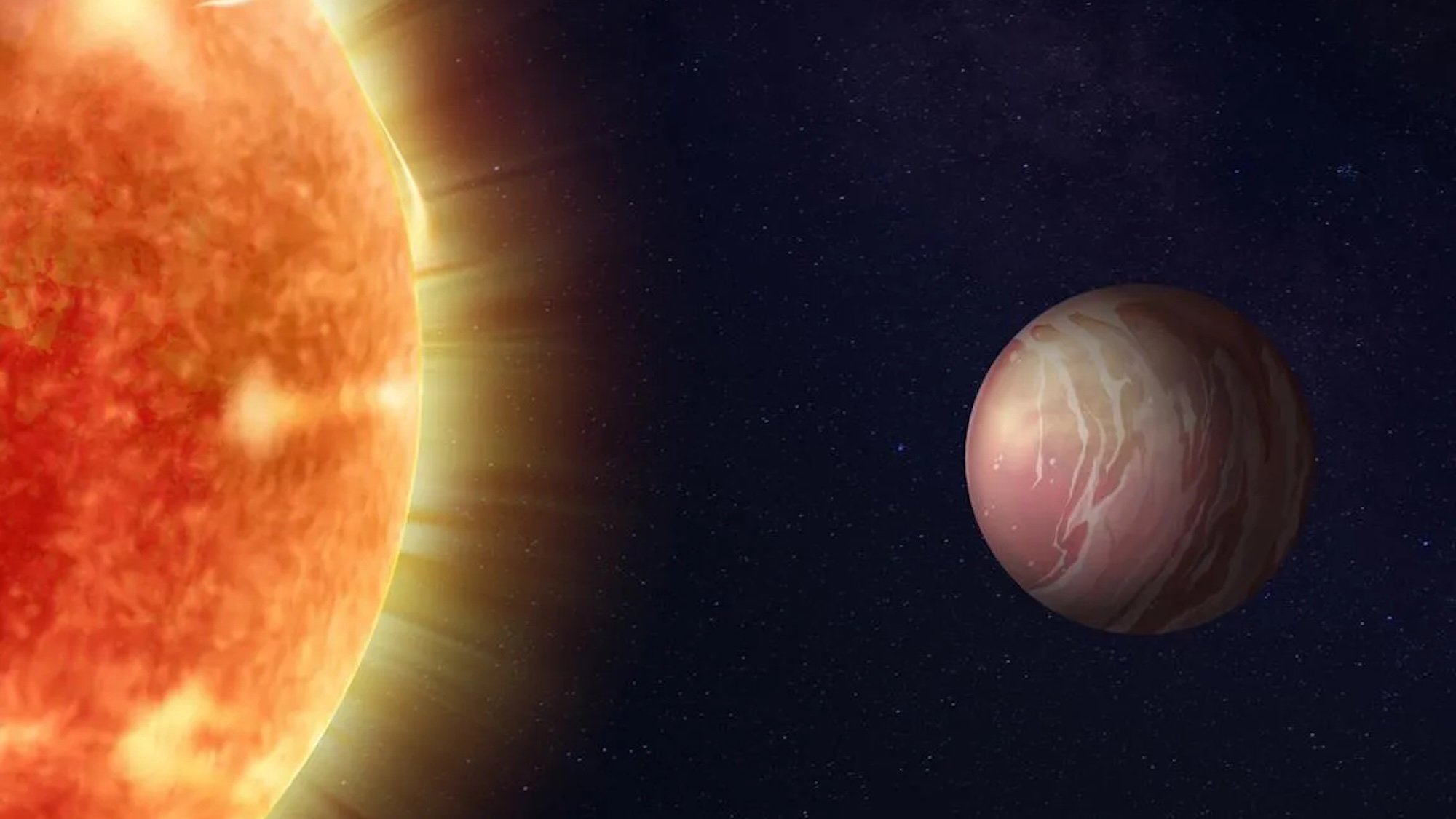
The exoplanet TOI-561 b is fascinating to observe from 280 light-years away—but it’s not a place anyone would want to visit. Not only is it blanketed by an ocean of molten lava, but TOI-561 b is constantly bombarded by destructive radiation from its host star. The planet endures so much stellar energy that astronomers have long assumed its atmosphere evaporated eons ago.
However, new observations from the James Webb Space Telescope (JWST) contradict those initial conceptions. After examining TOI-561 b for 37 hours—almost four complete orbits—researchers now believe the planetary lava lamp actually features a thick atmospheric shell. The surprising evidence recently detailed in The Astronomical Journal isn’t what scientists assumed from a planet under such stellar duress.
“Our discovery challenges current theories,” said study co-author and University of Birmingham astronomer Anjali Piette. “We would expect a heavily irradiated rocky planet like TOI-561 b to have lost its atmosphere billions of years ago.”
Like Earth’s moon, TOI-561 b is tidally locked, which means its rotation coincides almost exactly with the time it takes to orbit its star. This ensures one side of the planet constantly experiences daylight, while its other half is always enveloped in darkness. JWST’s extensive observation window allowed Piette and her colleagues to study TOI-561 b’s phase curve—how its brightness and heat shift during its orbit. However, the results didn’t make sense. The planet’s dayside was cooler than it should be, while the nightside didn’t account for the temperature difference.
“[We] revealed that the planet reflects a significant amount of light from its star, and that heat is being redistributed around the planet instead of only on the sunlit side,” explained University of Waterloo astrophysicist and study co-author Lisa Dang. “Together, these point to the presence of an atmosphere.”
It’s likely not a thin layer of clouds, either.
“The evidence suggests it still has a significant atmosphere today,” added Piette.
Computer simulations of TOI-561 b’s climate indicate that its atmosphere is possibly composed of silicate minerals like silicon dioxide and magnesium silicate. If true, these would hypothetically reflect much of the harmful stellar radiation away from the planet’s surface. Regardless, the discovery creates more questions than it answers. It could be that TOI-561 b simply began with a huge quantity of gas. Another theory contends that the planet-wide molten ocean functions like a single, gigantic volcano that continually supplies gas into its atmosphere.
Armed with the new data, astronomers next hope to determine whether TOI-561 b resembles a hotter version of Venus that reflects about three-quarters of starlight, or if it operates like a superpowered iteration of Jupiter’s volcanic moon, Io. Either way, JWST will be called into service once again.
“Observing the planet at longer wavelengths with JWST could give us insights and help explain how a planet this hot has held on to an atmosphere for billions of years,” said Dang.
KioskNews shows a cleaned-up reading view extracted from the publisher’s page — the original always lives on their site, not ours.