Chinese ships suspected of spying
SUSPICIOUS BEHAVIOR: The four ships identified had been repeatedly spotted in waters close to routes where international cables connect to Taiwan, a report said
By Fion Khan / Staff writer


Four Chinese survey ships spotted near Taiwan since May are suspected of gathering intelligence on undersea cables, Japanese newspaper the Yomiuri Shimbun reported yesterday, citing data from an intelligence company and Taiwanese authorities.
The four ships have been spotted repeatedly making irregular moves in specific waters around Taiwan close to routes where international undersea cables connecting Taiwan and other areas have been laid, the report said.
The four ships are the Xiangyang Hong 22 (向陽紅22), which belongs to the Chinese Ministry of Natural Resources; the Tongji (同濟號) and Jia Geng (嘉庚號), operated by universities in Shanghai and China’s Fujian Province, respectively; and a vessel whose Automatic Identification System (AIS) identified it as Mushanzi (暮山紫), it said.
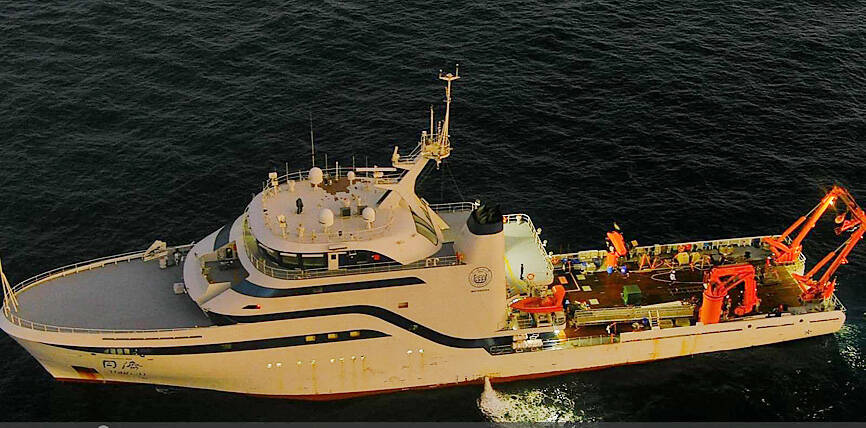
The Chinese research vessel Tongji is pictured near Taiwan on May 22.
Photo courtesy of the Coast Guard Administration via CNA
The newspaper cited analysis conducted by ingeniSPACE, a geospatial intelligence analytics firm based in the US and Taiwan, using data from AIS and other sources, as well as through information obtained by the newspaper from Taiwanese authorities, it said.
The Xiangyang Hong 22 has repeatedly sailed back and forth in specific waters off northern Taiwan since May, frequently slowing down, stopping and making irregular course changes, the report said, citing data provided by the company.
The Jia Geng engaged in similar behavior in eastern waters, and the Mushanzi made similar moves in the Bashi Channel in the south, while the Tongji was spotted repeatedly circling Taiwan proper, and stopping and slowing down at specific locations, it said.
The intelligence firm assessed that the Chinese ships have surveyed undersea cables in a wide area, identifying the routes where major undersea cables have been laid using its own method, the report said.
Based on AIS data, the company concluded that the waters where the four ships slowed down or stopped all coincided with locations where undersea cables connecting Taiwan and other countries have been laid, the newspaper said.
A Taiwanese official told the newspaper that the data and analysis presented by the company was deemed reliable, as they are consistent with the authorities’ understanding of the situation.
Another official was quoted as saying that the possibility of Chinese survey ships collecting information on undersea cables cannot be ruled out.
From 2021 through last year, Taiwan experienced a series of incidents in which undersea cables are believed to have been cut or damaged intentionally by cargo ships and other vessels, the report said.
Taiwanese authorities have pointed to China’s involvement in these cases, it added.
The activities of such Chinese ships could be preparation for sabotaging undersea cables, Keio University professor Motohiro Tsuchiya, an expert on issues related to undersea cables, told the newspaper, citing China’s past moves.
China “may have been surveying not only the location of the cables, but also the seabed topography, water depth and ocean currents where the cables have been laid,” he was quoted as saying.
Activities by Chinese vessels similar to those around Taiwan also have been observed in waters near Japan and the Philippines, ingeniSPACE’s chief operating officer Jason Wang (王柏仁) told the newspaper.
In May, Japan and the Philippines agreed to start negotiations toward the delimitation of boundaries of their exclusive economic zones and continental shelves, the report said.
Objecting to this move, China has repeatedly deployed patrol vessels and survey ships to waters near Taiwan, asserting what it calls “jurisdiction,” it said.
China is using “gray zone” tactics in a wide area along the First Island Chain, which stretches from south of Kyushu to Taiwan and the Philippines, in anticipation of a contingency, Wang was quoted as saying.
Taiwan has been cautious about the “gray zone” tactics by China, which are aimed at causing social disruption through communication outages, such as disguising cable cuts as accidents, the report said.
There has also been a spate of cases in which undersea cables were cut or damaged in the Baltic Sea since 2024, with the involvement of China and Russia suspected, the report said.
Undersea cables, which are used for high-capacity communications, are said to take more than a week to repair if cut in deep-sea areas, it said.
KioskNews shows a cleaned-up reading view extracted from the publisher’s page — the original always lives on their site, not ours.